Wednesday, June 11, 2014

Forest Park- St.Louis, Missouri

Pictured above is the World's Fair Pavilion at Forest Park, one of the older buildings of the park.  Hard to believe that it is a 137-year old park.  When I first visited it, about 40 years ago, it was pretty much run down.  Weeds filled the grassy picnic areas, bridges and roads were crumbling.  Heavy use of the park over the years and deferred maintenance took its toll and by the 1980s this city park was declining rapidly.  Forest Park Forever was created in 1986 to work in partnership with the city to make the urban park the beautiful place it is today.  Public and private funds were raised and $100 million dollars was used to restore the park.  It is one of the largest city parks in the United States, surpassing Central Park by 500 acres.
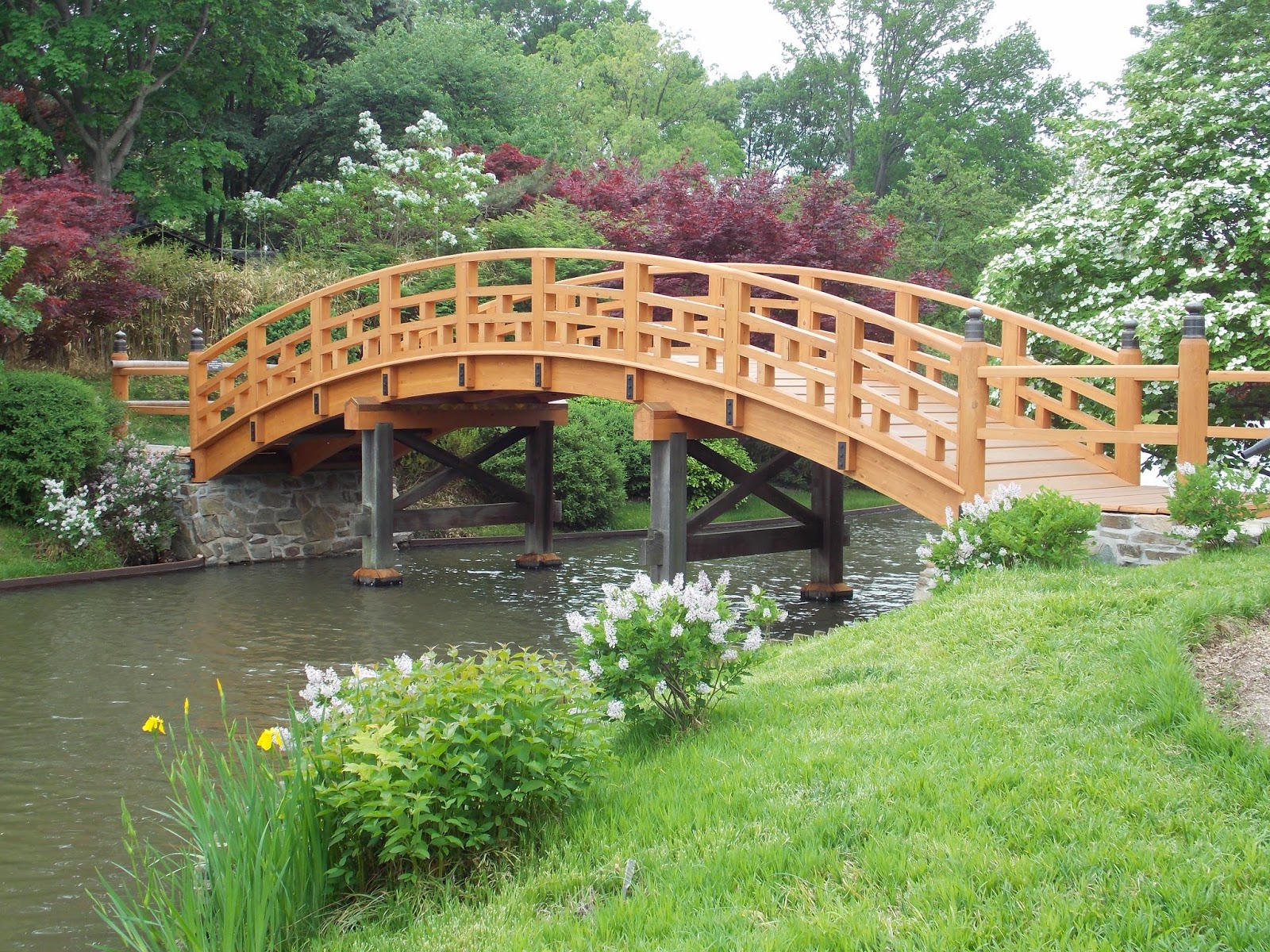
Last week John and I drove around the park before visiting the History Museum.  We first stopped at Art Hill where the St.Louis Art Museum is located.  From atop of that hill we could look down at the Emerson Grand Basin, which is quite picturesque with it numerous fountains.  Our next stop was at the Muny, where we have attended live theater many times over the years.  Pictured above is Pagoda Circle,  located in a small pond outside of the theater building.  Speaking of live theater, I noticed on the map of the park that there is an area designated Shakespeare Glen.  Every year, early in June, a different production of one of Shakespeare's plays is performed.  We have also attended some of those plays over the years.
The pond outside of the Jewel Box is quite beautiful at this time of the year because of the many colorful lilies blooming on the pond.
 
The Jewel Box building has been the setting for many marriages over the years.  At Christmas it is decorated with many poinsettias and at during the spring season with numerous Easter lilies.
For tourists visiting St.Louis I would also like to mention other features of the park, as a skating rink and golf course.  It also has a world class zoo, and planetarium, which is part of the Saint Louis Science Center,  located across Highway 40.

Tuesday, June 10, 2014

Bellefontaine Cemetery- Part Two

In my last posting I mentioned the Lemp family mausoleum.  That is located in a section of the park where many of the wealthier individuals of St.Louis are buried.  Many of the graves there have lots of land surrounding their family plots or mausoleum, so it was not possible to get a picture of a whole row of them.  The Anheuser mausoleum looks very stately with four classic Roman columns.  And then there is the most unusual Egyptian- styled mausoleum belonging to the Tate family.
Strolling around this area of the cemetery I saw some very  familiar St.Louis names as George Warren Brown (shoe manufacture and the school of Social Work at Washington University is named after him), Edward Mallinckrodt (founder of a chemical company), and Robert Barnes, founder of Barnes Hospital.  And I noticed that David Francis ( President of the 1904 World Fair) has a most different grave stone.
Herman C.G Luyties, Jr. has maked his grave with the statue of a girl in a box. 
Maud Judge has a statue of a beautiful woman on her grave, that lady is not in a box, fortunately.  And then there is Catherine Brewington Bennett, who according to the park brochure,  "died for beauty".  She has a most unusual gravestone.  Another interesting memorial is a three-sided obelisk with portraits on it.  I hope by now I have stirred up a desire within my readers to check out this cemetery!  And if you get tired of looking at grave, monuments, and mausoleums, just take in the natural grandeur of the park.  It is an arboretum with over 5,000 trees, and woody shrubs.


Saturday, June 7, 2014

Bellefontaine Cemetery

We learned at the St.Louis History Museum that some of the people who made their mark on the city's past are buried at Bellefontaine Cemetery.   We may have visited the place at least once in the past, but now with St.Louis history so new in our minds it seemed to make sense to revisit the place.  The cemetery began in 1849 and continues to evolve as an active, non profit cemetery.  After proceeding through the main gate we stopped at the park's main office to get a map of the cemetery.  The map showed us the burial location of 58 notables,  "just a few of the famous and fascinating people who lie at peace within our grounds".
Pictured above is the grave of William Clark, his expedition in 1804-06 with Meriwether Lewis "marked the progress of exploration and colonization which thrust our national boundaries to the Pacific".  Quotation was taken from the gravestone- which also noted that he was commissioned as Governor of Missouri Territory in 1813, and two more times after that.  Also carved on his memorial is a quotation from a letter Clark wrote to his old friend Thomas Jefferson in 1825: " it is lamentable that the deplorable situation of the Indians do not receive more of human feelings of the nation".
The grave of Sara Teasdale (first Pulitzer Prize-winning poet) was a bit more difficult to find as it is quite a bit smaller.  Many of the graves certainly are not as simple or plain.  We were quite fascinated with the architecture of mausoleums and larger monuments which display influences from Classical, Romanesque, Gothic, Egyptian and modern architecture.

Pictured above is the Wainwright Tomb, a National Historic Landmark mausoleum.  Speaking of the latter, we peered into the Lemp Family mausoleum and saw the beautiful stained glass window pictured below.  They were a brewer family with a tortured and mysterious family history.  It is possible to visit the Lemp House here in St.Louis and learn more about their story.  I can not begin to do the cemetery justice in one sitting, so I will write more on it in my next posting.


Friday, June 6, 2014

History Museum of St.Louis

We have seen quite a few of the cakes, as the one pictured above, located around St.Louis ever since we have arrived here about a month ago.   We came upon this one in front of the Art Museum, in the background is Art Hill.   We saw others in front of the Jewel Box, as well as in the Cherokee Neighborhood of  South St.Louis, which we visited last week.  What a wonderful way to acknowledge the 250th birthday of St.Louis!  And I am proud to say that it has been my home for 40 of those years.  Seeing those decorated cakes sparked an interest in me to learn more about the city's history, so John and I spent an afternoon at the St.Louis History Museum.  Before entering the museum we noticed an outline of the Louisiana Purchase.
An important event in St.Louis history is the St.Louis 1904 World's Fair, which came about to commemorate the 100th anniversary of the Louisiana Purchase.  I must admit that I never had a good concept of the size of the land involved with this treaty, and so this sidewalk drawing of it helped.  The United States bought the land from France in 1803 for $15 million dollars.  It included land from as far east as Alabama and westward into what is Montana.  Owning that land made it possible for our country to pursue westward expansion to the Pacific Ocean.  This would be a good segue into a discussion of the Lewis and Clark Expedition, which started near St.Louis in 1804- but I will leave that for my next posting.
In the entry hall of the museum is a statue of Thomas Jefferson, who was president at the time of the Louisiana Purchase.  The museum known, as the Jefferson Memorial Building, was built in 1914 with funds from the St.Louis World Fair.
Currently the museum has a wonderful exhibit featuring St.Louis history.  It has accomplished that by focusing on fifty people, fifty places in St.Louis, 50 moments in its history, as well as fifty objects (artifacts) which belong to the city's history.  I spent a good deal of my time reading about the fifty different people who have  impacted the city in their own unique ways- from a founding father, to a clown and a Cardinal, baseball player and aviator, to a writer, social activist and an environmentalist.  That was just to name a few of the fifty people which the museum chose as being important to St.Louis over the years.
The fifty objects relating to St.Louis were also fascinating to me.  The museum displayed the uniform of  a Brown baseball player, as well as the dress of a Ted Drewes worker some fifty years ago.  Pictured above is the flag of St.Louis.  The black lines demonstrate the confluence of its two major rivers, the medallion represents the fleur-de-lis of the French heritage, and the colors are of the various countries associated with the city- which are Spain, France and the United States.   I have written in this posting about only a small fraction of what I learned about St.Louis at the History Museum,  it was certainly an afternoon well spent!


Thursday, May 29, 2014

Visiting our Favorites in St. Louis

It has been awhile since our last posting.  As you may have guessed, we are still in St.Louis.  It has been hot and muggy here- we keep wondering why we are still here and have not headed north to cooler temperatures.  That will happen eventually, for right now we still have doctor visits and friends to see in the St.Louis area.  Our little grandson has also proven to a big reason for sticking around the area.
Nathan is pictured above with his mother Melissa.  At 3 months of age he does a lot of laughing, cooing and is absolutely charmed by ceiling fans, they do not even have to be moving!  We saw him and his parents Sunday in Farmington at a graduation party.
 A favorite park of our is Castlewood State Park in Ballwin Missouri.  We hiked the Lone Wolf Trail along the Meramec River, a trail we have taken many times which goes up over river bluffs and then down along the river.  The trail has steep slopes composed of loose rock, and we found it wise not to get too close to the edge of the bluffs, some of which may suddenly plunge dramatically downward.  Despite it being early afternoon and rather humid there were quite a few other hikers also on the trail.
We just were not ready to head home after our hike and listen to the air conditioning roar in our metal box.  We chose instead to head downtown to take in a game.  It was our first visit to Ballpark Village.  The largest venue in the Village is Cardinal Nation, a two story restaurant and bar which also houses the Cardinals Hall of Fame Museum and Cardinals retail store.  On its roof top deck is seating which offers a view of the ballpark.   The Ballpark Village seems to add another interesting dimension to the whole experience of watching a Cardinal game.  Many fans wearing red were hanging out here and ready to party two hours before the game.  Our home team played the Yankees last night, it was a game which had a lot of action, but unfortunately the Cardinals lost.
Today, Thursday, we biked around Creve Coeur Lake, another favorite St.Louis spot of ours.  The bike path takes us close to the waterfalls pictured above.  According to legend, the lake is named for a tragedy which happened at this site, called  Dripping Springs.  Here a lovelorn Indian maiden died, and it was her broken heart which gave the lake its sad name of "Creve Coeur".

Thursday, May 22, 2014

Hannibal to Omaha

The above picture gives you a good perspective of the countryside in northern Missouri along the Mississippi River.  Before arriving at Hannibal we drove through the Missouri river towns of  Elsberry, Clarksville, and Louisiana along Highway 79.  I will grant you that traveling on two lane highways is a slow way to go, but John and I are discovering that the interstates have very little to offer in the way of scenery.  On highway 75 we drove through rolling hills of pastureland and woods.  Along some sections of the highway there are also high river bluffs.  The tiny town of Clarksville is dotted with historic Victorian style homes.  Clarksville is where eagles come to feed along the river during the winter months, we have visited the town during its festival of Eagle Days.
In my last posting I wrote about Hannibal, however there is more to do there other than touring the Mark Twain museums.  After our tour of  them we did took some time to step into a few of the antique shops which are located in the historic area.   We found Mrs.Clemmons Antique Store to be especially interesting with its life-size mannequins.  Who would not like to have Elvis Presley or Harry Potter in their home?
We were in Omaha primarily to attend our nephew's graduation.  However, before the ceremony we walked around in the downtown area and had our lunch at the Table Grace Cafe.
We had a delicious lunch of soup, salad, pizza and cinnamon rolls.  Estimated cost for the lunch was $3.98, but one can pay what they want, or nothing at all.  A restaurant like that is certainly needed in many communities of our country, the cafe certainly had many customers when we visited there.  I promised the manager, pictured in the foreground of the picture above, that I would get the word out about Table Grace.

Tuesday, May 20, 2014

Hannibal, Missouri

We are still located in St.Peters,Missouri.  Last week we made a trip to Omaha to attend the college graduation of our nephew Michael from Creighton University.  It had been at least twenty years or so since we spent any time in Hannibal, so we decided to take an extra day to see the town again. 
Mark Twain (aka Samuel Clemens), America's best-loved author spent thirteen years of his childhood in this town.  He was born in 1935 and once made the comment that at that time "Missouri was an unknown new state and needed attractions".  He certainly has been an attraction for Hannibal for many years!  Pictured above is Cardiff Hill, the setting for many of his stories, including Tom Sawyer and The Adventures of Huckleberry Finn.  Sam Clemens returned to this town at least seven times after he left it, the last time was in 1902.   On those visits he usually visited Laura Hawkins, the girl known as Becky Thatcher in Mark Twain's books.  Laura Hawkins moved back to the town in 1875.  Her childhood home is pictured below.
That home is currently being restored so we could not tour it.  We were able to visit the homes of Sam Clemens, as well as that of his friend Tom Blankenship (aka Huckleberry Finn, a character in Mark Twain's book).  We could also step into the law office of John Clemens, the father of Samuel.
Growing up in Hannibal certainly provided Mark Twain with plenty to write about in his book.  In the above building he spent a night hiding out when he had played hookey from school.  It so happened that a corpse was lying on the floor of his Dad's office that same night.  A man had recently been stabbed and the town officials were temporarily holding him for the night in that building.  As a child Sam also saw a slave murdered by his white overseer, and another time a shooting took place right outside of his home. 
In Hannibal is located a Museum Interpretive Center where we learned many more interesting facts regarding Clemen's life as a boy in the town, as well as his life as a steamboat pilot, gold miner, and newspaper writer.
In the Mark Twain Museum Gallery are many wonderful displays pertaining to the books Twain wrote, as well as 15 original Norman Rockwell paintings of Tom and Huck.  After touring that museum I wandered to a back room where a man (Jim Waddell),  impersonating Mark Twain, was doing a monologue on Twain's recollections on his brief stint as a soldier during the Civil War.  We spent way more time than we had planned to in Hannibal, but it was certainly time well spent!

Tuesday, May 13, 2014

Missouri Botanical Garden-Part 2

As I had mentioned in my last posting, there are many different plants, shrubs and trees blooming presently in the garden, one of which is the fringe tree, a native of eastern United States. 
The park does have an azalea-rhododendron garden but we saw blooming azaleas in other sections of the garden, one of which is the Japanese Garden.  In the above picture is an azalea bush along with a couple of Japanese maple trees.   This part of the garden was dedicated in 1977.  It has waterfalls, beaches and plantings designed with a theme of "garden of pure clear harmony and peace".  Spring is certainly a wonderful time to walk through this area of the Missouri Botanical Garden.
Something to look for when visiting the garden is Dale Chilhuly Glass sculptures, as well as other artwork, which can be seen in all areas of the park.  They certainly add to the beauty of the various gardens within the park.  The sculpture "Sole Provider" (artist Joe Mutasa) is located in the azalea garden.  It was a gift from the artists of Zimbabwe and Chapunga Sculpture Park "in memory of those who perished on Sept. 11, 2001". 
 I hope that the pictures in this posting, and the previous one, proves to you our readers the truth of my comment that I made when I noted that this is the best time of the year to visit the Missouri Botanical Garden!   Its beauty is quite awesome and I am glad I had my camera with me.


Springtime at Missouri Botanical Garden

This garden has been the subject of at least a couple of other postings which I have written in the past several years.  We visited the garden again yesterday and I must say that this is the best time of the year to view the garden.  Many different wonderful flowers are presently blooming- some are at the end of that time and others just at their peak of beauty.  I was surprised to see that there are amaryllis still in bloom.
The Linnean House was our first stop, where I took the above picture.  The building was built in 1882 and is the oldest continuously operated public greenhouse west of the Mississippi.  The building was originally designed as an orangery to over winter citrus trees and other plant specimens.   As an aside here, and for those of you not familiar with the garden, it was built in 1859 by Henry Shaw a 19th century businessman who lived in St.Louis most of his life.  Not only is the garden's greenhouse  the oldest in the nation, but that can be said also for the Missouri Botanical Garden- that it is the oldest in continuous operation.
I think that the biggest attraction right now in the garden is the Iris patch.  An interpretive sign in the vicinity noted that the "Fleur-de-lis" is a term and symbol associated with a hybrid German iris.  According to legend the flower helped save the French army in the sixth century from a hostile army that had cornered them in a bend of the Rhine River.  The French king spotted a potential ford in the river by the presence of an iris in the water.  He deduced that it indicated a shallow area where it was possible for his army to cross and escape from the enemy.  The grateful king then choose the flower as a symbol for the royal family of France.
A wonderful floral smell was in the air as we approached the flowering bush pictured above.  I mistakenly identified it as a lilac bush.  It is instead a beauty bush from China, a member of the honeysuckle family.
Some of the charm of this garden can be found in its buildings which Henry Shaw constructed.  Pictured above is the neoclassic structure which is one of only five of  the original buildings left on the grounds.  It was constructed between 1859 and 1860.  The building serves as a natural history museum, a library, as well as a herbarium.  A sign in front of the building states that it (the building) "was a visible reminder to all visitors that this Garden is not just a pretty park, but also a scientific institution".
I just could not cover everything we saw in the Garden in one posting- so I will continue this later.


Friday, May 2, 2014

Burden Falls Wilderness

In our travels covering Southern Illinois I have often written of places we have seen within the Shawnee National Forest.  More than 280,000 acres of that forest lie in rough unglaciated areas of southern Illinois known as the Ozark and Shawnee hills.  John and I decided that there was still a lot of the Shawnee Forest we needed to see yet, which prompted us to take another road trip over the roads of southern Illinois yesterday.   And again we found the scenery quite spectacular with rolling hills, meadows and forests dotted with blooming dogwood and red bud trees.  Flowering azaleas, iris, and wisteria are also contributing now to the springtime beauty.  At Bell Smith Springs we saw a fairly large patch of wild flowers.
Shawnee National Forest has seven wilderness areas designated by Congress in 1990.  Yesterday we were in the Burden Falls Wilderness- Bell Smith Springs is located within that area.  We could not do any hiking whatsoever around the springs because of high water which even covered the foot paths.  At Burden Falls, however, we could do a some walking around the falls, but the paths were quite muddy.
Burden Falls is an impressive series of falls with a total drop of 100 feet.  Our last stop of the
day was at Millstone Bluff Trail.  John is pictured below standing in front of the bluff with his grandson Nathan.  The baby has been a good traveler this past week, as long as we keep the car moving!
The bluff use to be the site of an old quarry from which early settlers retrieved sandstone to make millstones.  However, the more important story at the top of the bluff is the presence of a settlement of prehistoric Native Americans 1,500 years ago.   Archeologists have found here what remains of a stone wall, community cemetery, rock carvings and village dwellings.  We hiked up the bluff to view those sites.  Pictured below are the rock formations on which we could barely discern the petroglyphs.  Wind and rain have eroded much of the carvings of the Mississippian people who once lived here.  Looters have removed many of their artifacts.


Thursday, May 1, 2014

Marion, Illinois

In my last posting I stated that I would not write anymore on Southern Illinois.  However, we have done more touring of the area in the past couple of days, so I have found additional items which I want to pass on to you our readers.  Marion is the town where our rig is parked .  Our first trip into Marion brought us to the town square, which is dominated by a clock tower.
Williamson County Courthouse once stood where the tower is located, and the square use to be called the Courthouse Square.  The courthouse went into disrepair and was demolished.  The tower was designed as  a memorial to the courthouse, and the square is now dubbed the the Tower Square Plaza.  As we walked around the square we noticed a statue of the current mayor, Robert Butler.  He has been in office since 1963 and is the longest serving mayor in Illinois.  The success of this small town can be seen in some of the newer buildings which surround the square, one of which is the Marion Cultural and Civic center.  It is a state-of-the art facility built in 2004. The charm of this town is in the fact that it also has preserved some of its older buildings, some of which we saw in a driving tour of the older section of town.
Yesterday we returned to downtown Marion where the Williamson County Historical Society Museum is located.  The large brick building in which the museum is housed was constructed in 1913.  It use to serve as the county jail until 1972.  The jail also served as the sheriff's residence, sixteen sheriffs and
their families lived here.  The front portion in which they lived was considered to be an elegant home of the late nineteenth century.  Pictured below is the living room which features a crimson loveseat circa 1850 and a red satin lamp in the "Gone With the Wind" style.
We had a tour guide for the house and jail.  He had a lot of interesting history to share with us regarding some of the jail's famous inmates.  They were:  members of the Charlie Birger gang, the Klu Klux Klan, and defendants awaiting trial for the Herrin Massacre.  The latter had to do with a coal miner's union dispute.
As you can see in the above picture, the museum has kept some of the original cell blocks.  The building is quite large and contains more than twenty rooms focusing on Southern Illinois history.
We returned home that evening to see a bird fly out from under the hood of our motor home.  Upon further inspection of our engine compartment we found the above nest with eggs in it.  Unfortunately we had to remove it, there is no way the eggs will hatch and the little ones leave the nest before we leave in several days!  That is a first for us.


Wednesday, April 30, 2014

Further tours of Southern Illinois

We have been quite fortunate that the strong storms of the pass few days have passed us by.  We have had heavy rains with creeks overflowing and some roads flooded.  That all is minor, however, compared to the devastated areas in Arkansas and Mississippi.  So, despite overcast skies and a cool breeze, we decided to do a road trip yesterday, with our daughter Melissa and son Nathan joining us.   Our first stop was Makanda, Illinois which is located near Giant City Park. 
The town is an artist's colony of sorts.  Pictured above is one of the buildings in a single strip mall.  We strolled along the boardwalk and entered some of the stores which offered for sale some of the work of local artists as well as New Age merchandise and antiques.  In the back of the mall we found the town's Secret Garden which features rainmaker art (copper sculptures) by Dave Dardis.
 
It is probably not a good time of the year to view the garden, it seemed to be a bit over-grown with many vines and bushes.  In its own way it is still a quaint and interesting garden with a creek running through it.  We drove from Makanda to Cobden looking for any restaurant where we could get lunch.  It is not tourist season yet for Cobden or any other small town in the region, so we had no luck on that score until Melissa remembered a winery she had visited last year.  We came to realize that we were on the Shawnee Hills Wine Trail, and at Von Jacob Vineyard/ Brewery we had some very good German sausage sandwiches.  After our lunch the sun came out and we felt that we might as well extend our touring further and check out the Pomona Natural Bridge in the Shawnee National Forest.  It is pictured below.
What a beautiful quiet place this is, tucked away amid a forest of pine trees.  We walked across the bridge and down into a canyon where we looked up at tall rocky bluffs.  On the ground a patch of may apples caught my eye and, checking under the leaves of the plant, I discovered that the plant is now in bloom.
I do not think we will do any more touring of Southern Illinois, as least for the present time.  There is certainly lots more to see and explore, but by the end of this week we should moving up to St. Louis.

Wednesday, April 23, 2014

Rim Rock National Recreational Trail

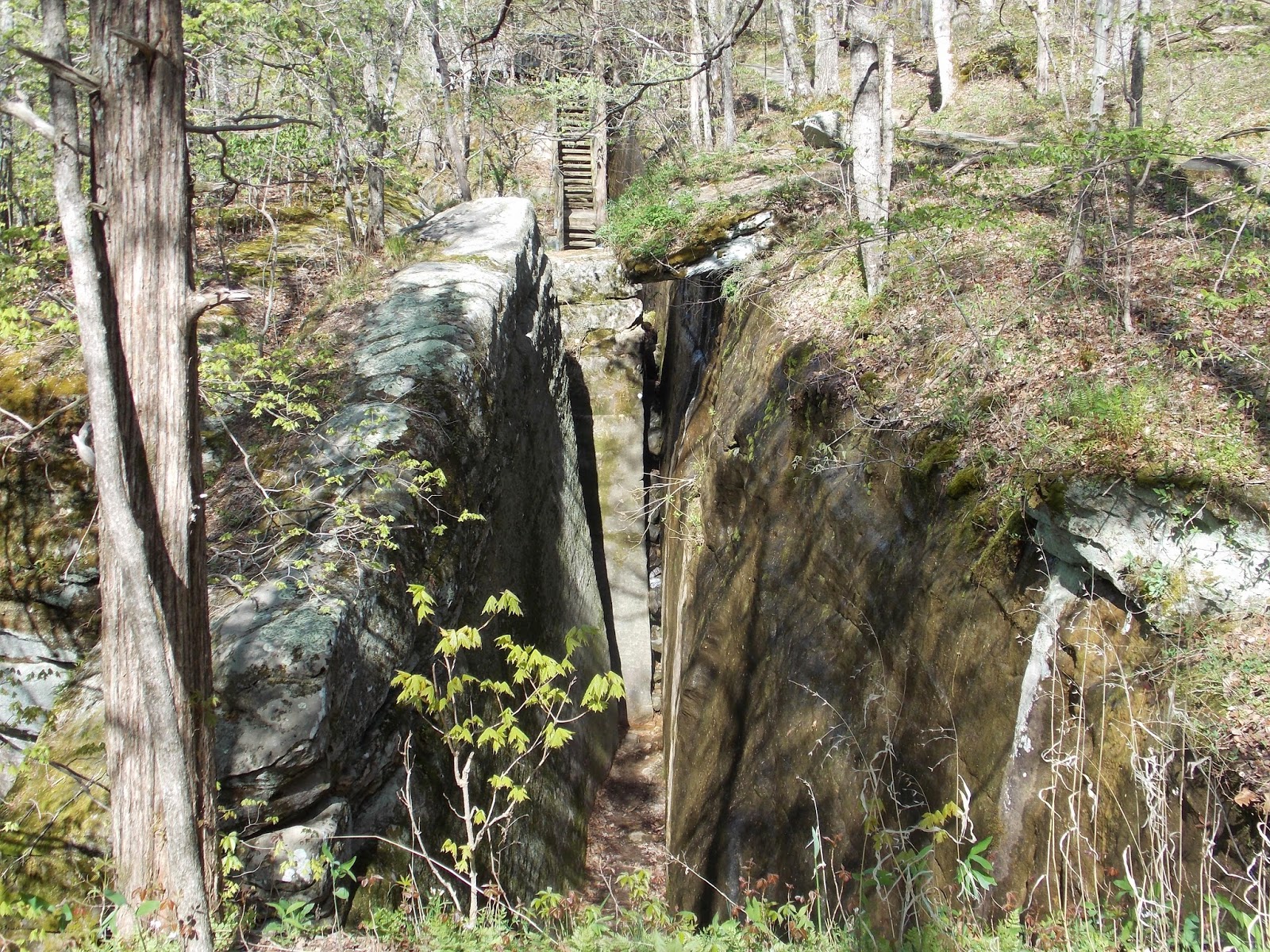
The last stop on our trip through Southern Illinois was in the Shawnee National Forest where the Rim Rock Trail is located.   That trail  is located on a natural escarpment or bluff and from that height we could see mush of the surrounding countryside as well as the valley spread out below us.  Halfway around the rim we came to a series of steps which took us down into a narrow rock passageway.
In this passageway we found ourselves surrounded by massive cliffs and huge boulders.
Fortunately, as I was about to snap the picture, two young children stepped into the passageway.  They were agreeable to be in the picture, which helped to give the picture some perspective.  We continued down more rock stairs until we reached the valley below.  There we found Ox-Lot Cave, a large rock bluff used in the 1890s by eastern logging enterprises to shelter livestock.  A fence was built in front of the cave, which created a corral.   In the back of the shelter is a spring that provided a watering hole for the animals.  Pictured below is the front of Ox-Lot Cave.  The immediate area around it is called Pounds Hollow, an old English term meaning "some sort of enclosure".
A cool running stream runs through the canyon and into Pounds Lake which is about 1/2 mile away.  Part of the enjoyment of our time on the Rim Trail were sightings of such wildflowers as violets, buttercups, and shooting stars (which are pictured below).  Unfortunately, because of the long winter, the wildflowers are just starting to come out.  In another week or so the trail should have an abundance them in bloom.