Sunday, June 19, 2011

Ohio State Reformatory Historical Site

We have moved on to Loudonville, Ohio. Friday we drove to Mansfield, the location of an old prison. As you can see from the picture this building is beautiful. The castle-like structure was built in 1886 and was considered by many to be a 19th century architectural wonder. Its style was meant to give the inmates a rebirth of their spiritual lives. Initially the prison did help many of its inmates turn their lives around. In this prison they could learn almost any skill they wanted. The prison was self-sustaining in that it produced, prepared and even canned its own food. There was also a large furniture shop. Classrooms and teachers  gave the inmates an opportunity to get their high school diploma. However, by the 1970s over-crowding gave the prison a sub-standard rating (at certain times in its history it held 2200 to 3000 men).  It was quite sobering for John and I to view the two cell blocks. In the East Cell Block alone (there are two of the blocks) are six tiers which can house 1,200 men in cells 7’x9’. The platform shown in the picture below was left behind after a movie was filmed there in that cell block. That picture was taken looking down on the tier of cells. Many of prison walls do need a new paint job!
Six movies have been made within these prison walls, Shawshank Redemption being the most popular one of them all. We found on our tour of the prison quite a few signs indicating “Hollywood Prop” sites.  Some of the sites were certainly not part of the original building, as you may see in the picture below. The hole where the prisoners escaped in Shawshank can be seen to the right of Morgn Freeman.
 The prison closed in 1990.  After it was cleaned up, tours of the building were given. The building also became available for weddings. Every November there is a “Glamour in the Slammer Expo” when future brides can meet the vendors who will assist them with planning their wedding in the Central Guard’s room. While we were there the room was being readied for a wedding reception that evening.   Paranormal activity has been reported everywhere in this prison, this would not be my choice for a wedding site!

Friday, June 17, 2011

Carillon Historical Park, Dayton, Ohio

In my last posting I mentioned this historical park, where the Wright brother’s first plane is housed.  The park has 25 exhibit buildings relating to Dayton’s rich heritage of creativity and invention. In 1884 Dayton was a rapidly modernizing city which provided a rich milieu for the Wright Brother’s curiosity and creative genius. The entrepreneurial boys ran a print shop from 1887-1899. In the Park there is a 1930s era working print shop with period equipment. Pictured below is the printer which Orville Wright gave his great-nephew to use while he was in college- to print out the college newspaper and other items, which provided him a little income.
In 1895 the Wright Brothers added a bicycle shop to their business ventures, the first step on their path to the invention of an airplane. The Park has a Dayton Cyclery building which houses a collection of rare and antique bicycles with a special emphasis on Ohio’s role in bicycle evolution. Pictured below is a 1899 Cyngnet bicycle for ladies, made by the Dayton Stoddard Manufacturing Company (the company also built cars and farm implements). There is a netting over the back wheel which protected dresses from the spokes and chain. That bike has real class!
 From 1908- 1912 Charles Kettering and his “Barn Gang” of scientists developed the electric self-starter for the automobile. In the Park there is a replica of a Dayton barn where those first experiments began. Lastly, I would be very remiss if I did not mention John H. Patterson, who also played a big role in Dayton’s modernization. He was the founder of the Dayton National Cash Register Company. The museum has an exhibit of the company’s old advertisements. We enjoyed touring the Park, it certainly is a very unique museum. In this posting I mentioned only a few of the many exhibits which can be found there. The park is named because of the presence of a 24 foot high carillon which is present on the grounds. Concerts with the carillon are played weekly during the summer.


Wednesday, June 15, 2011

Orville and Wilber Wright in Dayton

There are five sites in Dayton where one may follow the path of the Wright brothers to the invention of the airplane. Since John and I are already on the Wright Patterson Air Force Base, Monday we stopped at the Hoffman Prairie Flying Field located on base. Hoffman field in the late 1890s was flat open pasture land.. A Dayton banker, Torrence Huffman, allowed the Wright brothers to use that field for their flying experiments. His only requirement was that they keep his cows out of harm's way while flying their experiments.Trolleys from Dayton stopped at a small depot called Sims Station, located near the field. The depot allowed the Wright brothers to transport equipment from their bicycle shop in Dayton to the flying field. A replica of that depot is pictured below. No trolley tracks can be seen there today.
 In the spring of 1904 the brothers cut the tall grass of the field with scythes to prepare the terrain for flying. Below is a picture of the field and a replica of the first wooden hanger they built for their airplane. They soon built a much larger hanger. This also later became the location of  Wright Flying School.
 From this area John and I drove to the Huffman Prairie Interpretive Center, also located on the base. In the center we were able to try a flight simulator using the rudimentary controls which the Wright brothers built into their first plane. With the assistance of a park ranger we learned how to handle the lever which, when moved forward or backward, controlled the pitch of the plane. John and I never were successful in keeping our planes up the three minutes allowed for one flight on the simulator. At Carillon Center (more on that museum in my next posting) we saw the reconstructed first practical plane made by the brothers. After trying that simulated flight in the center, the mechanics of that first plane did make some sense to me. I could understand the principle of how, by lying in a snugly hip-fitting cradle and shifting side to side, the pilot operated the wing warping mechanism. And there are two  levers to control a front elevator and rear rudders, for pitch and yaw respectively.  A small motor to power the plane is on the pilot's right side. Orville, in 1947, was able to retrieve some of the 1905 Wright Flyer 111 parts and supervise its reconstruction.
Wilber Wright died in 1912, after the brothers had demonstrated successful flights in America and Europe. Orville died in 1948. It must have been amazing for him to see over the ensuing years what he and his brother had started in the field of aviation. By World War ll airplane technology had advanced a great distance from those first experiments in Huffman field!

Tuesday, June 14, 2011

Yellow Springs, Glen Helen, Clifton Gorge

The village of Yellow Springs has been called one of "America's Coolest Small Towns".  It has an eclectic array of shops, restaurants and galleries. The town itself has an artsy feel to it with its many decorated light posts and trees, which you may notice in the picture below.
Discovered around 1800, the area was popular for those seeking the curative waters of Yellow Springs, which we found yesterday while hiking in the Glen Helen Nature Preserve. The wooded glen was donated to Antioch college by Hugh Birch in memory of his daughter Helen.
Glen Helen can be found along the scenic Little Miami River Valley Trail. One can choose to even take a short trail in this preserve and still find 400-year old trees, limestone cliffs and overhangs. There is also a Hopewell Indian Mound built BC100 and AD400, which we saw while hiking the preserve.
Clifton Gorge on the Little Miami River is a post glacial canyon which has carved out scenic waterfalls and and rapids. The town of Clifton was once a hub of Ohio industry and travel. The natural geography of the area provided ideal conditions for the establishment of a variety of mills. A woolen mill furnished material for the army during the War of 1812. It was also on the banks of this gorge that Daniel Boone pulled off a dramatic escape from the Native Indians. We enjoyed our hike above the gorge, it is always very thrilling for us to discover such places of natural beauty among the flat lands of the midwest!

Monday, June 13, 2011

Wright Patterson Air Force Base

Our home is now located on this base, where our niece Laura's husband Mike works. Security clearance is needed to reside here and consequently passes are needed every time we leave and later need to get back in. Reveille is played every morning Monday through Friday at 7:30 am. I keep thinking of that phrase: "you are in the army now".  There is a certain military mentality which comes with living on such a large base, and it is an ever present feeling even when one is off the base. Yesterday, at Peace Lutheran church, the pastor slipped up and said "Pentagon" instead of, what I am sure he meant, Pentecost. Anyway, it  seemed natural then that the first place to visit while in the Dayton area would be a museum of airplanes.
 This is the oldest and largest military aviation museum in the world, and features more than 300 aircraft and missiles in 17 acres of indoor exhibit space. It took John two days to see most of it, I chose to see it in one day. It was not as boring as I imagined because I discovered that in its presentation of the development of aviation, the museum is also covering a rather comprehensive military history of the United States. We started our tour in the Presidential Aircraft Gallery. The aircraft of Presidents Franklin D.Roosevelt (his was named the Sacred Cow), Harry Truman (The Independence), Dwight D. Eisenhower( Columbine), John Kennedy and Johnson are housed there. It was during Kennedy's term that the presidential aircraft started receiving the name Air Force One. Below is a picture of Kennedy's aircraft, it had the sad task of carrying Kennedy's body back to Washington after his assassination. It saw a total of 30 years of service serving 8 presidents, the last one being President Clinton.  Notice the presidential seal in the front side of the plane.
The museum also displays the unmanned aerial vehicle or "drone".This became important for strategic reconnaissance and was first designed in the 1960s.
 There is also a section of the museum devoted to the aircraft and tools of the 21st century. Below is a picture of a rescue all-terrain vehicle.
 Seeing that vehicle and also viewing a short film recounting the events in Afghanistan in 2002 at the battle of Takur Ghar(our first major battle there) made it all too real to me what our servicemen and women are enduring in many war zones of the world today.

Wednesday, June 8, 2011

Turkey Run State Park

On our trip both to and from this park we followed again some of the markers to the covered bridges of Parke County. We can now say that we have seen at least half of the 31 bridges. Below is a picture of the West Union Bridge, longest of the double-span bridges. It was built in 1876.
On our way to Turkey Run Park we drove by many Amish farms. At one of their farms we were intrigued by the laundry hanging high from a barn. We figured that pulleys were used to get the clothes to that height.
Many years ago John and I camped with our children at Turkey Run Park. All we remembered were the awesome rugged hiking trails through deep canyons and along Sugar Creek. Yesterday we again headed out over those trails. It was quite warm, but we figured that the majestic old-growth trees and deep canyon walls would keep us cool and protected from the sun. However, we did not figure on it being so muggy! And somehow we, as usual, ignored the park service warnings that one particular trail was "very rugged". We had to do some rock scrambling on that trail and, once we were at the top of a ridge, was surprised to see where the next part of that trail took us. I was at first hesitant to go down those ladders, but they turned out not to be as treacherous as they looked. That area is called "Bear Hollow" You may notice water on the floor of the canyon. While hiking we did have to slough through some very muddy areas!
 During our hike we noticed that some trees had large holes pecked out of them, and those holes were located at the lower end of the trees. At the nature center later we learned that many different woodpeckers can be found in the area (at the bird feeding area of the center we saw a red-headed and a hairy woodpecker). Pileated woodpeckers are also in the park and are reputed to excavate long rectangular as well as oval holes in trees. Maybe that explains the large holes we saw.  We were exhausted, sweaty and hot at the end of our hiking, but it felt good to know that we still are in shape to tackle the most difficult of trails! Turkey Run is a beautiful park and it was worth the effort to see as much as we could of its many natural wonders. By the way, Turkey Run was so named because many turkeys use to gather in the canyon bottoms or "runs" to keep warm. We never saw one wild turkey while in the area. Maybe it is not the right season.

Tuesday, June 7, 2011

Terre Haute, Indiana

We had a major thunderstorm Saturday night,  it rained in copious amounts. When we got out of church Sunday morning it was still raining. We certainly could not do any outside touring so it seemed that our destination was to be the art museum in Terre Haute. Most fortunately for us the museum was closed because we discovered another wonderful museum,  the Vigo County Historical Museum. It is located in an old Victorian Home built in 1868 and  first owned by a local baker and confectioner.
When we arrived we were the only visitors so the docent gave us a personal tour of the museum. The house contains 12 rooms- among them restored Victorian rooms, a drugstore collection, toy shop and a dressmaker's shop. We learned a great deal about the local history. The city was once the home of the Root Bottling Company. In 1915 they designed the winning glass bottle for Coca-Cola, it was created in the shape of a cocoa bean. Terre Haute is also the home of Clabber Girl,  makers of baking powder and roasted coffee. The original building still stands in the downtown area of Terre Haute. And did you ever drink Champagne Velvet beer?  Terre Haute  has a brewery which is famous for producing that beer. The secret ingredient is cornflakes, or so we were informed by our museum guide. One additional interesting fact which we discovered in the museum is that the city was the home of the poet and philosopher Max Ehrlmann. He is mostly remembered for writing "Desiderata". 
John and I drove from the museum to 7th and Wabash streets to view the above sculpture of Ehrmann. It was in this vicinity that he was often seen writing. In 1926 this corner was designated as the "Crossroads of America". It is where U.S. highways 40 and 41 intersect (highway 40 opened the west, highway 41 was a north-south route).
 On the bricks around Ehrmann's statue are quotations from "Desiderata".  We enjoyed our time in Terre Haute very much and wondered why we never made it a week-end destination during all the years we lived in St.Louis. Our last stop for the day was in Brazil, where we enjoyed an outdoor concert by the Brazil Concert Band. The band has been playing for 150 years, and played for the occasion of the Lincoln-Douglas debate.

Monday, June 6, 2011

Billie Creek Village

It is fascinating to me how nicknames get started and soon no one knows what the real name is. That happened with Billie Creek, once known as William Creek. Billie Creek Village is a recreated, authentic turn-of-the-century village and home to three of Parke County's famous bridges. Two old churches, a school and even Indiana's tenth governor's home has been moved to this village. It is very much a living history museum. I especially like the old livery stable which is located in this village. It was built in 1870 and the signage on it noted that it was a "stable environment" where one could rent or keep horses. The Village's original architect considered the barn "one of the finest specimens of hand workmanship in the area".  The up-right studs are all hand-hewn and are held together by wooden dowels.  Below is a picture of the old livery stable.
Western Indiana has not been spared from all the recent flooding. For lunch we stopped at a park in Montezuma as John wanted to see the Wabash Erie Canal Turnaround. We soon discovered that it no longer exists, but is rather now a ditch with a trickle of water in it. We ate lunch in a city park by the Wabash, as you can see by the picture, the river has overflowed its banks.
It was a very warm day and got even hotter when the sun came out. We stopped at Mansfield, Indiana to check out the Mansfield Roller Mill State Historic Site. However,the mill was too warm for me so I walked down to the covered bridge, located near the mill, to sit by the creek and dip my feet in the cool water.
I mentioned earlier about nicknames and how they sometimes take on their own interesting history. The same can be said of certain common phrases. Ever hear of the expression "rule of thumb"? I learned at the mill that a miller could tell whether his machinery was working properly by the feel of the flour between his thumb and fingers. It was not very scientific, but it was the Rule of Thumb.

Saturday, June 4, 2011

Covered Bridges of Parke County Indiana

Our campground is in a heavily wooded area, and there are plenty of birds around.  To my listening pleasure early this morning I heard the unique song of a whip-poor-will. I had not heard the song of that nightjar since about ten years ago. Such are the unexpected pleasures in our nomadic life style! Parke County is the "covered bridge capitol" of our nation. Yesterday we saw three of the thirty-one covered bridges in Parke County. To see those three we covered sixty miles over winding narrow country roads. The first one we saw was the largest and most scenic. Bridgeton Covered Bridge lies across Racoon Creek and has a waterfall nine feet in height.  It also has an operating grist mill. The bridge was built in 1823, and rebuilt in 1870. In 2006 an arsonist burned it down, but it has subsequently been rebuilt. Last week a tornado did some major damage to the bridge and roof of the mill. Hopefully insurance will pay for the damage.
When we entered the mill we met up with Mike Roe, the owner and operator of the mill. He was busy doing some repairs to the mill, but still was eager to talk with us about the history of the building. He informed us that not only has he had to contend with arsonists, but also with people who have the proclivity to shoot out the windows of his mill!  Our next stop, after a lunch break, was the covered bridge at Rosedale. Built in 1910, it still is the original bridge. Rosedale is the second oldest town in Indiana.
 After driving to the Harry Evans Bridge, we headed to the strawberry festival in Brazil. The festival was held on the grounds of the Clay County Courthouse. After finishing our strawberry shortcakes we wandered into the courthouse ( surprise, the doors were wide open with no security measures in place). The interior of the courthouse is quite beautiful with pillars of granite and a dome of decorative stain glass. I stood in the rotunda and pointed my camera upward to get the picture shown below. As I wrote earlier, it is always the unexpected  that keep our travels interesting!

Thursday, June 2, 2011

Traveling East

We left Farmington yesterday morning, driving south to Perryville, Missouri and then crossing the Mississippi River at Chester, Illinois. We stopped at the Welcome Center, which is located at the river's edge.
Chester is the home of Popeye, a 6 foot 900 pound statue of him can be found in Segar Memorial Park. Elzie Segar was the creator of Popeye, the sailor man. We did not have the time to drive in to see the statue, so we just had to be satisfied with the smaller statue at the Welcome Center.
I have another picture to share, which I took yesterday during our lunch stop. We had to chuckle at this one.
Our stop for the night, which is where we are planning to reside for a week, is located north of Brazil, Indiana. Driving over flat land and fields of sprouting corn, John and I wondered about the name of the campground which was to be our final destination of the day; Fallen Rock Parke Campground. That name suggested to us something a bit more scenic than farm fields! Suddenly the road we were on curved and, most dramatically, our scenery changed to that of  forested ravines with towering rocky bluffs. After parking and getting settled in the campground, we were invited to sit at the campfire of one of our neighbors. We learned from them that we have a lot to look forward to in touring Parke County Indiana; quaint small towns, covered bridges, as well as just hiking over 60 miles of trails  in Fallen Parke Campground. And there really is a "fallen rock" to check out.

Monday, May 30, 2011

Silver Mines and Mill Stream Gardens

Yes, we are still in Missouri. Our plans are to leave on Wednesday for Indiana. On Saturday my sister Julia and her husband Cal, as well as their daughter Katie and her boyfriend, and sister Linda visited us in Farmington. We drove with them to Silver Mines and Mill Stream Gardens to do some hiking. The two areas are in Mark Twain National Forest, one of the most beautiful locations in Missouri. It is here that the St.Frances River cuts a rugged canyon through granite bluffs. Silver Mines was once the location of a busy mining district at the turn of the twentieth century. Remnants of the old mine and and dam are still present.
The only white water in Missouri is here at the St.Frances River. While we were hiking along the river, we stopped to watch a man navigate his kyack through a section of rapids. As you can see in the picture, this area is full of large boulders. It was necessary for us to do some rock scrambling while hiking through this forest. Parts of the river at this point do look a bit like Johnson's Shut Ins. Julia and Katie could not resist the cool flowing water and did stick their feet into Tiemann Shut Ins at Mill Stream Gardens.
The St. Frances is currently quite swollen from recent rains. All that water seems to have attracted a large in- flux of gnats. If we wanted to avoid eating them with our lunch, it was necessary to eat in the car. While we were eating lunch I happened to look out at a patch of honeysuckle and observe a beautiful swallowtail butterfly who was quite busy flitting among its flowers. He would not stop to pose for me so I captured him in action, which is why his wings appear a bit blurred in the picture.
 Another picture I took that day, and which I am proud of, is that of a large water snake. I had to lean over a bit on a high rocky river bluff to get his picture. He was catching a nap on a outlet pipe for the dam, which extended into the river. Certainly no one could disturb him there!

Monday, May 23, 2011

Springfield, Illinois

Last week John and I moved our home to Farmington, Missouri so we could spend some time visiting with his family. However, in the ensuing days, we have made a couple of trips back to St.Louis. Last Wednesday we attended a Cardinal game and Saturday we joined our Holy Cross family for a bus trip to Springfield Illinois. John and I have visited the Lincoln sites in Springfield but have not seen the Abraham Lincoln Presidential Museum. As we entered the museum statues of Lincoln's family, as they appeared in 1860, greeted us.
Behind them is the south portico of the White House as it looked when the Lincolns moved in. The museum has a walk-though journey covering the years of Lincoln's life which includes, besides exhibits in the White House, a replica of his boyhood home as well as his law offices in Springfield. Modern technology is very much used in this museum. I especially liked the "you are there" setting of his law office. While Lincoln is studiously reading, and very oblivious to his sons Tad and Willie, they are jumping on his desk, scattering papers and ink everywhere. The sounds of their giggling fill the room. Currently a special exhibit is at the museum featuring excerpts from Doris Kearns Goodwin's book Team of Rivals: The Political Genius of Abraham Lincoln. That gallery does an in-depth study of Lincoln's first cabinet;  how he chose each member and his political acumen while debating the initial momentous decisions pertaining to the attack on Fort Sumpter by the Confederacy. That exhibit, more than any other one in the museum, showed the brilliance of Lincoln's mind. I could have spent much more time than I did in the museum, but our tour group had to move on for lunch. We ate at the "Incredibly Delicious" restaurant in the Aristocracy Hill area of Springfield. The French restaurant/bakery is in an old Victorian style home built in the 1840s. Below is a picture of the front of the home. The grill work and decorations on top of the pillars are quite beautiful to see, and the inside is equally spectacular with gleaming woodwork, fancy chandeliers and stained glass windows.  Equally important, our food was delicious, and purchasing one of their baked desserts is a must.
We finished out our day walking around the historic section of Springfield, where an art fair was being held. Below is a picture of the fair, with the historic old courthouse in the background. Rain was predicted for the day but it turned out to be quite sunny and pleasant.

Friday, May 13, 2011

An Evening at the Black Repertory

If you live in St.Louis you still have this week-end to see "Black Pearl Sings!" at the Black Rep theater on Grandel Avenue. John and I saw it Thursday evening and thoroughly enjoyed it. Jazz vocalist Denise Thimes is outstanding as Pearl, a black woman  in a Texas prison 1935. The only other character in the play is Shanara Gabrielle who plays Susannah, a wealthy white woman who meets up with Pearl while searching for prisoners who know folk music dating back to the years before the civil war. The story itself is historical fiction and is not a biography. It is a story of two women from different cultures sharing their passions and ambitions. Pearl is willing to sing the songs which her family passed down, including the one her grandfather taught her while coming over to America on a slave ship.  In exchange for a recording of Pearl's songs, Susannah agrees to search for Pearl's daughter from whom she had became estranged while being imprisoned. Pearl sings all the songs she remembers without any musical accompaniment. A couple of times when she is singing she thumps on the floor with her bare feet, in time with her music.  She does that so well that I thought for sure there had to be drums accompanying her!  Denise Thimes is more of a singer than actress, but in this play she artfully portrays a black woman who has borne plenty of pain in her life, but  remains determined to keep her pride intact at all cost.  What is equally impressive to me is that Denise is able to pull all this off so well, even while grieving the death of a sister who was killed last month.

Tuesday, May 10, 2011

Augusta, Missouri

To celebrate Mother's Day John and I decided to join my sister Julia, her husband Cal and their daughter Katie (who came with her boyfriend) at the Montelle Winery in Augusta. As you can see in the picture above, we even had entertainment while we enjoyed our lunch. The winery advertises that it is the most scenic winery in all of Missouri. It is certainly a beautiful spot as its dining pavilions overlook the Missouri river hills. And Sunday was finally a perfect spring day, with no rain. All the water puddles near us seem to be attracting shore birds.We have never seen so many egrets in Missouri as we have recently. We even saw a blue heron on our way to church Sunday.  
The cafe at the winery on Sunday had a buffet for Mother's Day, which seemed to draw a fairly large crowd of people. However, our group was just as satisfied with sandwiches, crackers and cheese for our lunch. Of course we did wash all that down with several bottles of delicious wine! I think that both John and I have been itching again to hit the road,  because we took a slow meandering route over several country back roads for our return trip home. The fields around Augusta are starting to display the new crop of grape plants for 2011. By the way, there are several other wineries besides Montelle in the Augusta area. Missouri has its own Napa Valley. Our plan is to remain in St.Louis for one more week, and then to move south to Farmington.

Monday, May 2, 2011

St.Louis-Stuttgart Volksmarch

The Volksmarch Club originally started up in Germany. Loosely translated into English, the German word volksmarch means a people's walk. John and I, together with my two sisters Linda and Julia, have taken quite a few of these six mile walks in and around the St.Louis area over the years. We certainly have come to appreciate the cultural differences which can be found in the many different neighborhoods of the metropolitan area while taking these walks. My favorite walk probably will always be the Hill area. When we take that walk we always end up at one of the fantastic Italian restaurants of that area. Saturday our walk started in Brentwood. This walk was primarily residential, and included one large park plus a couple smaller ones. The large park is Tilles, which was quite busy when we walked through it. Many sport's teams were playing in its ball fields and there was a walk for Huntington's Disease. Below is a picture of that park's play area for children. I once worked for Children's Hospital so that entrance sign caught my eye.
Fortunately for us the weather was pleasant Saturday, except for being a bit breezy and cool. Many people were out in their yards doing much needed gardening. For St.Louis it has been a very wet spring and there has been few opportunities to get any gardening done. However, many of the yards are still quite beautiful with blooming lilac and azalea bushes. I even saw a rose just starting to bloom.
 
It was pleasant walking the residential area of Brentwood with its many tree-lined streets and well manicured lawns. The picture below also should give you feel for what we enjoyed on that walk.
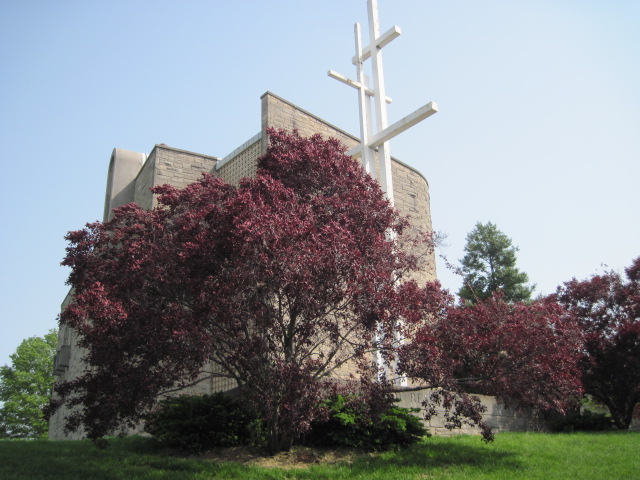
 Our walk also took us past Mt.Calvary Lutheran Church. Its grounds are quite beautiful with their flaming red maple trees. It seems like in a couple of weeks barren trees have now suddenly filled out with their fresh brightly colored leaves. All the rain has certainly given nature a bright new look!
By the end of our walk we were famished and quite tired. Suddenly the Kolache Factory on Brentwood Boulevard  looked like a good place to eat. It has a variety of meat, egg, and vegetable- filled rolls which, when heated, are quite delicious. It was the perfect place to end our walk.