Two days ago, Monday, we drove 135 miles south of Miami over the Keys. By the way, the word Key was taken from the Spanish cayo or small island. The Keys are a 220-mile long string of islands southwest of the Florida mainland. In traveling these island we drove over many causeways and one 7-mile bridge. The first thing which I noticed, looking over the sea, was that the water's color ranged in many shades of greens and blues. In some areas it was even brown and white. When I mentioned this to John, he quoted for me what he had read in a boating brochure entitled " Keeping your Bottom off the Bottom" ( in other words, the boater needs to be aware that there are places off the Keys where there are dangers of running aground). "Green, green nice and clean"; no saw grass or coral reef to scrape the boat's bottom. "Brown, brown run aground", and "white, white, you might". With the color blue you "cruise on through" ! One of our stops in the Keys was the Turtle Hospital, which even owns a turtle ambulance. Being a nurse, I was fascinated at how that place can tube feed sick turtles as well as do amputations of flippers and removal of fibrinous tissue! We also stopped at the National Key Deer Refuge where, driving on some back roads, we were able to spot a couple of the deer. They are a relative of the white tail deer but much smaller, an average of three feet high.. The Key deer are an endangered species, 119 of them were killed last year by cars.
Our final destination for the day was Key West. Driving around the town we found a marker noting that Key West is the southernmost city of the continental United States. Hard to believe that Cuba is only 90 miles from this point.
A popular thing for tourists to do in Key West is walk around Mallory Square Dock at sunset. Every night, weather permitting, there is a celebration one hour before sunset complete with jugglers, contortionists, and other entertainers. While we were there we watched two fire-eaters who announced their show by blowing on conch shells. We did not stay for the entire show as there was a cold wind coming down from the north, notice the palm trees swaying in the picture below. There will be more on Key West in my next postings.
Wednesday, December 8, 2010
Monday, December 6, 2010
Vizcaya Museum and Gardens
This is another house built during the Gilded Age, an age of extravagance and grandeur. The interior of the home is furnished with elegant European art objects which mostly reflect Renaissance Italy. Decorative furnishings and art objects span 400 years. While James Deering lived there it was an open-air home, but since then it has been enclosed in glass to protect the contents of the home. James Deering was an industrialist, owner of a company which eventually became known as International Harvester. The back of this mansion looks out over Biscayne Bay. The sculpted barge pictured below served a practical purpose as it provided a calm area of water between the house and the bay. It was also another place for Deering to entertain his guests. Such an object is known as a "folly", something which is meant to please and surprise ones friends. Maybe I have already defined that word in another posting.
There are many small gardens on this ten-acre estate, divided by hedges and walls. Pictured below is what Deering called his secret garden. Deering really wanted orchids around his gardens, but then he realized that what worked best in southern Florida were tropical plants.
The gardens have many sculptures from Italy. One area of the grounds has a theater garden, complete with a stage and the figures of Harlequinade and Pierrot. I believe those characters are from a sixteenth century Italian comedy. The garden even had a place for the audience to sit. Of course, no stage play was produced in this garden, it was just something to look at and admire. There are also pools and fountains located around the estate, Mr.Deering liked to surround himself with the sound of water.
You may notice a bride in the background of this picture. The day we were there we noticed that in several of the gardens preparations were being made for weddings which were to occur later in the afternoon. Mr. Deering certainly had a beautiful place for his own wedding, but he remained a bachelor all his life.
There are many small gardens on this ten-acre estate, divided by hedges and walls. Pictured below is what Deering called his secret garden. Deering really wanted orchids around his gardens, but then he realized that what worked best in southern Florida were tropical plants.
The gardens have many sculptures from Italy. One area of the grounds has a theater garden, complete with a stage and the figures of Harlequinade and Pierrot. I believe those characters are from a sixteenth century Italian comedy. The garden even had a place for the audience to sit. Of course, no stage play was produced in this garden, it was just something to look at and admire. There are also pools and fountains located around the estate, Mr.Deering liked to surround himself with the sound of water.
You may notice a bride in the background of this picture. The day we were there we noticed that in several of the gardens preparations were being made for weddings which were to occur later in the afternoon. Mr. Deering certainly had a beautiful place for his own wedding, but he remained a bachelor all his life.
Sunday, December 5, 2010
Everglades, Part Two
Fresh water and sea water mix together in the watery wilderness of the Everglades. Yesterday, while in the Everglades National Park, we drove by miles of scrub plants as sawgrass and saw palmetto. It was hard to imagine that there is water under that prairie, until we did some walking on the boardwalks above the grassy water. There really is a marshy underworld in all that scrub brush which is teeming with life, and which provides food for such birds as herons, egrets, ibises and wood stork.
Beyond the prairie, in the picture above, you may notice an island of trees. In the Everglades we saw many of these tree hammocks in which may be found forests of hardwood trees, pine, or the the royal palm to mention a few of the varieties. Cypress trees also dot the landscape of the marsh but, in this environment of mostly shallow water, growth of that tree can be quite stunted. They actually appear dead, but it is the time of the year when their leaves turn color and even fall off.
We hiked through a mahogany as well as a gumbo limbo tree hammock. The latter tree is quite interesting and one I never seen before. It is also called the "tourist tree" by Floridians because its bark is red and peeling, same as the tourists who view it! It ended up to be quite a long drive through the park, but we were determine to see the mangrove estuaries at the southern most tip of the park, which was at Florida Bay. From there we could see the Florida Keys. As I was walking around the marina there, looking for either manatees, or dolphins, I happened to see this young brown pelican who lazily stared at me. Many gulls were also hanging out on the docks, as you may notice in the picture below. They completely covered the dock in the background.
On our way out of the park we happened to make a couple more stops. At one of those stops we took a short hike into a forest and saw a tree which was labeled as the poisonwood tree. Apparently every part of that tree can cause a bad rash, it is in the poison oak family. Our last stop was at a marsh pond, which was filled with many birds, both in the pond and surrounding it. There I had my first sighting of the roseate spoonbill bird. Two of those beautiful pink birds were perched in trees above the pond. Seeing them sure made a perfect ending to our day in the Everglades.
Beyond the prairie, in the picture above, you may notice an island of trees. In the Everglades we saw many of these tree hammocks in which may be found forests of hardwood trees, pine, or the the royal palm to mention a few of the varieties. Cypress trees also dot the landscape of the marsh but, in this environment of mostly shallow water, growth of that tree can be quite stunted. They actually appear dead, but it is the time of the year when their leaves turn color and even fall off.
We hiked through a mahogany as well as a gumbo limbo tree hammock. The latter tree is quite interesting and one I never seen before. It is also called the "tourist tree" by Floridians because its bark is red and peeling, same as the tourists who view it! It ended up to be quite a long drive through the park, but we were determine to see the mangrove estuaries at the southern most tip of the park, which was at Florida Bay. From there we could see the Florida Keys. As I was walking around the marina there, looking for either manatees, or dolphins, I happened to see this young brown pelican who lazily stared at me. Many gulls were also hanging out on the docks, as you may notice in the picture below. They completely covered the dock in the background.
On our way out of the park we happened to make a couple more stops. At one of those stops we took a short hike into a forest and saw a tree which was labeled as the poisonwood tree. Apparently every part of that tree can cause a bad rash, it is in the poison oak family. Our last stop was at a marsh pond, which was filled with many birds, both in the pond and surrounding it. There I had my first sighting of the roseate spoonbill bird. Two of those beautiful pink birds were perched in trees above the pond. Seeing them sure made a perfect ending to our day in the Everglades.
Saturday, December 4, 2010
Everglades
We now have moved to Miami, the southern end of the city. Amazingly we found a campground which is in a large county park and quite isolated from the city. The traffic jams we encountered yesterday driving through the city were quite awful so we were very relieved to find this campground and get out of the traffic. The Everglades we toured today is the area within the Everglades National Park. Just before entering the park we drove past many agricultural fields which were being irrigated. The first informational sign we saw within the park said something to the effect that the Everglades were on "life support". In other words, the surrounding areas have been so developed that the Everglades are drying up, and to keep them alive pumping stations have been set up for their life support. It is hard to imagine that our grandchildren may not be able to see what we saw today, we so enjoyed our time within the park. At our first stop I noticed a bush with a zebra longspan butterfly on it, he sat long enough for me to get this picture.
The first hike we took in the park is called the Anhinga Trail. It was in this area where we saw the majority of wildlife found in the park. Initially we saw cormorants and thought they were the anhinga which heavily populate this area.. The anhinga is similar to the cormorant by the manner in which he drys his wings, and he also has blue eyes.. However, the cormorant is all black and his beak is hooked at the end. The anhinga is pictured below. We watched him for a long time while he was diving and eating his lunch of fish. He is quite an interesting bird. While he is diving for fish you can only see his long skinny neck come up out of the water for air. I thought at first that it was a large snake I was seeing jumping out of the water!
The anhinga has a beautiful turquoise ring around his eyes when he is mating. We would never had noticed that had we not met up with a park volunteer. It was his day off, but he still was eager to share with us his knowledge of the wildlife we were seeing. He also pointed out to us a purple gallinule bird, which he claimed is one of the most beautiful birds in the park.That bird is in the lower left corner of the picture below, unfortunately he was a bit too far from us for us to fully appreciate his colors.
We saw many alligators below the boardwalk of the trail, even a baby one who could not have been more than a foot long. The alligators pictured below seemed to enjoy hanging out with each other. I can already see now that I will have to do another posting on the Everglades, there is so much to share about everything we saw during our day there.
The first hike we took in the park is called the Anhinga Trail. It was in this area where we saw the majority of wildlife found in the park. Initially we saw cormorants and thought they were the anhinga which heavily populate this area.. The anhinga is similar to the cormorant by the manner in which he drys his wings, and he also has blue eyes.. However, the cormorant is all black and his beak is hooked at the end. The anhinga is pictured below. We watched him for a long time while he was diving and eating his lunch of fish. He is quite an interesting bird. While he is diving for fish you can only see his long skinny neck come up out of the water for air. I thought at first that it was a large snake I was seeing jumping out of the water!
The anhinga has a beautiful turquoise ring around his eyes when he is mating. We would never had noticed that had we not met up with a park volunteer. It was his day off, but he still was eager to share with us his knowledge of the wildlife we were seeing. He also pointed out to us a purple gallinule bird, which he claimed is one of the most beautiful birds in the park.That bird is in the lower left corner of the picture below, unfortunately he was a bit too far from us for us to fully appreciate his colors.
We saw many alligators below the boardwalk of the trail, even a baby one who could not have been more than a foot long. The alligators pictured below seemed to enjoy hanging out with each other. I can already see now that I will have to do another posting on the Everglades, there is so much to share about everything we saw during our day there.
Wednesday, December 1, 2010
Merritt Island National Wildlife Refuge
This island shares a common boundary with NASA's Kennedy Space Center. The picture below was taken from the refuge, John thinks that the space shuttle on the right is the one scheduled to take off later this month. It was originally to go up this Thursday, which was one of the reasons why we moved our rig here.
The island has a wide variety of habit, ranging from freshwater impoundments to vast saltwater estuaries. John and I saw a lot of wild life here yesterday, from a most beautiful small butterfly to the huge ugly black turkey vulture. The one pictured below was feeding on a fish on the road. He does not do carry out as hawks prefer to do; the vulture wants to eat in, or wherever he finds the food. Only until our car started to move toward him did he reluctantly drag his meal to the side of the road.
I mentioned hawks, this island has many osprey hanging over the waterways looking for a meal of fish.We also saw a lot of brown pelicans, ibis, and wood storks and a variety of ducks. I was very confused trying to identify the numerous herons and egrets, only to find out later that the island has ten different kinds of that species.
Another bird which I had always wanted to see was the belted kingfisher. I espied him high up in a tree, I certainly would have liked to have seen him closer! There were many alligators and turtles out sunning themselves by the marshes. But I think the last picture I want to show is that of an armadillo, who was busy foraging for grubs by the side of the road. We have been seeing a fair number of them while driving around in Florida, so I decided that it was about time I snapped a picture of one. They do not pose well either. This armadillo's head was constantly down into the grass. I have to take what I can get! His head is on the left side of the picture, maybe you can see his little pointed ears sticking up if you enlarge the picture.
Our last stop in the refuge was to look for manatee at the Haulover Canal. The island is home to Florida's largest population of manatees, but none were seen there today. Anyway, it was getting late in the day and we were hungry. On the way home we stopped at Dixie Crossroads restaurant in Titusville for a delicious meal of rock shrimp. It was the first time I had eaten them, the shrimp have a sweet-tasting meat, much like lobster.
The island has a wide variety of habit, ranging from freshwater impoundments to vast saltwater estuaries. John and I saw a lot of wild life here yesterday, from a most beautiful small butterfly to the huge ugly black turkey vulture. The one pictured below was feeding on a fish on the road. He does not do carry out as hawks prefer to do; the vulture wants to eat in, or wherever he finds the food. Only until our car started to move toward him did he reluctantly drag his meal to the side of the road.
I mentioned hawks, this island has many osprey hanging over the waterways looking for a meal of fish.We also saw a lot of brown pelicans, ibis, and wood storks and a variety of ducks. I was very confused trying to identify the numerous herons and egrets, only to find out later that the island has ten different kinds of that species.
Another bird which I had always wanted to see was the belted kingfisher. I espied him high up in a tree, I certainly would have liked to have seen him closer! There were many alligators and turtles out sunning themselves by the marshes. But I think the last picture I want to show is that of an armadillo, who was busy foraging for grubs by the side of the road. We have been seeing a fair number of them while driving around in Florida, so I decided that it was about time I snapped a picture of one. They do not pose well either. This armadillo's head was constantly down into the grass. I have to take what I can get! His head is on the left side of the picture, maybe you can see his little pointed ears sticking up if you enlarge the picture.
Our last stop in the refuge was to look for manatee at the Haulover Canal. The island is home to Florida's largest population of manatees, but none were seen there today. Anyway, it was getting late in the day and we were hungry. On the way home we stopped at Dixie Crossroads restaurant in Titusville for a delicious meal of rock shrimp. It was the first time I had eaten them, the shrimp have a sweet-tasting meat, much like lobster.
Tuesday, November 30, 2010
Dow Museum of St.Augustine
We moved today to Cape Canaveral, and are located now in a park which comes up to the shores of the Banana River. It has been cloudy and rainy, we hope that improves over the next couple of days but they Florida does need rain. I have one more item to cover on St. Augustine, the Dow Museum. It covers an entire city block of St.Augustine, and within this area are nine historical homes. Arguably, it is the largest collection of older homes in all of the United States. Also, under and around this historical area are the foundations and structures of the 16th century colonial town. The homes were bought up by Kenneth Dow in the early 20th century. The oldest one is the Murat Home, built in 1790. The owner of the home, Charles Louis Napoleon Achille Murat was the crown prince of France (nephew of Napoleon Bonaparte). Murat came to the United States at the age of 22 years seeking political asylum. He happened to strike up a friendship with the philosopher Emerson, who visited him at this house. Emerson came to St.Augustine frequently to restore his health. Another interesting fact regarding Murat is that he married a relative of George Washington. This home is well furnished with antiques of that era.
Dow traveled around the world to find the most odd and unusual art for these homes. This can especially be seen in the courtyard and gardens surrounding the homes, which he decorated with many statues and fountains. On a brick wall of the gardens he even installed a street grate, which is quite decorative. It is a very fascinating museum. Two of the buildings house the studios and galleries of local artists.
In a square of this historic village is a bell with a historical marker under it. The marker claimed that according to a report provided by a slave, Mary Gomez, in 1863 all the slaveholders of St.Augustine were ordered by the mayor to release their slaves and to have them gather in this vacant lot. There the Emancipation Proclamation Act was read.. After the reading the "bonds" were struck off. I think that we will never forget St.Augustine because of its many layers of history, which can easily be discovered all over the city.
Dow traveled around the world to find the most odd and unusual art for these homes. This can especially be seen in the courtyard and gardens surrounding the homes, which he decorated with many statues and fountains. On a brick wall of the gardens he even installed a street grate, which is quite decorative. It is a very fascinating museum. Two of the buildings house the studios and galleries of local artists.
In a square of this historic village is a bell with a historical marker under it. The marker claimed that according to a report provided by a slave, Mary Gomez, in 1863 all the slaveholders of St.Augustine were ordered by the mayor to release their slaves and to have them gather in this vacant lot. There the Emancipation Proclamation Act was read.. After the reading the "bonds" were struck off. I think that we will never forget St.Augustine because of its many layers of history, which can easily be discovered all over the city.
Monday, November 29, 2010
Love and Chocolate in St.Augustine
John, who very diligently reads all the travel books before touring a city, found some small reference to a "love tree" located in St.Augustine. While walking around the town Friday we came upon the"Love Tree Cafe". The small juice bar has a beautiful garden, but we saw no marker noting a love tree in the area. We were just about ready to give up and walk away when John found The Tree.
You may wonder, as I did, what was so unusual about the live oak. John pointed out to me the palm tree growing out of the live oak. What a testament to true love! Those trees look like they are not just tolerating each others existence, but are thriving with one's roots sunk deep within the other. Since then I have found out that if a couple kisses under it, their love will last forever. John and I missed that opportunity, but I believe that our love will last anyway, without the help of that tree! Yesterday, Saturday, we returned to St. Augustine to tour Dow Museum, as we had arrived there Friday at closing time. I have said it before, there are some days for us which turn out totally different than planned. Saturday we passed Kilwins Chocolate shop and remembered that they give tours and samples for a small fee. We stopped, found out that a tour was happening soon, and that took care of the rest of the day for us. We got a crash course on everything there is to know about chocolate, from the bean in the pod on a small farm (only small farmers grow the plant) in the tropics, to the finished product in a chocolate shop. In the factory we saw chocolate covered cashews being made. The worker below is placing the nuts in a chocolate mold.
In the picture below another worker is pouring the chocolate into the mold, after which the mold is set aside to harden. And yes, that is chocolate pouring down into container below it. Looks yummy, right?
We were still in the factory when the chocolate cashews got popped out of their mold. One was a dud, it was not completely covered with chocolate, so I volunteered to get rid of it! What is there not to love about chocolates, except maybe their calories.
You may wonder, as I did, what was so unusual about the live oak. John pointed out to me the palm tree growing out of the live oak. What a testament to true love! Those trees look like they are not just tolerating each others existence, but are thriving with one's roots sunk deep within the other. Since then I have found out that if a couple kisses under it, their love will last forever. John and I missed that opportunity, but I believe that our love will last anyway, without the help of that tree! Yesterday, Saturday, we returned to St. Augustine to tour Dow Museum, as we had arrived there Friday at closing time. I have said it before, there are some days for us which turn out totally different than planned. Saturday we passed Kilwins Chocolate shop and remembered that they give tours and samples for a small fee. We stopped, found out that a tour was happening soon, and that took care of the rest of the day for us. We got a crash course on everything there is to know about chocolate, from the bean in the pod on a small farm (only small farmers grow the plant) in the tropics, to the finished product in a chocolate shop. In the factory we saw chocolate covered cashews being made. The worker below is placing the nuts in a chocolate mold.
In the picture below another worker is pouring the chocolate into the mold, after which the mold is set aside to harden. And yes, that is chocolate pouring down into container below it. Looks yummy, right?
We were still in the factory when the chocolate cashews got popped out of their mold. One was a dud, it was not completely covered with chocolate, so I volunteered to get rid of it! What is there not to love about chocolates, except maybe their calories.
Sunday, November 28, 2010
The Gonzalez-Alvarez House of St.Augstine Florida
One of these day I just may run out of places to talk about in historic St.Augustine. But I just could not pass up mentioning this home as it has 400 years of documented history and is the oldest home in the city.
The first home on this site was made of logs and had a thatched roof. It burned in the town fire of 1702. The next house built here, as seen above, had a tabby floor and coquina wall. At that time it had one floor. A family by the name of Tomas Gonzalez was believed to have lived in it then, proof of that was found in the local Catholic church books which has recorded the baptism of their child in 1702. That family lived in the home until the British occupied the city in 1763. It was then that the second story, as well as other alterations in the size and shape of the house, was built. For some time it was even a tavern, a room on the first floor shows what a bar room may have looked like back in the 1700s. It also portrays what a main room may have looked liked for the first Spanish dwellers of the home.
The British influence is very evident on the second floor where there are private rooms for sleeping and visiting. What especially impressed me about this house was that it was continually in use and fully occupied by people over the 400 year of its existence.
As we know from history, the British left St.Augustine in the late 1700s and the Spanish came back in. The Geronimo Alvarez family owned the home for 100 years after which it went to various occupants until it became a museum in 1918. Below is the entrance into the courtyard of the home as it appears today.
The first home on this site was made of logs and had a thatched roof. It burned in the town fire of 1702. The next house built here, as seen above, had a tabby floor and coquina wall. At that time it had one floor. A family by the name of Tomas Gonzalez was believed to have lived in it then, proof of that was found in the local Catholic church books which has recorded the baptism of their child in 1702. That family lived in the home until the British occupied the city in 1763. It was then that the second story, as well as other alterations in the size and shape of the house, was built. For some time it was even a tavern, a room on the first floor shows what a bar room may have looked like back in the 1700s. It also portrays what a main room may have looked liked for the first Spanish dwellers of the home.
The British influence is very evident on the second floor where there are private rooms for sleeping and visiting. What especially impressed me about this house was that it was continually in use and fully occupied by people over the 400 year of its existence.
As we know from history, the British left St.Augustine in the late 1700s and the Spanish came back in. The Geronimo Alvarez family owned the home for 100 years after which it went to various occupants until it became a museum in 1918. Below is the entrance into the courtyard of the home as it appears today.
Saturday, November 27, 2010
Washington Oaks Gardens State Park
This park, on Anastasia Island, was our last stop of the day when we visited that island. Although formal gardens are the centerpiece of the park, it does have 425 acres of Florida's original coastal scenery. The land is part of Bella Vista Plantation, once owned by General Joseph Hernandez, a Floridian of Minorcan descent. You may remember that in one of my past postings I spoke of the Minorcans, or Greek immigrants who settled in St.Augustine. A surveyor named George Washington, distant relative of our first president, married Hernandez's daughter in 1845. History can sure be fascinating. The plantation ended up as a winter resort for Mr. Young and his wife in 1937. He help found the RCA corporation.
Speaking of gardens, we also visited Ravine Gardens State Park in Palatka, Florida on Thanksgiving day. In that park gardens have been landscaped with tropical and subtropical plantings in a setting of ravines and springs. March or April is probably the best time to see this garden as azaleas thickly cover the area then.
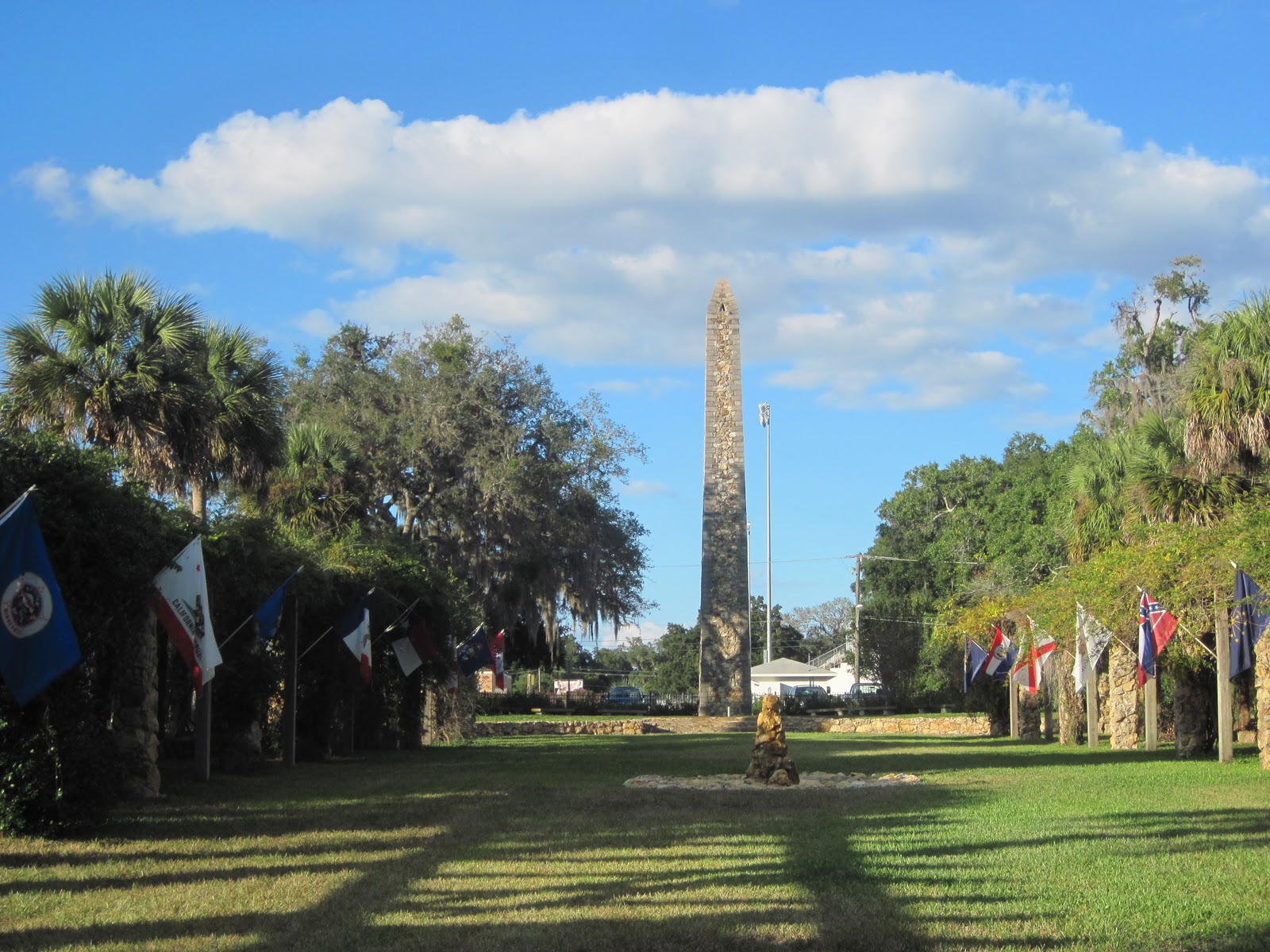
In 1937 the gardens were declared "the Nation's outstanding CWA project". CWA was the Federal Civil Works Administration formed during the depression to spur economic recovery. Ironically, both the gardens and the town of Palaka could use the same help today, as they are now looking rather down in the mouth with physical structures crumbling, streets and sidewalks cracking. In the park there is an obelisk dedicated to Franklin D. Roosevelt, president at the time when this garden was built. Leading up to the monument are all the flags of the states, placed in order according to their time of statehood. Our weather has been great for the past few days, average of 80 degrees.
Speaking of gardens, we also visited Ravine Gardens State Park in Palatka, Florida on Thanksgiving day. In that park gardens have been landscaped with tropical and subtropical plantings in a setting of ravines and springs. March or April is probably the best time to see this garden as azaleas thickly cover the area then.
In 1937 the gardens were declared "the Nation's outstanding CWA project". CWA was the Federal Civil Works Administration formed during the depression to spur economic recovery. Ironically, both the gardens and the town of Palaka could use the same help today, as they are now looking rather down in the mouth with physical structures crumbling, streets and sidewalks cracking. In the park there is an obelisk dedicated to Franklin D. Roosevelt, president at the time when this garden was built. Leading up to the monument are all the flags of the states, placed in order according to their time of statehood. Our weather has been great for the past few days, average of 80 degrees.
Friday, November 26, 2010
Anastasia Island
This barrier island is a short drive over from the city St.Augustine. The picture above was taken from the top of the lighthouse on the island, it shows the city off in the distance. Part of the island is nestled between the Mantanzas River and the Atlantic Ocean. In April 1942 the German submarine U-123 sank the USS Gulfamerica off Jacksonville Beach. It was discovered that the American boats were being fired at as they passed in front of the lights of the lighthouse, so during the war those lights were dimmed.. Our main goal in going over to Anastasia island was to see old Spanish quarry, which is now located in Anastasia State Park. The stone found here largely contributed to the building of the fort and settlement of St.Augustine. Presently there is not much to be seen in this quarry. Plants that thrive in disturbed areas have displaced the marine hammock that once covered this quarry. Coquina is the white rock that can be seen in the middle of the picture below. The picture was taken in what is left of the quarry. Many years ago the ocean came much further inland and left deposits of coquina (in Spanish the word means "tiny shellfish") in this area.
. We went to two beaches on the island and found piles of coquina rock formations. When it is first quarried, it is soft and easily soft hewed into desired shapes. After it is allowed to dry it becomes very hard. It is calcium carbonate (leached from the shells) which cements the loose deposits of sand,clay and shells to form coquina.
I took a close-up picture of the rock while I was walking the beach to show you how many shells form into the coquina. The stone can get up to 50 feet thick. The holes in those rocks made for some nice tide pools while the tide was out.
While walking the seashore I happened to look down at my feet as the tide was going out and was surprised the see the shape of a star appear in the sand. It was a beautiful starfish, and when I picked it up I saw little white feet wiggling on its underside, so I quickly placed it back in the water. What an absolutely beautiful creature, its colors of blue and gold were quite stunning. I don't think I will ever find walking on the beach boring!
. We went to two beaches on the island and found piles of coquina rock formations. When it is first quarried, it is soft and easily soft hewed into desired shapes. After it is allowed to dry it becomes very hard. It is calcium carbonate (leached from the shells) which cements the loose deposits of sand,clay and shells to form coquina.
I took a close-up picture of the rock while I was walking the beach to show you how many shells form into the coquina. The stone can get up to 50 feet thick. The holes in those rocks made for some nice tide pools while the tide was out.
While walking the seashore I happened to look down at my feet as the tide was going out and was surprised the see the shape of a star appear in the sand. It was a beautiful starfish, and when I picked it up I saw little white feet wiggling on its underside, so I quickly placed it back in the water. What an absolutely beautiful creature, its colors of blue and gold were quite stunning. I don't think I will ever find walking on the beach boring!
Thursday, November 25, 2010
Thanksgiving 2010
This is to wish all of our family and friends a most blessed Thanksgiving. The above picture was taken at Memorial Presbyterian Church chapel. That was not where we attended Thanksgiving services. I fear that one of these years we will not find a place to attend Thanksgiving services. The city of St. Augustine had one church where we could attend, Trinity Episcopal Parish built in 1830.
It was a Thanksgiving eve service, and the church was half full. The streets were full of people admiring the Christmas lights of the city, shops and restaurants were all open and buskers were playing Christmas carols. Thanksgiving has certainly gotten lost between early Christmas celebrations and Black Friday. For me Thanksgiving will always remain a special time to give thanks to God from whom all my blessings flow! Before the service last evening we returned to Flagler college to take a guided tour from one of its junior students.The dining area is truly awesome with Tiffany stained glass windows and painted murals on the walls. Hard to believe that the tuition is only $21,000 a year. It is a nationally recognized liberal arts college.
St. Augustine
I would be very remiss if I failed to mention two other buildings of the Gilded Age built in St.Augustine. The Villa Zorayda was built in 1883 by a Boston millionaire, Franklin Smith. He had fallen in love with the Alhambra while visiting Spain and was determined to build his home in that style. The end result was an exact replica of one wing of that palace, but one-tenth its size.
The second owner of this place turned it into a gambling casino in 1922. It was quite the social gathering place for wealthy vacationers back at that time. However, it was closed and turned back into a home when Florida outlawed gambling in 1925. Today it is a beautiful museum with antiques and paintings from around the world. Ripley's Believe It Or Not! original museum is another building constructed during the late 1800s. It was built in the style of Moorish Revival. The second owner was Norton Baskin, the husband of Marjorie Kinnan Rawlings, author of The Yearling. They ran it as a hotel and resided in a third floor apartment of the hotel.
What I love about St.Augustine is the influence of the Old World, seen not only in its buildings, but also in the narrow streets and courtyards tucked between the homes and shops. And I felt like I was back in Spain when I saw the fountain below, it was a gift from St.Augustine's sister city of Spain, Aviles, to the city. Aviles has the original of that fountain in one of its neighborhoods.
The second owner of this place turned it into a gambling casino in 1922. It was quite the social gathering place for wealthy vacationers back at that time. However, it was closed and turned back into a home when Florida outlawed gambling in 1925. Today it is a beautiful museum with antiques and paintings from around the world. Ripley's Believe It Or Not! original museum is another building constructed during the late 1800s. It was built in the style of Moorish Revival. The second owner was Norton Baskin, the husband of Marjorie Kinnan Rawlings, author of The Yearling. They ran it as a hotel and resided in a third floor apartment of the hotel.
What I love about St.Augustine is the influence of the Old World, seen not only in its buildings, but also in the narrow streets and courtyards tucked between the homes and shops. And I felt like I was back in Spain when I saw the fountain below, it was a gift from St.Augustine's sister city of Spain, Aviles, to the city. Aviles has the original of that fountain in one of its neighborhoods.
Wednesday, November 24, 2010
Henry Flagler Buildings of St.Augustine
John and I have walked the streets of St. Augustine, toured four museums, and still feel as though we have not made much headway in seeing all of this town.That is not a complaint, for it has all been most interesting. In the aftermath of the Civil War, Florida became a winter retreat for northern visitors. Henry Flagler, a self-made millionaire, who with John D. Rockefeller founded the Standard Oil Company, was the man who turned St. Augustine into a winter vacation spot. He started building a great Gilded Age empire of hotels and railroads that extended from the city south to Key West. There are three of his hotels still in St. Augustine today, one of them, the Cordova, still functions as a hotel today. Another one, the the Alcazar, is a museum today as well as the city hall for St.Augustine. Otto Lightner bought the hotel in 1947 to house his 40 to 50 thousand antiques and collectibles. The hotel rooms surrounding the courtyard are now the city hall offices, the museum part is located where there once were steam rooms, the bowling alley,casino and ballroom. The hotel once had the largest swimming pool in the world, now it is a cafe for the museum. The picture below was taken from the ballroom looking down at the cafe.
The courtyard outside is quite beautiful with plants and a fish pond. When we were there it was quite decked out both for Christmas and a wedding, which occurred just as we were leaving the museum.
While the Alcazar was built in the Spanish Renaissance Revival style, the Ponce de Leon (the third hotel which Flagler built) was created to look like a Moorish-style palace with tall spires and turrets. It is now Flagler University, a liberal arts college. Below is a statue of Henry Flagler, which stands at the entrance to the college. The hotel is the main hall of the college, and is quite luxurious with Tiffany stained glass, imported marble and carved oak The picture below captures some of the beauty of the rotunda. At the end of the rotunda is the student dining hall and I am fairly certain that no other college has their dining hall in such a beautiful setting! Five past presidents stayed at this place when it was a hotel.
The last ornate Henry Flagler building, pictured here, is the Memorial Presbyterian Church. Flagler's daughter died tragically in childbirth in 1890. St. Augustine already had a Presbyterian church, St.George, but Flagler wanted a new one built in memory of his daughter. It was built in less than a year, although the stained-glass windows took 11 years to complete. It is a Venetian Renaissance structure, the size of which to me seemed quite over-whelming. It is still an active congregation with a preschool. In the church is a mausoleum where Henry Flagler, his first wife, daughter and her baby are buried.
The courtyard outside is quite beautiful with plants and a fish pond. When we were there it was quite decked out both for Christmas and a wedding, which occurred just as we were leaving the museum.
While the Alcazar was built in the Spanish Renaissance Revival style, the Ponce de Leon (the third hotel which Flagler built) was created to look like a Moorish-style palace with tall spires and turrets. It is now Flagler University, a liberal arts college. Below is a statue of Henry Flagler, which stands at the entrance to the college. The hotel is the main hall of the college, and is quite luxurious with Tiffany stained glass, imported marble and carved oak The picture below captures some of the beauty of the rotunda. At the end of the rotunda is the student dining hall and I am fairly certain that no other college has their dining hall in such a beautiful setting! Five past presidents stayed at this place when it was a hotel.
The last ornate Henry Flagler building, pictured here, is the Memorial Presbyterian Church. Flagler's daughter died tragically in childbirth in 1890. St. Augustine already had a Presbyterian church, St.George, but Flagler wanted a new one built in memory of his daughter. It was built in less than a year, although the stained-glass windows took 11 years to complete. It is a Venetian Renaissance structure, the size of which to me seemed quite over-whelming. It is still an active congregation with a preschool. In the church is a mausoleum where Henry Flagler, his first wife, daughter and her baby are buried.
Tuesday, November 23, 2010
First Greek colony in St.Augustine
It is amazing how such a small town can hold so many layers of history. Also, many nationalities are represented in the city still today. St. Augustine did not become a part of America until it was over 200 years old. After touring the fort we did a walking tour of St Augustine's oldest section of town, and there found the beautiful Greek Orthodox National Shrine. It is quite a unique chapel with exquisite Byzantine style frescoes depicting scenes from the life of Christ.
It is dedicated to the first colony of Greek people who came to America in 1768. A Scottish physician, Dr. A.Turnbull, received a grant for land from Great Britain with the stipulation that the land be occupied within ten years. Natives of Greece at the time were experiencing many hardships, many of them had withdrawn to the mountains fearing reprisals from the Turks. They hoped to find freedom in the New World. Dr. Turnbull went to Greece and promised them a new beginning, enlisting them under the English Indentured Servant Act. Unfortunately life here was hard for them. Many died on the sea voyage over, and in the New World many also died doing slave labor on Dr.Turnball's plantation. Life became better for them once they were able to flee to St.Augustine at the time of the Spanish occupation. A Catholic priest, Father Pedro Camps, was their spiritual leader when the the immigrants came over. A memorial statue to him and the Greek immigrants, a gift from the Greek island of Minorca, can be found on the grounds of St. Augustine Cathedral.
Subscribe to:
Posts (Atom)