Saturday, March 12, 2022

Pictures on Stone

Pictures on Stone is currently an exhibit at the St.Louis Art Museum.  I must admit that I had no clue as to what I would be viewing, possibly just rocks with pictures on them. Surely it is not possible to paint a picture on a rock and then frame it?  Maybe I should give the correct title of this exhibit: "Paintings on Stone:Science and the Sacred 1530-1800".  As I viewed the paintings displayed, it was possible to see the science involved in selecting a rock to paint on, and slicing it down so thin that it could be framed.  This type of art started in the 12th through 15th century, and took off in the 16th century by Venetian painter Sebastaino del Piombo (1485-1547) who came to Rome in 1511 and encountered competition from the painters Raphael and Michelangelo. There were also arguments between Leonardo de Vinci and Michelangelo about whether sculptures or paintings were the superior art form.  So Piombo chose to perfect the art of stone painting, and inspired others to do the same.

  
Jesus Teaching Mary and Martha  
 In the exhibit there are 70 examples of stone paintings by 58 artists, featuring 34 different stones.  The picture above was done with oil on slate by Giorgio Vasari (1511-1574). Many of the pictures are of a religious nature, a few were mythological or portraits of people.  In the interpretive signs of some of the Biblical paintings it is noted that the stone support of the picture aids in the religious theme- that of Jesus's role as the cornerstone of the foundation of the church.
Resurrection of Christ
That painting was an oil on agate, artist was Sigismundo Leyrer (1552-1639).  The note on this pointed out that the painter did not need to paint the grave site as the painting had the stone support in the picture.

Portrait of Young Ferdinando Medici
The above painting was done on red porphyry, a type of igneous stone.

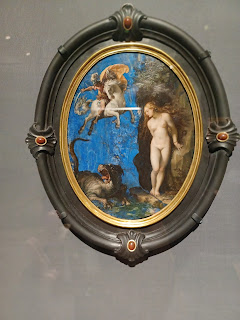
Perseus Rescuing Andromeda

In 2000 the art museum purchased the above painting done by artist Cavaliere d'Arpino.  I love the lapsi lazuli stone which provides the blue background for this painting.  It was this acquisition that caused the impetus for Judith Mann, senior curator of European art to 1800 at the museum, to do additional research which created this current exhibit of stone paintings.

Jesuit Church in Antwerp

The above painting, by Wilhelm Ehrenberg, was done in marble and alabaster.   Marble was the most luxurious stone to be used for paintings and it was used sparingly in Northern Europe by artists.


The Nativity was done by the Spanish artist Bartolome Murillo (1617-82).  The reflectivity of obsidian lends a deeper spirituality meaning to the painting, as noted by the art museum.  Aztecs considered the stone sacred; their empire had been conquered by Spain, through colonization of the Americas. 

I hope that I have given you an appetite to see this exhibit, and even if you do not live in St.Louis, it would be worth a few miles or more down the road.  Congratulations to the St. Louis Art Museum for a job well done!


Friday, February 25, 2022

A Serendipitous Weekend

 Have you ever been faced with what you perceive as a boring weekend?  That was what I thought as John and I packed for a weekend in Farmington, Mo.  His sister Carolyn lives there, and our main reason for going to that town was to visit with her.  Farmington is John's childhood home, and we have visited that town many times over the years- that was where his parents lived until they passed; his sister and some of her family currently live there.  Needless to say, we have seen all there is to see in that small town.  

On Saturday, after we had arrived, his sister informed us that she had recorded a television show which she thought John would be interested in.  After the program started I quickly became engrossed with it.  It was a story about Clint Harp, a woodworker from Texas, who is featured on the show "Restoration Road" (found on the Magnolia Network).  His interest is in restoring old buildings, and he was informed about an old granary, built pre-Civil War, located in Uniontown, Mo.  That town is in southeastern Perry County, Missouri.  The history of the building was that it was built by a German Saxon immigrant.  Uniontown was settled in 1839 by people from Thurigia, Germany.  By the way, the town was originally called Paitzdorf until the Civil War when the Union army had an encampment there.  Hence the name of Uniontown.

Apparently there was some interest in dismantling the granary, moving it to St. Genevieve,Mo., and  building a  cabin out of the logs.  Below is the final result.

No, that was not how the granary looked, it does have a similar shape- the logs were numbered so they could be easily reassembled.  However, a couple of the top beams had to be discarded because they had rotted, and new pine wood logs had to be cut and hand hewn.  Windows and a porch were added.  Also new chinking was needed between the logs- back in the day clay, dirt, silt sand and lime were used.  Today it is made with an acrylic elastic compound.  The door of the granary had a special marking on it, carved there by the immigrant farmer.  Historians call it a hex, s symbol placed there by farmers to protect the grain.  It could have had a religious meaning or perhaps was part of some black magic.  That door was saved in the restoration and used as the door to the bathroom in the log cabin.  An antique door was found for the front door, and surprisingly, the new proprietor had a key in her pocket which fitted neatly into the lock!  It all just came together very well for the new building, even its current location. The porch of the log cabin is pictured below.  The television show did display the interior of the cabin- quite a cozy place!

 Sunday, of what I thought was going to be our boring weekend, we drove south from Farmington for a drive through the countryside.  At our lunch stop in Perryville I suggested that we drive further south to Ste. Genevieve and look for the log cabin.  Fortunately the Welcome Center was open and we received directions to the cabin.  We found the cabin, the sign outside of it indicates it is the Sassafras Creek Cabin ( is a bed and breakfast facility).  This little adventure taught us something else.  We have been to St.Genevieve before, knew that it is the oldest European settlement in Missouri, settled by the French in 1850.  It is an interesting town to walk in, as it has kept many of the older homes.  What we learned this time is that the town now has Saint Genevieve National Historic Park, located near the Sassafras Creek Cabin.  Clint Harp mentioned in the television show that the French built their homes vertically, and he showed the Green Tree Tavern as an example of that architecture.  Within walking distance of the cabin we saw that building.  According to the national park brochure it has been dated to 1790 using dendrochronology.  The Janis family built it and used it as both their home and a tavern and an inn.  It is pictured below.  What an interesting weekend we had!  There are other older buildings, which have been moved to this national park, unfortunately nothing opened for viewing the day we were there.  We hope to return!


Friday, February 11, 2022

Six Mile Cypress Slough Preserve

 This was another interesting place which we visited during our second week in Florida.  It is within Fort Myer's city limits, and is over 3,500 acres of protected wetlands and uplands. It received its name in the early 1900s when travelers in wagons on their way to Fort Meyers would get stuck in a low swampy area (known today as the Slough).  When that happened they knew from experience that it was six more miles to town.  By the way, a slough is a forested wetland with slowly flowing freshwater.  A boardwalk was built over the slough in 1991, and is 1.2 miles in length.  Walking it we passed the largest body of water, called Gator Lake.

There really is a gator in the above picture!   We also passed by Otter Pond, and stood there for awhile looking for otters, but none made an appearance.

What did surprise us was a large water snake, hanging out in the water near the boardwalk.  We also saw a fair number of turtles, anhinga, herons and egrets.  Pictured below is a black-crowned night heron.  I was so pleased that I spotted him, he was a bit hidden.

My next picture here is of a sign I noticed by the bathrooms.  It sure gave me a chuckle!

Our last adventure in Fort Myers was an air boat ride.  In the past an boat ride meant a certain amount of time sitting quietly in a bayou or swamp looking at the wildlife surrounding us.  The air boat ride this time had only the purpose of giving us a wild experience; zipping among many mandrake groves at a rapid speed.  I did not appreciate it at all and felt sorry for the wildlife we were frightening.  And there were two other air boats near us also going at that speed!  Once we even got drenched with a big splash of water.  As we were leaving the boat later I saw a great blue heron sitting quietly in the water.  In the Slough I saw a quote which said: "Falling in love with the earth is one of life's greatest adventure" (Steve Van Matre wrote this, an environmental activist).  I have found, in our travels, that seeing any creature in its natural habitat is an awesome moment for me.


Wednesday, February 2, 2022

Our Second Week in Florida

 All of our family returned to their homes after Christmas, but John and I drove south to Fort Myers, were we took up residence for a week.  We had spent one winter there about 10 years ago, and now had plans to revisit some of the natural areas we had seen before.  There was one exception to that plan, and that was Myakka River State Park.  It has a mailing address of Sarasota, which places it about northwest of Fort Myers.  This park is one of Florida's "oldest and most diverse natural areas", according to the park's brochure.  The Myakka River flows through the park with miles of wetlands, prairies, hammocks and pine lands.  Besides the river, there are two shallow lakes here which attract many wetland creatures.  We saw quite a few of them, and spent a very enjoyable day at this park.

At one of the lakes we saw a large number of pelicans and maybe wood storks hanging out.  Unfortunately we were a good distance away from them, any good identification of them was consequently quite difficult.

Shortly after we were in the park we stopped near a bridge to check out what a few people were staring at.  An alligator was lying in the warm sun, near him were a few water birds.

Mayakka State Park has a canopy walkway and tower, part of which is pictured above.  It is necessary to climb 70 feet to reach the walkway. I just had to take a picture of John once we arrived at the top. I could not help but appreciate the fact that John seemed to climb that distance upwards effortlessly, not bad for a man who just turned eighty!

The next day we revisited a favorite park of ours, which is Corkscrew Swamp.  Unfortunately there was a dearth of animals and birds.  We did see what looked like a hawk up in the trees, however it was all white.  A park volunteer explained to us that it was a red shoulder hawk and that some birds in Florida loose their coloration during the winter months.  

One wonderful feature of Corkscrew Swamp is the old growth forests stretching back 5,000 years.  Pictured above is the Calusa tree, host to the endangered Ghost Orchid.  John and I were fortunate to see it blooming on our first visit to this swamp.

We left this park disappointed that we had not seen the birds and alligators here which we had seen in previous years.  But wait!  What was that sound rustling above us as we walked to our car?  Can you make out what that is in the picture above?  As best we could figure out it was a racoon.   Corkscrew swamp had not totally disappointed us!


Friday, January 28, 2022

Family December Celebrations in Florida


We finally arrived at our Florida beach house, pictured below.


The house is just a few blocks from the beach located on the Gulf of Mexico.  We only had a few blocks to walk to it, and with planning John's birthday party, setting up for Christmas, we only were able to take small amounts of time to spend at the beach.

It was a wonderful party for his 80th birthday, with little over twenty in attendance.  We had a delicious Italian catered meal for the occasion.  What made it especially special was that we as a family were all together, which had not happened in a couple of years.  Mike came in from Los Angeles, Dan and Amanda from D.C., as well as Melissa, Spencer and their three children.  Also my sisters, Linda and Julia, flew in to celebrate with us.  We had not been able to see them either for a couple of years.  And yes, we all were tested for the covid virus.

On one of our walks outside I could not help but notice a flowering tree decorated for Christmas.  The sun was shining on it, which already added beauty to it, and then there were the Christmas decorations; white snowflakes on the tree and a Santa standing below it.  Christmas always seems strange in Florida.  The same can be said for the decorations in the main room of our rented house.  We kept the crepe paper bunting, for which we put up for the birthday party (strangely red and black), in place for Christmas.

Someone stuck a metal crane (lawn decoration gift) in the plant, and then the crepe paper decoration above it seemed to give a right feel for our celebrations that week!  Yes, we did have a beautiful decorated Christmas tree, but for some reason it seemed more fitting for me to take the above picture to sum up our week!  Strange but good.

A couple of days before Christmas we walked through Largo City park which was lit up with many Christmas lights and decorations- we have enjoyed doing that in past years.  As we were headed out of the park the Grinch stopped to talk to our grandchildren.  Nathan, the oldest, would have nothing to do with him because "he stole Christmas".  However, Sammy, our youngest grandchild, was totally fascinated by the strange man.

Christmas day was a big party all day.  There were many gifts to be unwrapped, especially by the grandchildren.  We had a few guests for our Christmas dinner, and then Spencer and Melissa, with their children, took leave to spend the rest of their Florida vacation with his family.  John and I, along with Mike, Dan and Amanda, walked to the beach to watch the sun go down.  It was a good ending for our Florida Christmas.


Wednesday, January 26, 2022

Our Christmas Trip to Florida

 Time for another road trip!  It probably would not have happened had John not had his 80th birthday December 21st.  Our daughter Melissa and I cooked up a plan to give him a party in Florida, so we rented a beach house big enough to hold all of us- her family, as well as our sons Mike and Dan as well as Dan's wife Amanda.  Fortunately we found a place south of Clearwater, on the Gulf of Mexico.  It was conveniently located fairly close to Melissa's in-laws (they reside in Dunedin Fla.); she and Spencer needed to spend some of their time with them also.  We planned to stay in the beach house through Christmas, and for that holiday it was important that the grandchildren split their time between both sides of their families.

It was on the second day of our journey south that I decided to start taking pictures to share with you all.  Our stop that evening was in a motel located by Lake Eufaula, on the Chattahoochee River.  To be more precise, we were on the southwest border of Georgia, and the southeast edge of Alabama.  The next day we would be traveling through Florida. 

We had plan to spend a day in Tarpon Spring,s Fl. before continuing on to our final destination.  We had been to this town before and appreciated its history, as well as the shops and restaurants. It also has one particular park which we enjoy visiting, Whitcomb Bayou, where the springs are located (after which the town is named- tarpon is the name of a fish caught in the local waters).   As we began to walk around the bayou I heard a ticking sound- a noise which sounded like a traffic crossing alert which allows pedestrian to walk across a street.  I glanced around, but no traffic light seen.  I then looked up and saw the osprey on top of an electric pole.  First time I had ever heard any sound from an osprey!  According to my bird book they make the sound similar to whistled kyew notes.  Not too sure if that is what I had heard!


Whitcomb Bayou park is the location every Epiphany for the diving of the cross, an event sponsored by St.Nicholas church ( Greek Orthodox).  The statue above is located outside of that church- it is of a young boy who has just victoriously found the cross under the waters of the springs.  At that time of the year it is a cold dive for sure!

Surrounding the park are large Victorian homes like the one pictured above.  A sign nearby notes that that home is called "Annecy of the Bayou", built in 1885 and restored 1976.

From the bayou John and I drove into the town and walked over to what is called the Sponge Docks.  This town is known as the "sponge capital of the world".  Early Greek immigrants to this town on the Gulf settled here because of the opportunity to continue sponge harvesting, which they had done back in their home country.  Pictured above is the "Susie Sea".  You may notice the pile of brown sponges loaded on her deck.  Recently the town had a Christmas parade of boats, looks like the Susie Sea still is decked out with her Christmas finery!


Thursday, September 9, 2021

Two Treasures of South Dakota

 Well I am not sure everyone would agree that the two places I am mentioning here would be considered treasures, because the Badlands in that state should get a higher rating from tourists passing thru South Dakota.  What I am going to tell you about here is what some people call "tourist traps.  I am referring here to Wall Drug, and the Corn Palace.  Each are located in a southern corner of the state, Wall Drug in the western and the Corn Palace in the eastern.

We have been to Wall Drug store several times.  This was one time we just did not have much desire to explore it as extensively as we did in the past,  primarily because there was a heavy crush of people.  Very few people were wearing masks.  In case you know nothing about this store, it did start out as the only drug store in Wall, South Dakota.  The owners, Dorothy and Ted Hustead, at first were getting very little business (there was the depression going on in 1931, and a drought).  Then Dorothy got the idea in the summer of 1936 to have the store give out glasses of cold water.  That brought the people in, and the store expanded with other stores, a Western art gallery and dining areas.  A big attraction for many people are the life-size statues of people sitting on benches outside of the stores.  One that many men especially seemed to like is the statue of show-girl- I did not get a picture of her because she was kept busy with men hugging her.  I did get a picture of a little old lady playing cards.  Looked like she was waiting for someone to play a card!

Strangely, while wandering around in the different stores, I found a chapel.

Imagine having a wedding at Wall drug store!  Well, I could not see that as a destination wedding.  We had lunch and I found a drug store in the complex to purchase some Advil.  We moved on east and made a stop at the Corn Palace in Mitchell, South Dakota.  We have also visited that building several times in the past.  That place really is not a tourist trap, but just a fascinating stop.


The Corn Palace is having its 100th anniversary this year!  Actually in the present building for that long- all total it has been 128 years.   The building has been redecorated every year with a different theme, this year it is "come and play". Thirteen different shades of corn are used to complete each picture.  About 325,00 ears of corn are sliced  lengthwise and carefully nailed into place.  Different grasses, as rye and sour dock, are used for the trim work.  In the picture below you can get a close up of the decorative mural celebrating the building's anniversary. 


We wandered around the inside of the building (munching popcorn of course) where there are many interpretive signs explaining the history of the building and the the process by which different artists through the years have been able to make the murals using corn.  The process is best described as "corn by number".  The city pays about one hundred thirty thousand dollars a year for different corn murals to be placed on the outside of the building.  The large hall on the main floor inside has been used for basketball games as well as stage shows.. So the building besides being decorative is quite useful!

Main Hall inside the Corn Palace
This concludes my postings of our trip out west, sometime the miles were long and a bit boring- but all in all it was a very enjoyable trip!


Tuesday, September 7, 2021

Surprise in Sundance, Wyoming

When we drove into Sundance we were looking for a motel.  Strangely, most of the motels were full, but we were finally able to obtain a  room.

The streets of the town were empty.  We asked the motel clerk where all the towns people were.  He informed us that the Crook County Fair was going on at present and that almost everyone were there.  Next we needed supper, and there were not many restaurants in town open to choose from.  We lucked out again and found one.  We decided that after all the cattle we had been seeing, it was time for a steak meal..


Sign above John says: "The West Needs More Cowboys".   I don't think John would qualify.   After supper we felt in need of a good walk.  What a surprise when we came upon Sundance Square (just built in 2020), a lovely park with a bit of history to share with us.

Sundance Kid
 The Sundance Kid, Harry Longabaugh, served time in the local jail and took his name from the town.  He put in 18 months there for stealing a horse, the only time he was in any jail.  After leaving Sundance he became notorious for bank robberies and a train heist.  


Sundance Jail, circa 1800s

Besides the sculpture of the Kid, there were these large photographs in the town square.  We noticed that besides Harry Longabaugh, Butch Cassidy was also in the picture.  I was surprised, I thought the pictures would be of the town founders!    It was a Prussian-born immigrant who staked his claim in 1879 and named the town Sundance.   He gave that honor to the Native Americans and the sun dance they performed on both Sundance and Imyan Kara Mountains.  Before I end this posting I will share with you an interesting plant which I found in the square.  I don't think I have seen this plant ever, or at least if I did I did not know what it was!

catnip


Sunday, September 5, 2021

Wyoming

"Welcome to Wyoming, don't do anything stupid".  I found that comment in my notes of our travels; it was a statement I saw on a road sign after we entered the state.  I did not notice whether that was an official state highway sign or not.  Maybe that rates right up on the top of my list with  the other strange sign which I saw: "celebrate freedom, get a gun".  That one was not in Wyoming

Devil's Tower

One of our goals while driving through Wyoming was to see this large rock formation again.  Maybe it was about the third time we have viewed it.  According to the park brochure it has the longest, largest rock columns in the world.  The columns range from four to seven sided.  Formed 50 to 60 million years ago, it grew by magmatic activity (meaning by molten rock pushing up through rock layers) and erosion.  Over time the Belle Fourche River carved away the older rock layers revealing the hard rock of the tower. The tower rises 867 feet from its base.  It is known as "Bear Lodge" by North Plains Tribes. It is important in their belief systems and sacred narratives,  and has a important place in their spiritual life.  Still today Native Americans make prayer offerings, seek visions and perform the annual Sun Dance.  For that reason, the Towers was eligible for  listing on the National Register of Historic Places as a Traditional Cultural Property. 

The Bel Fourche River also carved away "red beds" which surround the tower.  Those red rocks are part of the Spearfish Formation- which can be seen in the Black Hills of South Dakota, also in North Dakota, Wyoming and Montana.  They are oxide-rich layers of siltstone,shale and sandstone.
On our road trips out west we always look for pronghorn antelope, mule deer, and prairie dogs.  We did not see the pronghorn, saw one mule deer and a colony of prairie dogs.  A pull-out off the highway was provided and I snapped away until I finally got one to sit still!   These are not dogs, but a type of ground squirrel.  The black-tailed prairie dog has the widest range and is found throughout western United States, from Canada to Mexico.


Friday, September 3, 2021

Native Americans and Montana

Before leaving the topic of the Little Bighorn Memorial, I have one more necessary detail to add. The leader of the Native American warriors on June 25, 1876 was Chief Sitting Bull, warrior and statesman. He was the spiritual leader of the Lakota tribe who thought it important that his people keep their traditional way of life.  We found a quote from him on one of the interpretive signs at the memorial: "you are fools to make yourselves slave to a piece of fat bacon, some hard-tack, and a little sugar and coffee".  After the battle of Little Big Horn he continued for awhile to lead several bands of Sioux and Cheyenne in skirmishes against the United States. Another item which I want to mention here is that the theme adopted by the Native Indians for their memorial was:- "Peace through Unity". 


The rest of our journey through Montana took us through Native American reservations.  One town is named Lame Deer, located on the North Cheyenne Reservation.  We went slowly through the town, but along the main route through town we saw no park, or even the sight of any fast food places.  One gas station had food to offer- but that was only fried offerings.  We were carrying our own supplies for a picnic.  Before leaving Lame Deer we saw an interesting mural, however.

We also noticed a sign pointing the direction to Chief Dull Knife community college.  Interestingly enough, after we arrived home we saw an article in the paper mentioning that a forest fire had come near the town Lame Deer.  We just thought it so neat that a small town in Montana, mentioned in the paper, was a town which we had just traveled through- and we are quite happy for the town's people that the forest fire was stopped before reaching it!

So here was our lunch spot, just a picnic table by the side of the road in the town of Ashland-  located east of the of the North Cheyenne Reservation boundary, and not very far from Lame Deer.  How sad for these small reservation towns, lacking any shady type of parkland or even playgrounds.  But they are small towns- Lame Deer has a population of around 2,000 and Ashland 464.  Small shacks or trailers dot the land, this speaking to the apparent poverty found in these areas.  I also found the names of Lame Deer and Chief Dull Knife intriguing, but discovered later that those were the name of important Native Indian leaders.


Thursday, September 2, 2021

Battle of Little Big Horn

 Traveling through Idaho, and then Montana, we encountered a few hazy days when we did not see much of the sun.  At one point we could smell the forest fires, which were some distance away.  And one morning we found ash on the hood of our car, which caused me to think that we were perhaps not as far away from the fires than I thought!  The picture below can give you an idea of how hazy the sky was.  After we got home and I looked at the pictures, I at first wondered why so many of my pictures of Montana looked so poor and a bit dark- I then realized that I had the forest fires to thank for that!

The Battle of Little Big Horn took place on June 25th, 1876.  Shortly after we arrived at the memorial site we encountered a group of tourists who were avidly listening to a park ranger tell of what has become known s "Custer's last stand".  The park ranger did a very dramatic recitation of the story, soon John and I also became mesmerized and listened to the details of that dreadful battle.  Later I picked up a park brochure which gave information on what events led to that confrontation.  In 1874 gold was discovered in the Black Hills, the heart of a new Indian reservation in eastern Wyoming.  The army tried to buy the Black Hills back from the Indians and failed.  The Lakota and Cheyenne left the reservation and began raiding parties on settlements and travelers.  In December 1875 the Indians were ordered to return to the reservation before Jan. 31, 1876, or be treated as hostiles by "military force".  The battle at Little Big Horn was the army's campaign against the Lakota and Cheyenne.  Some of what happened in June of that year has been told by Indians, as Kate Bighead.  The Lakota,Cheyenne and Arapaho (approximately 7,000 of whom 1,500 to 2000 were warriers) were camped by the river called Little Big Horn (in an area located in southeastern Montana).  Several women were digging wild turnips, while their children were seeking relief from the afternoon heat in the river.  Men were sitting and smoking.  In the distance a dust cloud was arising, and the shout arose that "Soldiers coming.Plenty white soldiers".  Soon women and children were screaming.  Old men were calling young men to battle.  It was the 7th Calvary of the army which had discovered the presence of the camp, led by General Custer.  He did not realize the size of the Indian presence and had divided his regiment into three battalions.  It was one of those battalions that raided the Indian village; they retreated when they saw that they were out numbered.


Site of Custer's Last Stand
There are many more details of the 7th Calvary movements on that fateful day, which I will not go into.  What happened during the course of that day is the stuff of legend and has become known as "Custer's Last Stand".  With 250 men under his command Custer was surrounded by the Indians and destroyed.  At the location of his last stand he and approximately 41 of his men shot their horses for breastworks, to no avail.  A total of 262 men were killed and 52 wounded.  The Indians lost no more than 100.  Red Feather, a Lakota Indian, commented that  "It was a terrible battle..a hard battle- both sides were brave warriors".

In 1988 two Native American groups pressured the National Park Service to give equal recognition to Native Indians who died at this battle site.  This prompted Congress to pass legislation authorizing a construction of a memorial for the Indians, which President G.Bush signed into law in 1991.  The theme of the memorial is "Peace through Unity".  It acknowledges the need for cooperation between Indian tribes and the federal government.
Public Law 102-201 redesignated Custer Battlefield National Monument as Little Bighorn Battlefield National Monument and approved establishment of a memorial to recognized Native Americans who participated in the battle.