Santa Fe is about 40 miles northeast of Albuquerque. We felt that there was a lot to be seen in the capitol city so we made the trip yesterday. Our entire day was pretty much spent walking around the older section of Santa Fe, which we found to be somewhat similar to old Albuquerque's town square,although much bigger. In that section there are historic buildings and museums, among which include several Catholic churches. Santa Fe is sometimes called the Royal City of the Holy Faith, translated into Spanish it is referred to as La Villa Real de la Santa Fe de San Francisco de Assisi. I will first start here with San Miguel Mission, the oldest church in the United States. At the time of its construction the old Santa Fe trail passed in front of it. It was built in 1610, when the town was founded. Part of the structure was damaged during the Pueblo Revolt of 1680, but it was rebuilt after the Spanish reconquest in 1692.
The Cathedral Basilica of St.Francis of Assisi is also in the older section of town. The congregation was established also in 1610, but the building itself has been rebuilt a couple of times. I really liked the baptismal fountain and pool which located in the center of the nave. The font is located on an axis between the church doors and the altar to remind us of our baptismal journey. The pool is cruciform in shape.
It was through the initiative of Archbishop Lamy in 1875 that the cathedral was expanded from a simple adobe building into the large stone structure which it is today. He is buried in a crypt below the cathedral floor. His name has become famous by the book Death Comes to the Archbishop written by Willa Cather in 1926. The last church I want to mention here, the Loretto Chapel, has a circular staircase which is a marvel of beauty and construction. The top of the staircase rests against the loft at the top and on the floor at the bottom where its entire weight seems to be supported. It has no center support and has 33 steps and makes two complete 360 degree turns. It has been the subject of a book and movie.
Saturday, October 29, 2011
Friday, October 28, 2011
Albuquerque, New Mexico
The above picture is of the main street of Raton, New Mexico, a few hours before their first major snowfall. The day before, Tuesday, we had left Denver about 12 hours before the first snowfall of the season had arrived there. We drove from Denver southwest into New Mexico over the Raton Pass, and about two days later that pass was covered with snow and ice. Wednesday morning we had some light snow showers in Raton and fortunately drove out of there before the heavier snow storm arrived. We made it to Albuquerque Wednesday afternoon where, most fortunately, we only encountered rain. Albuquerque lies in a big valley between the Sandia Mountains and sweeping plateau country. Yesterday, Thursday, we toured the old town of Albuquerque which in the late 1600s was the heart of the business district. St.Felipe Catholic church dominates the town square there, the parish had its beginnings in 1706. The building has been reconstructed several times. We toured the church, and was surprised to find that it is quite small inside
There were many little shops around the town square, however many Native Americans had their wares on display outside of the shops. Most of of the items on sale were turquoise jewelry
In the Turquoise Museum, located near old town, we learned that many Native Americans purchase the semi-precious gem from China to make their turquoise jewelry. It is cheaper to buy turquoise from that country as the labor needed to mine it is less expensive. Another nugget of information we learned about the gem is that word turquoise means "of Turkish origin". During the middle ages Europeans who bought the gem from Turkish traders thought that the gem came from Turkey, but in reality the traders had obtained it from Persia. The rest of our afternoon in old Albuquerque was spent in the Turquoise Museum, where there are samples of that gem from around the world, in its raw state as well as a finished product.
There were many little shops around the town square, however many Native Americans had their wares on display outside of the shops. Most of of the items on sale were turquoise jewelry
In the Turquoise Museum, located near old town, we learned that many Native Americans purchase the semi-precious gem from China to make their turquoise jewelry. It is cheaper to buy turquoise from that country as the labor needed to mine it is less expensive. Another nugget of information we learned about the gem is that word turquoise means "of Turkish origin". During the middle ages Europeans who bought the gem from Turkish traders thought that the gem came from Turkey, but in reality the traders had obtained it from Persia. The rest of our afternoon in old Albuquerque was spent in the Turquoise Museum, where there are samples of that gem from around the world, in its raw state as well as a finished product.
Monday, October 24, 2011
Denver Botanical Gardens
This garden is one of the top-ranked botanical gardens in the nation. Fortunately for us winter has not done its damage there yet. Many of the plants are at the end of their blooming, but we still found some awesome beauty in the garden when we toured it Friday. We had only a couple of hours to see the gardens before we were due at a bridal shop for our daughter Melissa's first appointment of the week-end. She had flown in early Friday morning to spend the week-end with us and her cousin Heather. I was surprised to discover at the gardens that there is an autumn crocus. That plant is pictured below, it caught my attention as it looked so pretty nestled among the lamb's ears foliage.
Denver Botanical Gardens currently is displaying the work of modernist Allan Houser, called Native Roots. It features Native American plants and peoples. Pictured below is a sculpture which has the title of Morning Prayer. Around the figure are prairie grasses, of which a beautiful variety of them can be found in the garden.
As I mentioned in an earlier posting, the autumn colors here in Denver have been stunning. Below is a picture of that beauty in the botanical gardens. The warm sunny day also added to our enjoyment of the garden.
While in Denver I have also found a lot of joy in just seeing the Rockies off in the distance. I searched for a place where I could get a picture of their snow-capped peaks plus some autumnal beauty. Yesterday, after church, I finally found just the location in a park. Tomorrow night snow is in the forecast for Denver. We do plan to head south tomorrow morning, well ahead of winter's first blast of cold and snow.
Denver Botanical Gardens currently is displaying the work of modernist Allan Houser, called Native Roots. It features Native American plants and peoples. Pictured below is a sculpture which has the title of Morning Prayer. Around the figure are prairie grasses, of which a beautiful variety of them can be found in the garden.
As I mentioned in an earlier posting, the autumn colors here in Denver have been stunning. Below is a picture of that beauty in the botanical gardens. The warm sunny day also added to our enjoyment of the garden.
While in Denver I have also found a lot of joy in just seeing the Rockies off in the distance. I searched for a place where I could get a picture of their snow-capped peaks plus some autumnal beauty. Yesterday, after church, I finally found just the location in a park. Tomorrow night snow is in the forecast for Denver. We do plan to head south tomorrow morning, well ahead of winter's first blast of cold and snow.
Saturday, October 22, 2011
Lariat Loop Scenic Byway, Colorado
We are now parked just outside of Denver in Englewood. And I am very happy that a hard frost has not hit this area yet. Fall foliage is seldom seen this late in the year here in Colorado. Oaks and aspen leaves are just turning, primarily we are seeing trees which are a brilliant yellow in color. Those trees can be seen in the picture below, that picture was taken just outside of Coors Brewery, which we toured Thursday.
Coors Brewery is in Golden, Colorado on the Lariat Loop highway. The scenic highway is described as "40 miles of western adventure". Our first stop along this drive was at Red Rocks Park and Amphitheater. The red rocks are towering 400 feet sandstone formations. The rocks provide the best musical acoustics in the world, musical groups started performing there in the late 19th century. Locals say that actually it was used earlier than that by the Ute Indians for their dances. In the 1940s the Civil Conservation Corps built an actual theater among the rocks. From the highest level of this amphitheater we had a good 200 mile panoramic view of Denver. The park is in an area where the Great Plains meet the foothills of the Rockies.
Sadly most people only know of the park as a place for concerts. It is also 868 acres of park land where many wild animals roam, including mule deer which we saw casually roaming around the parking lots of the theater. Many years ago dinosaurs also roamed here, Dinosaur Ridge was our next stop. At the Ridge we took a guided tour to see the fossilized bones and tracks of those ancient animals. In the picture below is one of the fossilized dinosaur's tracks, pointed out to us by our very knowledgeable guide.
Three hundred plus dinosaur tracks and a dinosaur bone quarry are on the ridge, all representing five different time periods in the Age of Dinosaurs. Our day on the Lariat Loop ended at Lookout Mountain where Buffalo Bill's museum and grave is located. After seeing those places we headed back to the city so we could listen in on a rehearsal of the Broke Bridge Band, in which our niece Heather performs with her singing and fiddle. The band plays some awesome bluegrass music! It was a perfect ending to our very long day.
Coors Brewery is in Golden, Colorado on the Lariat Loop highway. The scenic highway is described as "40 miles of western adventure". Our first stop along this drive was at Red Rocks Park and Amphitheater. The red rocks are towering 400 feet sandstone formations. The rocks provide the best musical acoustics in the world, musical groups started performing there in the late 19th century. Locals say that actually it was used earlier than that by the Ute Indians for their dances. In the 1940s the Civil Conservation Corps built an actual theater among the rocks. From the highest level of this amphitheater we had a good 200 mile panoramic view of Denver. The park is in an area where the Great Plains meet the foothills of the Rockies.
Sadly most people only know of the park as a place for concerts. It is also 868 acres of park land where many wild animals roam, including mule deer which we saw casually roaming around the parking lots of the theater. Many years ago dinosaurs also roamed here, Dinosaur Ridge was our next stop. At the Ridge we took a guided tour to see the fossilized bones and tracks of those ancient animals. In the picture below is one of the fossilized dinosaur's tracks, pointed out to us by our very knowledgeable guide.
Three hundred plus dinosaur tracks and a dinosaur bone quarry are on the ridge, all representing five different time periods in the Age of Dinosaurs. Our day on the Lariat Loop ended at Lookout Mountain where Buffalo Bill's museum and grave is located. After seeing those places we headed back to the city so we could listen in on a rehearsal of the Broke Bridge Band, in which our niece Heather performs with her singing and fiddle. The band plays some awesome bluegrass music! It was a perfect ending to our very long day.
Monday, October 17, 2011
Goodland, Kansas
We are now parked outside of Goodland, Kansas. Its biggest claim to fame is that, as of 2002, it is the place of a 24 foot by 32 foot reproduction of Van Gogh's Sunflowers, created by a Canadian born Cameron Cross. The reproduction stands on an 80 foot high easel. The artist has plans to place reproductions of Van Gogh's seven different sunflower paintings on the seven continents; so far he has placed one in Canada, Australia, and now in Kansas. Kansas was chosen for the site because of its large sunflower fields.
Coincidentially, I just finished reading Sunflowers by Sheramy Bundrick. It is a fictional story of the last two years of Van Gogh's life as seen through the eyes of a young prostitute. The book has many references to the artist's sunflower paintings ( they were a favorite of his mistress Rachel, according to the story line), so I was thrilled to see one of those reproductions here in Kansas. Pardon me now if I jump to another subject entirely. Yesterday John and I had the wonderful experience of attending Goodland United Methodist church. The call to worship for the service adapted a quote from Steve Jobs: "Out time is limited, so lets not waste it living someone else's life... don't let the noise of other's opinions drown out your own inner voice...Let us have the courage to follow our heart and intuition.God is at work beyond all our imagination". Pastor Dustin Petz pointed out in his sermon that Goodland Methodist needs to find a way to reach out to the younger people of Sherman County. The average age of the surrounding community is 35 years, while that of the congregation is 54 years of age. It was the first time John and I had seen a pastor whip out an iPhone to read from the Bible. That was a very good object lesson to demonstrate the point of his sermon!
Saturday, October 15, 2011
Monument Rocks
These rock formations are about 20 miles southeast of the town of Oakley. Just before turning off the dirt road, which leads to the formations, we stopped at an old restored stone building. A sign by the road said it was the Keystone Gallery, an art gallery/fossil museum. I grumbled a bit about making the stop, as I just wanted to see Monument Rocks. It turned out to be a very informative stop, however! Barbara Bonner, who owns the museum with her husband Chuck, greeted us warmly and was very eager to share with us their stories of fossil hunting in the surrounding area. The land having the fossils covers two counties of Kansas. We saw some of their collection of fossilized ancient fish which they have found over the twenty some years they have had their museum. Chuck's primary occupation is painting and his work is also displayed in the museum. Barbara and I also discovered that we both have sons, of of the same age, out on the west coast and in the gaming industry. Despite that rather long stop we did make it out to the rock formations. The wind-carved and water-eroded limestone towers average about 70 feet in height. The site can be described best as a many layered ancient Cretaceous seabed sitting on a semi-arid plain.
Weathering has exposed many marine and reptilian fossils in these rocks. While walking around the formations I could find many small rocks on the ground with clam shells embedded in them. We also visited the Fick Museum in Oakley on Friday where some more marine fossils are on display. Paleontologists have been able to remove large pieces of rock with the skeleton of the ancient marine creatures still embedded in them.It is quite an involved process to remove the fossilized limestone and then to mount it for study and display. On exhibit in the museum is xiphactinus audax, which is figured to have been about 16 feet long. He is similar to modern day Tarpon . The fish was collected and prepared by paleontologist George Sternborg.
Also on display in the museum are 11,000 shark teeth, as well as many other fossil artifacts. Vi Fick, wife of the paleontologist Ernest Fick, created a lot of fossil folkart using such materials as fish vertebrae and oyster shells. Indian artifacts are also on display on the museum. Native Americans used the fossils to make jewelry as the crinoid necklace pictured below. Crinoids are marine invertebrates as sea lilies and feather stars.
It was quite a fascinating museum with a wide variety of local memorabilia and artwork. I will close off this posting with one more picture of the Monument Rocks.
Weathering has exposed many marine and reptilian fossils in these rocks. While walking around the formations I could find many small rocks on the ground with clam shells embedded in them. We also visited the Fick Museum in Oakley on Friday where some more marine fossils are on display. Paleontologists have been able to remove large pieces of rock with the skeleton of the ancient marine creatures still embedded in them.It is quite an involved process to remove the fossilized limestone and then to mount it for study and display. On exhibit in the museum is xiphactinus audax, which is figured to have been about 16 feet long. He is similar to modern day Tarpon . The fish was collected and prepared by paleontologist George Sternborg.
Also on display in the museum are 11,000 shark teeth, as well as many other fossil artifacts. Vi Fick, wife of the paleontologist Ernest Fick, created a lot of fossil folkart using such materials as fish vertebrae and oyster shells. Indian artifacts are also on display on the museum. Native Americans used the fossils to make jewelry as the crinoid necklace pictured below. Crinoids are marine invertebrates as sea lilies and feather stars.
It was quite a fascinating museum with a wide variety of local memorabilia and artwork. I will close off this posting with one more picture of the Monument Rocks.
Friday, October 14, 2011
Oakley, Kansas
The town of Oakley is not named after Annie Oakley, the cowgirl sharpshooter turned entertainer. She joined Bill Cody's Wild West Show in about 1886. Before Wild Bill Cody started his Wild West show he was a military scout working out of Fort Hayes, Kansas. In 1886 he and his partner Nate Salsbury loaded up their Wild West Show on the S.S.Nebraska and headed for England. They took quite a menagerie with them; 18 buffalo, a small herd of longhorn cattle, 200 horses and 12 elk. The show toured Europe for 10 years. Annie Oakley, the star of the show, was with them from 1885-1902. My posting today is not only about cowboys, but also of Native Americans. Our second stop of the day yesterday was at Battle Canyon.
The site of this Native Indian battle is advertised as the place where the last officer was killed in military action in Kansas. There is ever so much more to the story which speaks to a desperate situation that led to this battle. In 1878 a group of Northern Cheyenne chose to leave their reservation in Oklahoma because of the lack of food and malaria which was depleting their people in large numbers. The Cheyenne, which included 94 warriors, 120 women and 141 children, escaped the reservation. In that group was a squaw of General Custer and their son. The Native Indians were chased by the military to a canyon in Kansas. Here the Cheyenne women and children hid in the natural cave at the end of this dog-leg canyon, now know as Battle Canyon. A battle ensued until darkness fell and the soldiers retreated to re-group. The Cheyenne escaped in the middle of the night, leaving their pack horses laden with supplies and their lodge fires still burning. About one half of them did reach their northern destination, the other half were eventually captured.
Wednesday, October 12, 2011
Our Last Day in Lindsborg
Our plan was to leave this area on Monday. However, we recently learned that our daughter Melissa will be in Denver later this month and consequently we now are in no rush to get there. We do have a concern about the weather as it is getting cooler even out here in Kansas. Hopefully the snow will hold off for awhile yet in Denver! We also felt that there is a lot more in the town of Lindsborg to explore. Our first stop today was about one mile outside of the town at the Hoglund Dugout. In 1868 a young couple from Sweden, Gustaf and Maria Hoglund, created their first home in a 6ft.x12 ft. pit. During their first summer they used their wagon as a roof. It was hard for me to comprehend living in that small of a space with no windows!
In Lindsborg, after wandering through many of its fine small shops, we walked over to the Red Barn Studio. From 1945-1991 it was the home and studio of Lester Rhymer. When he married his wife Ramona her parents gave them several buildings, two of which were a livery stable and a wash house. He combined them into one rather large rambling building, adding a breezeway in the process. With extensive decorative touches he ended up with one awesome building.
Rhymer's house and studio proved to be a very intriguing place to tour. It is filled with his paintings, original prints, sculptures, ceramics, jewelry and furniture. Every year for Christmas he made his wife elaborate wooden toys with operating parts, they also are on display in the home. He also worked with fabric, even making a quilt. He usually worked only with recycled materials, finding them in the town dump or at auction sales. He twisted and crimped aluminum scrap to make decorative art objects. Below is a picture of the courtyard of the Rhymer home which shows some of his woodcarvings. The artist also created the ceramic tile on the brick wall which depicts the sun, a common theme in a lot of his artwork.
After touring Rhymer's art studio we walked the Valkommen Trail, a paved walking path around Lindsborg with historical markers. At the site of the water and power plant there is an interpretive sign explaining how charges for electricity and water were calculated during the early part of the twentieth century. The customer was charged by the light bulb; one dollar for two light bulbs monthly. Water cost six dollars for one faucet, and one dollar was charged for every additional faucet. Annual charge for a bathtub was three dollars.
In Lindsborg, after wandering through many of its fine small shops, we walked over to the Red Barn Studio. From 1945-1991 it was the home and studio of Lester Rhymer. When he married his wife Ramona her parents gave them several buildings, two of which were a livery stable and a wash house. He combined them into one rather large rambling building, adding a breezeway in the process. With extensive decorative touches he ended up with one awesome building.
Rhymer's house and studio proved to be a very intriguing place to tour. It is filled with his paintings, original prints, sculptures, ceramics, jewelry and furniture. Every year for Christmas he made his wife elaborate wooden toys with operating parts, they also are on display in the home. He also worked with fabric, even making a quilt. He usually worked only with recycled materials, finding them in the town dump or at auction sales. He twisted and crimped aluminum scrap to make decorative art objects. Below is a picture of the courtyard of the Rhymer home which shows some of his woodcarvings. The artist also created the ceramic tile on the brick wall which depicts the sun, a common theme in a lot of his artwork.
After touring Rhymer's art studio we walked the Valkommen Trail, a paved walking path around Lindsborg with historical markers. At the site of the water and power plant there is an interpretive sign explaining how charges for electricity and water were calculated during the early part of the twentieth century. The customer was charged by the light bulb; one dollar for two light bulbs monthly. Water cost six dollars for one faucet, and one dollar was charged for every additional faucet. Annual charge for a bathtub was three dollars.
Monday, October 10, 2011
Smoky Hill River Valley of Kansas
The Swedish festival of Lindsborg ended Saturday, but yesterday we were treated to more of the culture at Bethany Lutheran during the Sunday services. A children's choir, with the children in their Swedish garb, sang "Children of the Heavenly Father" in Swedish. It is wonderful that the town and its people still holds onto its heritage after 140 years! The town of Lindsborg was settled by Lutheran Swedish immigrants in 1868. By 1881 the citizens had started up Bethany College. On Saturday we stopped at the college and its campus church, Messiah Lutheran (daughter church of Bethany). Messiah has five sets of beautiful stained glass windows designed by Eldon B. Swensson, a church member. Below is a picture of one of them which has the title "Messiah's Path of Light". In the picture are Bethany's steeples as well as the Bethany College dove.
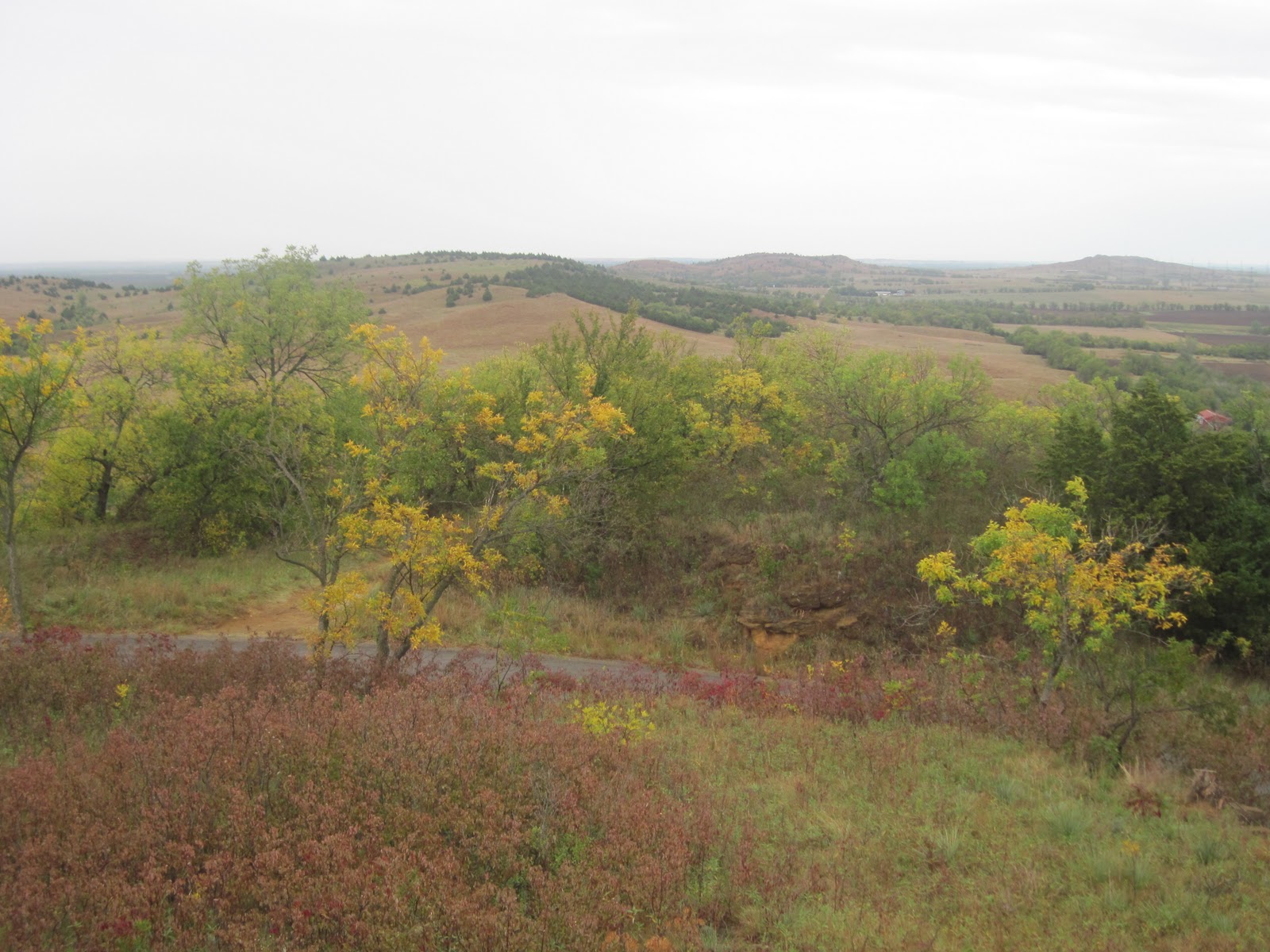
The first immigrants of Lindsborg settled in the fertile river valley of the Smokey River, pictured below. We took in the beautiful autumnal view of this valley and its surrounding wheat fields at Coronado Heights. In the 1930s the Works Progress Administration built a castle on this hill to serve as a picnic area and park. In the 1950s a professor from Bethany College found Spanish chain mail a few miles southwest of the park and hence the park was renamed Coronado Heights. It is thought that perhaps the legendary explorer, Francisco Vasquez de Coronado passed through the Kansas Smoky Valley in the 1541.
Sunday, October 9, 2011
Lindsborg, Kansas
It was a wet day yesterday, with continuing winds of up to 30 miles an hour. We still managed to have a great day in the town of Lindsborg. We knew there was a festival going on in the town, but we did not know the particulars. As it happened, we were most fortunate to attend the town's biennial Hyllningsfest. This festival, which honors the first Swedish pioneers of the town, has been occurring every odd year since 1941. During the year of Hyllningsfest the local schoolchildren learn Swedish dances in their general music classes. These performances, as well as other musical offerings, were a part of the festival which we enjoyed yesterday.
The teen dancers were accompanied by fiddle players. One of the girls played a nyckelharpa, a Swedish musical instrument. I found out later that it is a "keyed fiddle". In the picture of the musicians below the girl with the nyckelharpa is at the end, on the right.
Everything Swedish was a part of the festival; besides the musical presentations there were also arts and crafts and Swedish foods. While wandering through the festival we also got in a tour of the town. We had read somewhere that the town has 47 works of art in the form of sculptures, wind vanes, murals, iron works and tiles. Counted in that number are 29 wild Dalas. It is perhaps Sweden's best-known icon, a bluntly-rounded, tail-free horse which had been first whittled out of wood. It is a symbol of identity and welcome.
We stopped at Bethany Lutheran church as it is one of the historic buildings of Lindsborg. Too our pleasant surprise we happened to arrive when an organ concert was being performed, which we listened to for a short while. In that church another fiberglass Dala greeted us. I will have more on Lindsborg in my next posting.
Saturday, October 8, 2011
Abilene, Kansas
On Tuesday my husband John was released by his doctor to travel once again. By Wednesday we were on the road again, heading west to California. We are now parked outside of Salina, Kansas and have experienced the strong winds of the plains. Yesterday we drove to Abilene to tour the Eisenhower Presidential Library and Museum. The campus has been built around the childhood home of Dwight D. Eisenhower. That house seemed to small for a family of six boys! It was built in 1898 and Ida, Dwight's mother, lived in it until 1946. It has since then been preserved as a museum.
The presidential museum displays an awesome piece of American history. In Eisenhower's lifetime America had seen rapid technological changes, from the invention of the automobile and jets to the arrival of the space age. It took us a good four hours to tour the museum and I could not begin to cover all the information we learned in this one posting. However, I will share with you some Eisenhower trivia. Eisenhower's family was Mennonite, his mom was not too happy when he entered West Point. The day that this five-star general orchestrated the most decisive battle of WW ll on June 6,1944, his only son John graduated from West Point. Unfortunately his dad could not be there. It was during Eisenhower's presidential term that the motto of the United States became "In God we trust". The words "One nation under God" was added to the Pledge of Allegiance during Eisenhower's first term. Eisenhower was the first president to have a Chief of Staff, and also was the first to have televised press conferences. Below is a picture of his statue located on the campus.
On our way home later that day we drove to Rock City. Who would have known that such geological wonders can be found in Kansas? In this park are about 200 sandstone concretions.
The presidential museum displays an awesome piece of American history. In Eisenhower's lifetime America had seen rapid technological changes, from the invention of the automobile and jets to the arrival of the space age. It took us a good four hours to tour the museum and I could not begin to cover all the information we learned in this one posting. However, I will share with you some Eisenhower trivia. Eisenhower's family was Mennonite, his mom was not too happy when he entered West Point. The day that this five-star general orchestrated the most decisive battle of WW ll on June 6,1944, his only son John graduated from West Point. Unfortunately his dad could not be there. It was during Eisenhower's presidential term that the motto of the United States became "In God we trust". The words "One nation under God" was added to the Pledge of Allegiance during Eisenhower's first term. Eisenhower was the first president to have a Chief of Staff, and also was the first to have televised press conferences. Below is a picture of his statue located on the campus.
On our way home later that day we drove to Rock City. Who would have known that such geological wonders can be found in Kansas? In this park are about 200 sandstone concretions.
Tuesday, September 27, 2011
We are still parked in Missouri
Originally I had written that we would only spend three weeks in Missouri. As it turned out, that was not to be. John had heart issues which required emergency placement of stents and a brief hospitalization. He is better now and very anxious to hit the road again! However, we do need to stay another week for him to visit his doctor one last time. Thanks be to God that John is on the mend and that we happened to be near our doctors, family and friends when this all occurred last week! Another blessing came our way Saturday when daughter Melissa called and announced her engagement to Spencer. We are thankful that he is joining our family! Their wedding will happen about a year from now. We also had another surprise last week when our son Daniel flew in to visit us after he had received the news of John's illness. I was thankful to have his support, especially now that John needs encouragement to take on a new life style after his heart attack. A low-fat diet is now very important! On Monday we all decided to venture out and drive to the Riverlands Migratory Bird Sanctuary in Illinois. In the sanctuary we mainly saw herons, egrets and many swallows swooping and diving over the waters. We had hoped see either eagles or pelicans, unfortunately it is too early in the season for them. From the wetlands we drove over to Confluence Point State Park, one of the most significant places in our nation. It is where two of our greatest rivers, the Mississippi and the Missouri, flow together. They both were essential in the western expansion of the United States.
Most of our day was spent driving along the "green corridor" of conserved open spaces along the Mississippi River from St.Charles to Alton. We also stopped at one heritage location where there is a reproduction of the winter camp of Lewis and Clark (1804). Our day ended at the Chain of Rocks Canal. Many barges come through this canal but none could be seen while we were there.
As John and I always discover, it does not take much touring around to kill a day. By late afternoon we needed to head toward the airport for Daniel to catch his flight back to Washington D.C.
Most of our day was spent driving along the "green corridor" of conserved open spaces along the Mississippi River from St.Charles to Alton. We also stopped at one heritage location where there is a reproduction of the winter camp of Lewis and Clark (1804). Our day ended at the Chain of Rocks Canal. Many barges come through this canal but none could be seen while we were there.
As John and I always discover, it does not take much touring around to kill a day. By late afternoon we needed to head toward the airport for Daniel to catch his flight back to Washington D.C.
Tuesday, September 13, 2011
370 Lakeside Park, St.Peters
This is the area where we are currently located. It is Mississippi River bottom land which was farm land until the flood of 1993. A few soybean plants, lying in orderly rows, can be still seen struggling to survive along the lake's edge. High levees surround this park; soil was dug up from the farm land to create the levees, and consequently a 140-acre lake was formed. It has been newly stocked with fish. In this park is also many acres of protected wetland, as shown in the picture above. While biking around Lakeside Park I have seen egrets and herons sitting in the water, also deer in the forests. Canadian geese and killdeer are in an abundance here. During my morning bike rides I have made the acquaintance of another biker, Ed Prouhet (he is the youngest son of the Prouhet farm family from Bridgeton). He starts biking earlier than I do and consequently has wildlife sightings to report to me, as raccoons and bald eagles. We had more of a citified life when we came to St.Louis in previous trips here and stayed at the recreational vehicle park in St.Charles. I must say that I do not miss having easy access to stores as much as I thought I would! Below is a picture of one of the metal sculptures found through out the park. It has been fun exploring the many trails which wind around the lake and wetlands.
The only unfortunate part with living so far from St.Louis is that we do have a distance to go to attend events in the city. One trip which we made into the city was to hear the St.Louis Symphony kick off their season with a concert on Art Hill in Forest Park. Fireworks after the concert made it a perfect evening. Sunday we had only to drive as far as St.Charles to hear the Mahnken Brass Quintet. Susan Slaughter, past principal trumpet for the St.Louis Symphony, was part of that ensemble and it was a joy to hear her again. She also played the trumpet for some of the songs performed by the Community Gospel Choir. It all was first rate entertainment, and only for the price of a donation to the BackStoppers. The BackStoppers are a local organization which provides needed support and financial assistance to the families of local and county firefighters, and police officers who have lost their lives while in the line of duty. It has been great to be back in St.Louis again; not only is it wonderful to be in a city where we know our way around, but it is also a place where there is plenty of things to do. We have also been quite fortunate in the past week to meet up with friends from both Beautiful Savior and Holy Cross Lutheran churches at various social functions. Our plan is to stay here another two weeks and then head west to California.
Tuesday, September 6, 2011
Japanese Festival, St.Louis, Missouri
We arrived in St.Louis last Friday, and plan to stay here for three weeks. It was hard to take the triple digit temperatures on Friday and Saturday, especially when we thought back to the cool temperatures we had up north in the past two months. Fortunately a cool front moved in Sunday. It was a great day to visit the Missouri Botanical Garden and the Japanese Festival. The festival was explained in Friday's Post Dispatch. According to the article the organizer of the festival, Ed Shimamoto, started up the festival about 35 years ago. He and his family had been in an internment camp in 1944 in Arkansas. When the war ended he and his family and others traveled to St.Louis for work. Shimamoto is quoted in the article that the Japanese Festival was conceived "as our thanks to St.Louis for being so welcoming". The festival is now one of the largest and oldest in the nation. It is a celebration of Japanese food, music, art, gardening, and martial arts. There is something for everyone to see and do over the three days it is held. Our visit started in the Ridgway Visitor Center where we toured displays of Bonsai and Ikebana. Ikebana is the Japanese art of flower arranging, using flowers and other natural materials. Below is an example of Ikebana. Origami cranes decorate the wall next to the display. Bamboo for the flower arrangement came from the garden.
From the visitor's center of the garden we headed over to the Japanese Garden to observe Bon Odori, which is the summer festival dancing. As we came into that area of the garden we saw the Koinobori, or koi windsock display. Japanese revere the carp for their endurance when swimming in strong currents.
The Buddhist festival of Odon celebrates the return of the spirits of the dead to Earth. This ritual has evolved into bon odori, a dance that marks the end of summer. The dancers wear colorful kimonos and sandals.
In the picture above the dancers are waving fans, which are a prop for the particular dance which they are performing. There is a taiko drum on the elevated stage above the dancers, it is used to set the beat. In the evening we were treated to a taiko concert. Years ago Japanese drums were beaten to fool invading armies into believing a formidable opposition was on the march. The sound is thus quite loud and the movement of the drummers as they beat the drums looks something akin to martial arts. Some of the songs, however, were less traditional with modern music and dance. A bamboo flute sometimes was also played with the drums. It was quite an unusual musical experience for John and I! There is much, much more to the Japanese festival which I have not covered here. We hope to come back another year and give ourselves more time to take everything in. It certainly is a total cultural immersion into everything Japanese.
From the visitor's center of the garden we headed over to the Japanese Garden to observe Bon Odori, which is the summer festival dancing. As we came into that area of the garden we saw the Koinobori, or koi windsock display. Japanese revere the carp for their endurance when swimming in strong currents.
The Buddhist festival of Odon celebrates the return of the spirits of the dead to Earth. This ritual has evolved into bon odori, a dance that marks the end of summer. The dancers wear colorful kimonos and sandals.
In the picture above the dancers are waving fans, which are a prop for the particular dance which they are performing. There is a taiko drum on the elevated stage above the dancers, it is used to set the beat. In the evening we were treated to a taiko concert. Years ago Japanese drums were beaten to fool invading armies into believing a formidable opposition was on the march. The sound is thus quite loud and the movement of the drummers as they beat the drums looks something akin to martial arts. Some of the songs, however, were less traditional with modern music and dance. A bamboo flute sometimes was also played with the drums. It was quite an unusual musical experience for John and I! There is much, much more to the Japanese festival which I have not covered here. We hope to come back another year and give ourselves more time to take everything in. It certainly is a total cultural immersion into everything Japanese.
Thursday, September 1, 2011
Olbrich Botanical Gardens
These gardens lie on the shores of Lake Monoma in Madison. On its 16 acres are numerous specialty gardens, the most recent of which is the Thai Pavilion and Garden. That garden is a gift from the Thai government and the alumni of the Thai Chapter of the University of Wisconsin. It is the only one in the continental United States. The pavilion was built in Thailand and shipped in pieces to Madison. Artisans from Thailand flew in on Sept.11, 20001 to supervise its construction. They were on the last plane allowed to fly into Chicago on that fateful day. The pavilion is decorated in gold leaf and in its motif are three distinct features; a serpent, the lotus flower and the seal of the government of Thailand. A bridge connects the Thai Garden to the larger garden. The bridge and walkway represent the body of the snake. Symbols are prevalent in Thai culture and are woven into their belief of Buddhism.
The pavilion is the only one outside of Thailand to have a garden surrounding it. The garden entrance has many large-leafed plants and bright-flowered plants hardy enough for the Midwest winters. A small pond with blooming lily pads also adds to the serene feeling of a Thai-styled garden. Water is important to Thailand because of its implications for good health and prosperity.
One of the specialty gardens featured carnivorous plants, as the pitcher plant. I have a close-up shot here of the pitchers which the plants uses to capture its meal. I found the plant quite fascinating!
An interpretive sign nearby said that carnivorous plants grow in soil that is low in nitrogen. In order to make up for that deficiency they "eat" nitrogen-rich insects. We ended our tour of the garden in the 50 story conservatory. It is a tropical ecosystem which reminded me a lot of the one at Shaw's Garden in St.Louis. However this one has free-flying birds as colorful canaries, doves, quail, and waxbills. Apparently the birds serve a useful purpose in that they eat some of the "bad bugs" which attack the plants in the conservatory. Our final stop of the day was at the Madison zoo. The zoo is only a couple of blocks from Adam and Kjerstin's home, they also have Lake Wingra on the other side of their home. I think they have a lot to look forward to in their new city, Madison seems like a wonderful town to us! Unfortunately we have to move on. Today we are driving further south toward our home town of St.Louis.
The pavilion is the only one outside of Thailand to have a garden surrounding it. The garden entrance has many large-leafed plants and bright-flowered plants hardy enough for the Midwest winters. A small pond with blooming lily pads also adds to the serene feeling of a Thai-styled garden. Water is important to Thailand because of its implications for good health and prosperity.
One of the specialty gardens featured carnivorous plants, as the pitcher plant. I have a close-up shot here of the pitchers which the plants uses to capture its meal. I found the plant quite fascinating!
An interpretive sign nearby said that carnivorous plants grow in soil that is low in nitrogen. In order to make up for that deficiency they "eat" nitrogen-rich insects. We ended our tour of the garden in the 50 story conservatory. It is a tropical ecosystem which reminded me a lot of the one at Shaw's Garden in St.Louis. However this one has free-flying birds as colorful canaries, doves, quail, and waxbills. Apparently the birds serve a useful purpose in that they eat some of the "bad bugs" which attack the plants in the conservatory. Our final stop of the day was at the Madison zoo. The zoo is only a couple of blocks from Adam and Kjerstin's home, they also have Lake Wingra on the other side of their home. I think they have a lot to look forward to in their new city, Madison seems like a wonderful town to us! Unfortunately we have to move on. Today we are driving further south toward our home town of St.Louis.
Subscribe to:
Posts (Atom)