Shortly after we had arrived here in December I had seen advertisement regarding this festival, and already determined back then that we would it attend it. It is a big deal down here, almost like the Tournament of Roses in California. The festival celebrates what Rio Grande Texans are very proud of; their groves of oranges, lemons and grapefruits famous for their rose colored flesh and sweet taste. The activities for the festival begin a couple of weeks before, with a Product Costume Show and Royal Reception. A week later is the Royal Coronation of King Citrus and Queen Citrianna. The latter event is the first place where the 2013 Royal Court and the duchesses competing for a place on the court are introduced, wearing their regalia. The duchesses represent a Valley product, and must wear a ball gown the color of that product. The Duchess of the Ruby Red Grapefruit is pictured below. With her is her assigned page.
All of the duchesses rode in the Parade of Oranges, which we attended Saturday afternoon. The Royal Court, pictured below, was the first float in the parade. Other members of the court include heralds, train bearers as well as crown bearers. There are also princesses, who range in age from 6 years to college age students. The duchesses are of high school age. It is quite the social event for everyone involved.
While we were observing the parade a lady came and stood next to us, camera in hand. She explained that she wanted to get a good picture of her daughter who was Duchess of Palm. She had been a princess 10 years ago and, according to her mom, it was her time to be in the festival again. Her daughter successfully applied to be a duchess. The gown she wore was quite beautiful, it had to be specially designed and cost $3,000.00. The Duchess of Palm is pictured below.
"Kaleidoscope of World Cultures" was the theme of the 2013 Texas Citrus Festival. The Rio Grande Valley is a melting pot of culture, as evidenced by the many floats representing countries from around the world, as Germany, China, and Italy, to name but a few of those entries. Pictured below is a colorful float which depicted the theme of world cultures.
There were also floats representing various Texas cities, schools of the valley, as well as the Texas winter recreational vehicle parks. Many of those parks had their own chosen kings and queens. High school and mariachi bands, as well a variety of dancing groups, kept the momentum of the fun going with their rousing mixture of marches and Tejano music. It was a good parade, complete with over 80 floats. We came two hours early, just to get a good spot from which we could see it all. We had heard that the festivities bring in over 100,000 people annually, however we did not feel the crush of people which we have encountered at other parades in the past. Most importantly the weather was perfect, with a warm sun and a cool breeze.
Monday, January 28, 2013
Sunday, January 27, 2013
Rio Grande City, Texas
Our second stop of the day Thursday was at another border town, Rio Grande City. One of the oldest settlements in Texas, it was founded in 1746 by Jose de Escandon, a Spanish colonizer. The town was once part of a ranching community. During the 19th century the city had a active passenger and cargo shipping trade with New Orleans. We came to the city primarily to see Fort Ringgold, which was established in 1848 as a border cavalry post by General Zachary Taylor during the Mexican War. Driving into the historical area of the city we saw no signs pointing us to the fort, so we decided to get out of the car and walk. We soon found ourselves walking on a shady lane through a park-like area which covered several blocks. Large concrete picnic benches and tables were located along that path. The shade was appreciated as it had turned out to be quite a warm day with temperatures in the mid eighties.
This path ended at a Replica of the Lourdes Grotto Shrine. It was build and dedicated in 1928 by a Oblate Father of the Mary Immaculate. We decided to ask for help to find the fort.
The shrine was an unexpected surprise, as was our next stop. We stopped at the Starr County Historical Foundation office building to learn the location of the fort, and that office building was located near the La Borde House, a luxurious, full-service hotel. Built in 1899 it was once a traveler's way station for many years. It was also once a trading post.
We did eventually find Fort Ringgold. General Robert E. Lee served there in 1859 when he was sent to investigate a Mexican raid on Rio Grande City. His house is still on the grounds of the fort and is pictured above. During the Civil War Confederate Troops evacuated the fort when Union Troops anchored off the Texas coast. In 1865 it was reoccupied due to hostilities with Mexico. It was rebuilt in 1869, and occupation of it continued until 1944. In 1947 the fort was turned over to the Rio Grande Consolidated Independent School District, who rehabilitated some of the buildings for classrooms and administrative offices. It has not been very often when John and I have found original buildings of a fort still standing, so this was an interesting fort to explore. We saw the fort's hospital building, commissary, and several of its barracks. Most of those buildings, not in use by the school district, are badly in need of repair. Before leaving the town we made some effort to find a wildlife refuge, which a local citizen encouraged us to visit. While driving in the back streets of Rio Grande looking for that park we saw some very poor sections of the town. One time I glanced out my window and was surprised to see a calf hanging out on the back porch of a residence! We asked a local policeman about the wildlife refuge and he showed us its location, however because of its close proximity to the border, he did not encourage us to visit it. On that note we decided to head for home.
Friday, January 25, 2013
Roma, Texas
Brochures advertising this town tout it as having an outstanding birding center, great views of the Rio Grande River, and impressive 19th century architecture in its historic district. Once we arrived in the town on Friday, we immediately headed to the river bluff area for a view of the river. As we looked out of the river the loud noise of a swamp boat caught our attention. It was a Mexican Border Patrol boat cruising at a fast clip on the Rio Grande. Looking across the river we noticed a couple of trucks with machine guns loaded on them, as well as a large number of soldiers toting other guns. They were observing a yellow raft being pulled by a couple of men who were wading in from an island not far from the Mexican shore. The raft was loaded with cardboard boxes, which, upon reaching the shore, were loaded onto the trucks. It looked like all of the men were Mexican military troops, and a lot of their attention was directed toward the mysterious boxes.
We assumed that maybe the boxes contained illegal drugs. It seems that frequently in the local news recently there are reports of numerous drug busts on our side of the border, on one of those occasions tons of marijuana was recovered. A local man standing near us on the river overlook commented that just about a month ago some kind of shoot-out occurred on that same Mexican shore, with hand grenades being lobbed. In the course of our day Friday, in border towns along the Rio Grande, we were frequently warned by the Border Patrol and local police to stay away from any land near the river, that it is just not safe. The town pictured above, a Mexican sister city of Roma, is Miguel Aleman. Roma was founded in 1765 by Mexican families. Many residents of the town still have their land grants from that time, which was the Spanish Colonial era. While John and I were exploring the historic area around Roma Plaza, we were approached by one of its residents who seemed eager to share with us the history of the town. He said he was the eighth generation of his family to still be living in the town. He also pointed out to us a building across from his residence. It was where, in 1952, the movie Viva Zapata! was filmed, starring Marlon Brando. Anthony Quinn supposedly rode a white stallion on the balcony. The house is pictured below, it is pretty run down and in need of some major repairs.
Another old building, which I found interesting, was Rosita's Cantina. Built in 1880, it was where local residents would arrive on horseback to drink and have a good time.
The word "Beer" still appears on the side of the building. It is a good example of the 19th century architecture found in the historical area of the town. The buildings back then were either built of local sandstone or ornate molded brick, designed by a Prussian immigrant by the name of Heinrich Portsheller. After the Mexican-American War ended in 1848 many Anglo American entrepreneurs flocked to Roma because of the thriving riverboat commerce. After the Civil War the number of those Americans decreased and currently it is mainly Hispanic people who reside in Roma.
Wednesday, January 16, 2013
Mission, Texas
Of course, this town is named after an historical landmark, the La Lomita ( "the little hill"). It is a mission founded by the Oblate Fathers in 1865. The mission originally sat on land provided by a Spanish land grant in 1767. The land was used by the church for farms and ranches to support the priests and their charities.
The adobe church, built in 1865, has been rebuilt and restored a couple of times. It was relocated to its present location in 1899. The Oblate Fathers are credited with being the first to plant citrus in this region, which is now known for its ruby red grapefruit. We have a tree on the lot where our home is now parked, the fruit is quite delicious! In 1912 a local land developer, John Shary, started the first large-scale commercial citrus grove, and by 1922 shipped his commercial crop.
Our other stop yesterday afternoon was at the Mission Historical Museum. In the annex of the building there is currently a showing of local quilts. We were also able to explore the town's old post office (built in 1940), which use to be part of that building. It has a hidden room where the postal inspector was able to make a surprise visit to check on the postal workers. In that room there are very tiny windows whereby the inspector can make his observations without anyone knowing of his presence in the building.
In the main building of the building is currently on display a Sister Cities Exhibit. According to the museum newsletter, Mission enjoys a "thriving relationship" with 12 sister cities of Mexico. It is showcasing regional traditional Mexican dresses and art which reflect the customs and traditions from each of those regions. The dress pictured above is from Ciudad Allende Nuevo Leon, on it is painted points of interest and industries of that city. I found it interesting that the dresses from each of the 12 cities were so different from each other, and that there is such a a wide variety of cultures within Mexico. Also in the museum was an area dedicated to Tom Landry (1924-2000). He was a much loved coach of the Dallas Cowboys, and Mission was his hometown. We thought the museum in Mission would be quite small and uninteresting- however, we were pleasantly surprised at how well it entertained us on one cold afternoon in January!
I will be doing a road trip with my sister Linda back to St.Louis tomorrow, and will continue my posts on the Rio Grande Valley once I return next week. Unfortunately, now that my sister is leaving, the weather warmed up a bit today, at least the sun came out!
Tuesday, January 15, 2013
Birding in the Santa Ana Wildlife Refuge
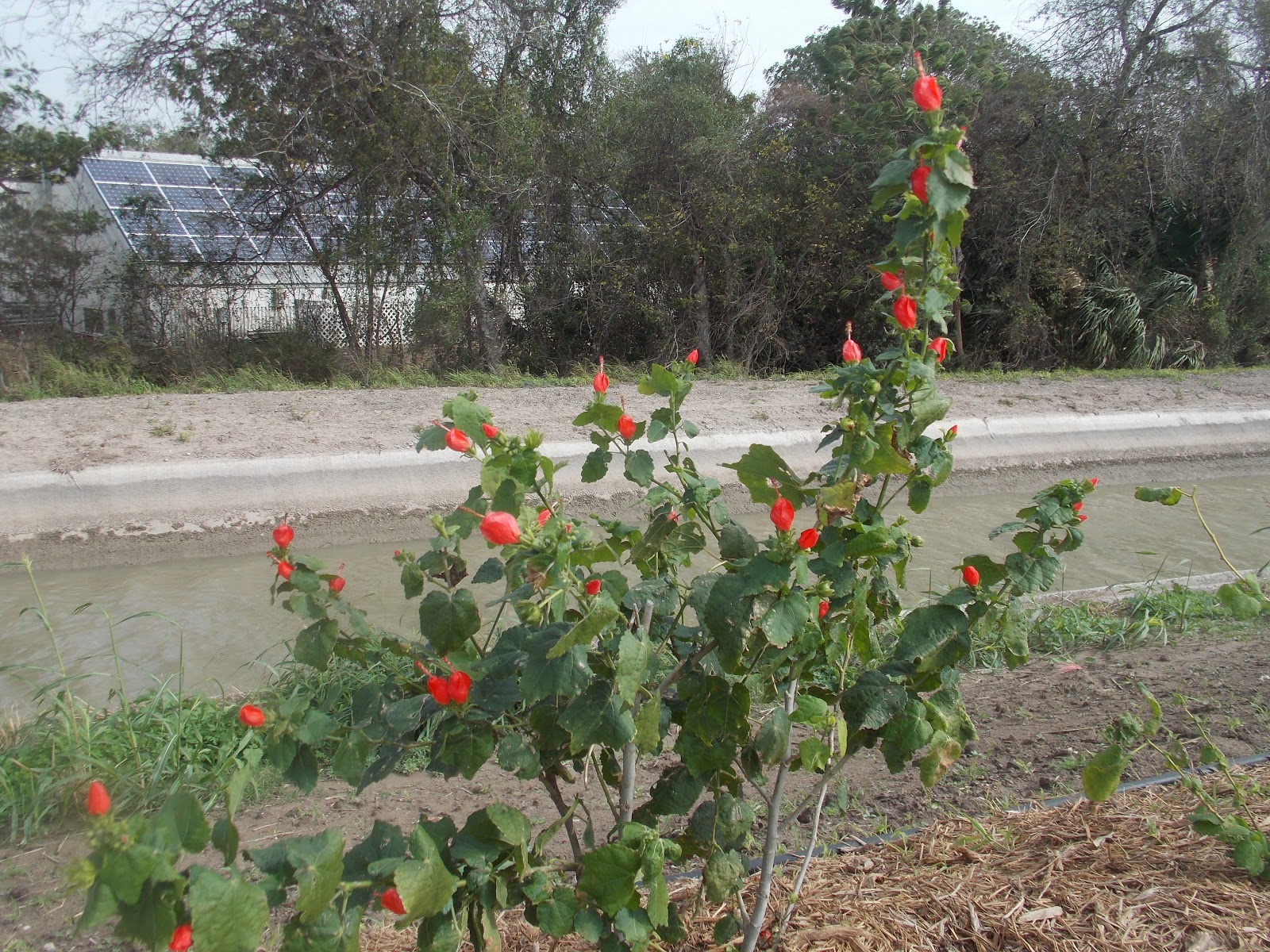
We did return to the refuge yesterday as we had learned in our previous visit that guided bird walks were offered daily at 8:30 AM. It was 48 degrees and misting, but we did the hike and thoroughly enjoyed ourselves. My sister Linda is visiting us and has only a few days to spend here. Yesterday was supposed to be the better one of the next two days, so we drove over to the refuge, not even being sure that a ranger was going to do a birding hike because of the inclement weather. What is amazing was that, even with the winter-like gray pall which seemed to hang over the park, the refuge was still pretty with the hanging Spanish moss, green cactus, mesquite, and red flowering shrubs. Pictured below is the Turk's cap shrub.
When we arrived at the visitor's center of the park a staff member had just put food out in the bird feeding station's outside of the center, everything from orange slices to suet to bird seed. I teased the park ranger and told her that since there were so many birds at the feeding stations, I saw no need to go out on a hike to find them! The first bird I saw at the feeding station was an Altamira oriole, I was interested in seeing that oriole because it is only located in the tree and willows of southernmost Texas It has very striking black and orange coloring. Another bird which I had been wanting to see was the golden-fronted woodpecker. That bird came to feed at a suet bar hanging from a tree. That bird has an orange nape, and the male has a spot of red on the top of his head. I did not initially have my camera with me, but after our hike with the ranger I returned to the feeding station with my camera. Many kiskadees and red winged blackbirds were then at the feeding station, and some chachalacs also made an appearance. Two other birds which I found interesting at the feeding station were the Inca dove and the olive sparrow. The latter is a striking small green colored bird. It was interesting to see different birds other than the usual morning dove and the brown sparrow.
After viewing the feeding station, where our guide for the birding walk pointed out many other different birds, we hiked to two different lakes in the refuge. The first lake, Pintail Lake, was out in the open, with no tall trees sheltering it- it was bitterly cold and here the mist seemed to turn into big drops of rain. But it did not matter, we were thrilled to see a variety of ducks in the lake, also some shore birds as black-necked stilts and sandpipers. A beautiful little blue heron hung around the lake, in flight his deep purple coloring stood out brilliantly against the gray sky. We also saw white-faced ibis. I was puzzled when our guide said they were ibis, having only seen white ibis, and the white faced ibis we saw is black. When our guide pointed out the long curved beak, I then could identify them as being in the ibis family. At Willow Lake we were a lot more comfortable, with the rain stopping and the wind less intense . I believe that it was there that the ranger espied a loggerhead shrike high in a tree. She shared with us the information that the black-masked bird is known as a "butcher bird". It impales its prey (as rodents, small birds and snakes) on thorny brush, and them consumes them. After two hours of hiking with the ranger, we left her to explore a bit more of the park on our own. We found a hanging bridge which connects two 25' observation towers. Those high vantage points gave us a great view of the refuge and from them we saw more chachalatas scurrying around on the forest floor. At that point we were quite chilled so we did not try to see any other wildlife.
Saturday, January 12, 2013
Wintering in McAllen, Texas
It has been awhile since I have sent out any further postings, sorry about that. Last week we had several days of cold, wet and windy weather. We were fortunate if the weather warmed up to fifty degrees during the day! We had very little desire to even get out and walk any short distance. Most Winter Texans spend their time playing cards or bingo when the weather turns bad, which is not for me. Then I saw a notice in our community hall from a food pantry. The Rio Grande Food Pantry was in need of packers and sorters. John and I filled out an application to work as volunteers and consequently spent an afternoon there this week. The pantry is in an old citrus warehouse, stacks of non-perishable items fill the large rooms there. Some of the containers have food to be sorted and packed, many boxes have already been filled and are ready to be distributed to the 200 food agencies which are located through out the Valley. We worked with two men who are also retirees, and later two college students joined us- they just wanted to kill some time while they are on break from college. We were also informed that sometimes the workers are people sent in from the courts who have to put in service time. Anyway, the work was a bit more labor intensive than we expected, especially when it came to filling boxes with 40 pounds of can goods, weighting them and placing them on a conveyor belt. John and I got smart after awhile and worked as a team, it did make the load lighter!
We also have joined the Texas Chorus and spent one afternoon this week in our first rehearsal. The chorus is a group of Winter Texans, residents of the many recreational vehicle parks in the area. Last year there were about 80 members joining the chorus. I was surprised at how our well our first rehearsal went, many of the voices have been in choirs for years. Our director has been leading the Texas Chorus for about 14 years and is an excellent musician. I also like the musical selections which we will be doing, one of which is a Broadway number. Our first performance, with an orchestra, will be in the beginning of February.
Tuesday our sister-in-law Mary Jo unexpectedly had to go into the hospital for surgery. Fortunately she is now on the mend, but it has been an interesting experience for me, having been a nurse for many years. The hospital is a few blocks from our home and is very reflective of the Hispanic culture which dominates this part of Texas. The medical center seems to be in touch with the latest technology and took good care of Mary Jo, they just do many things differently- which we found to be true of a lot of our experiences here in the Valley. I just have to keep in mind that this area was once part of Mexico and the rate of poverty here is one of the highest in the nation.
Today the weather was quite warm and muggy, but we were anxious to get out and hike. Pictured above is one of the wetland areas of the Santa Ana National Wildlife Refuge. It was established as a sanctuary for migratory birds and other wildlife in 1943. The Rio Grande River forms the southern border of the park. We were there by late morning. The sky was overcast and it was quite windy- all not very good conditions for seeing birds or other wildlife. However, we plan to be back next week for one of the refuge's guided birding tours. My sister Linda is arriving here tomorrow and I am sure she will be anxious to join us. Once she is here we will certainly start exploring the Rio Grand Valley more.
Saturday, January 5, 2013
International Museum of Art and Science
The beautiful sunny days we first had down here are only a memory now. Since then we have had almost a week of gray skies and moist cool weather. So we are left to explore the science and art museums in the area of the Valley. The International Museum is located in McAllen and is rather small compared to the one in St.Louis. It does have a couple impressive exhibits, however. In the science section there is a Science on a Sphere, a 6 foot, 20 pound fiberglass animated globe that uses four projectors and state of the art technology to show dynamic and animated images of the atmosphere, oceans, planets, and much more. It was designed by the National Oceanic and Atmospheric Administration and NASA.
In the art museum there are 29 imaginary portraits done by Picasso when he was 87 years old. He painted them on corrugated cardboard, and then had them transformed into lithographs by one of France's leading lithographers. The suite of 29 portraits were then sent back to Picasso for correction, the whole process took a year. Something else which I enjoyed very much in the art museum was a collection of stained glass windows obtained from churches on the east coast. They were made in the Tiffany studios.
Our time during these gloomy days is also spent attending the musical jam sessions in the clubhouse of our park. Many of our residents have been in professional musical groups and consequently the musical offerings have been quite good. Sometimes in the jam sessions there are as many as about 30 people playing on a variety of musical instruments as guitars, harmonicas, mandolins, and keyboards. My sister-in-law
Mary Jo joined the group yesterday on her dulcimer. Today we attended a big band jam session in another park. That session featured many brass instruments and was also very entertaining. By Monday the weather should be in the seventies, in the meantime we will just have to look away from the gray skies and enjoy the bright colors of the blooming plants and shrubs which can be found ever where here in the Valley. 
Tuesday, January 1, 2013
Hildalgo Pump Station
On the last day of 2012 we decided that it was necessary to get out and do some hiking as the weather was going to turn cool and damp after that. The pump station in Hidalgo has a museum as well as a birding park-it was a place which we had been wanting to visit.
The pump station was used in the early 1900s to siphon water off the Rio Grande, it helped the local ranchers not only in watering their cattle, but also in irrigating a variety of crops. The pump station was closed in 1983 when the Rio Grande had meandered off to the southwest. Unfortunately, once we got to the park we discovered that the museum was closed. However, it is also a birding center and we did find one trail which was open. We first explored the area immediately around the station. Here there are many blooming plants and shrubs with berries on them. There were numerous butterflies flitting among the flowers.While I was gazing at the activity of the butterflies I heard a bird chatter nosily in the tree above me. The owner of that voice was a bird with green and blue plumage. As he flew away he displayed his bright yellow tail feathers. I later learned that it was a green jay. We did not see much wildlife on the trail which we later hiked over. Several Border Patrol agents drove past us on their all terrain vehicles. The park is about ten miles southwest of the U.S.- Mexico border. According to the McAllen Moniter there has been an increase in illegal immigration, especially on the ranch lands north of the border. In December 127 illegals were found dead near a Border Patrol's checkpoint. That same month a large group of immigrants were apprehended walking through the brush, among them eight women and three children younger than 12, including an 11-year-old girl from Honduras traveling alone. It is hard to believe that our country has a neighbor in such dire straits that its citizens find it necessary to risk their lives in order to leave it! Even though we were still miles from the border yesterday, we saw tall fences around in the park, as well as cameras and numerous Border Patrol trucks in the vicinity. Our tax dollars at work!
Saturday, December 29, 2012
Birding Centers of the Rio Grande Valley
As I have alluded to in previous postings, the Rio Grande Valley is on the migratory flyway between Central and South American and Canada. Nearly 500 species have been sighted here. On Thursday we drove over to Edinburgh Scenic Wetlands where there are winding trails and lagoonside platforms to view various forms of wildlife. We had just started out on one of the trails when we noticed a bird perched over a small pond, he had a distinctive white collar and a ruddy colored breast with a dark green colored head. We discovered later from our bird book that we had seen a green kingfisher, the smallest bird in that family. Along one of the trails was another large pond where there were numerous waterfowl, one of which was a fulvous whistling duck. It is hard to deal with both a binoculars as well as a camera, but I try!
On Friday we visited Quinta Mazatlan, a 10,000-square-foot 1930s Spanish Revival adobe hacienda set amidst tropical gardens. We had a guided tour of both the house and the gardens.
Quinta Mazatlan is also a McAllen wing of the World Birding Center. Over 100 species of birds have been identified here, one of which is the chachalaca. That bird's only home is the Rio Grande Valley.
We watched a flock of about a dozen of those birds busily scurrying back and forth across our path, totally oblivious to our presence. They also were constantly ascending and descending from a nearby hackberry tree which currently is loaded with fruit. They look a bit like a road runner, but they are in a family by themselves and are a tropical-forest bird.. They give out a ringing cha-cha-lac sound. In the gardens we heard many different bird calls, but only identified the kiskadee- which we saw several times.
Friday evening we did a full moon hike in another World Birding Center, Estero Llano Grande State Park. We had an interpretive guided walk on the boardwalks and trails of the park. Unfortunately it was a cool night, and our guide could not find many night creatures out. Scorpions and tarantulas could not be found, but we did see the small gem-like eyes of many spiders in the grass. Speaking of eyes, the red eyes of one goatsucker gave him/her away. Goatsuckers are night hawks with wide mouths(those mouths help them catch insects), in that category are whip-or-wills and pauraques. It was the latter which we saw, sitting on the ground near our path. We also saw a great horned owl fly overhead and heard many whistling ducks who were perched in the trees. I was very impressed by our guide who could identify the many night sounds! He was also able to catch a glimpse of a bob cat who crossed our path, I only saw a white flash off in the distance. The night walk was a first time experience for us, now we are anxious to do it again, but on a warmer evening.
Wednesday, December 26, 2012
Christmas in Rio Grande Valley
We are now comfortably ensconced in McAllen,
Texas.
It is located in the Rio Grande
Valley, which encompasses the area
from the white sand beaches of South Padre Island down to the Rio
Grande River along
the U.S.-Mexico border. It also extends
to the north ranch country of Texas. Nine international bridges connect the Rio
Grande Valley to Mexico. The area has sub-tropical weather, since we have been here
we have enjoyed some rather warm weather.
Christmas day was in the mid 80s.
The park we are in once use to be the location of a citrus grove. There is a ruby red grapefruit tree next to our home and the park has a policy that we can pick whatever is on our lot. Looks like we have a winter of good eating!
A couple
living on another street in the park have a lemon tree on their lot, they were
generous and gave us a sack of them.
Blooming hibiscus, oleander and poinsettias also surround us here in the
park. And a delightful floral smell hit
me the other day as I was biking through the park in a Christmas parade. I discovered that it was an orchid tree which
was filling the air with that wonderful smell.
The beauty of the blossom of the orchid tree is as exquisite as its smell!
I once lived in McAllen. In fact, the school where I once attended
school and where my father was a teacher, is still standing. That period of time was in the early fifties,
when the building was not only a school, but also St.Paul
Lutheran Church. It now belongs to the Baptist Church.
Shortly after we moved from the town the
church built a more modern building in another section of the city. That building and
a school is still active today. On
Christmas day John and I attended church there, along with my brother Wayne and
his wife Mary Jo. Wayne
was confirmed at St.Paul’s church, he is
a older than I and has stronger memories of our time in McAllen.
I mentioned the Christmas parade, which we had here in the
park on the 24th. I put a
Santa hat on and joined other bikers as well as people in decorated gulf carts
for a parade through the park. That was
a bit out of my comfort zone! Something
else unusual we did on that day was to attend a bilingual Christmas Eve
service. The church, Our Savior Lutheran, has a ministry to the Hispanic community. There were a few Hispanic families who attended
the Christmas Eve service; their children wandered around the sanctuary during
the service. My guess is that they do
not attend services very often. The pastor, Steve Herzberg, had a wonderful
object lesson for the children. He
discussed the legend of the candy cane. That
sugary treat is a reminder that Jesus is our shepherd- the red stripes remind
us of his suffering and death. The gift
of the baby Jesus, which portents for us life everlasting, is certainly what
Christmas is all about!
Christmas day evening we drove to a small town south of McAllen, Hilalgo, to see their Festival of Lights. We walked around the main section of lights, which were around the city hall and library. After finishing that, we took the 3 mile driving tour around different sections of the town. It was quite an impressive display for a little town, and all free of charge. Our Christmas was a bit unusual but still a good one. We wish all our faithful readers a blessed holiday season!
Thursday, December 20, 2012
Bayfront of Corpus Christi
The jellyfish pictured above is of a different variety than the one I posted last week. The stringy substance above the fish are its tentacles. We also saw numerous dead monarch butterflies on the beach, and wondered whether that was a normal occurrence when they migrate along the coastline. Guess I will have to do some research on that!
Today, Wednesday, we drove into downtown Corpus Christi to visit the art museum. The first section, made of poured concrete and shell aggregate, was built in 1972. The second section was built in 2006 and features 13 roof-top pyramids. Currently there is a special display of Christmas trees from around the world. Public and private schools in the area decorated the trees. They were encouraged to research their chosen country, create themed decorations and trim their tree accordingly. After the exhibit the trees with their decorations will be donated to needy families. Many of the decorations were made from such simple materials as popsicle sticks, felt, paper, yarn and ribbons, and yet the total effect was quite beautiful on every tree! I especially like the Italian tree, which had a culinary theme.
The South Texas Museum of Science and History is next to the art museum, so that is where we headed next. We arrived in time for a tour on the Pinta. In 1983 the Spanish Navy and other specialists engaged in a study of the three Columbus ships. They then drew up construction plans for building the ships, taking care to insure authentic reproduction of the historic vessels. For a variety of reasons the carvels ended up on the waterfront of Corpus Christi in 1993. Unfortunately, they have since been damaged by a barge and now sit in dry dock. The Pinta has been partially repaired and we were able to board it with a guide. Actually, there is not much to tour on the ship- there is no galley, sleeping cabins or heads. The crew of 27 slept out on the deck, during storms they went below to the cargo bay where there just maybe could be animals running around. On calm days they could cook hot meals in an iron kettle on the deck. After seeing the primitive conditions on those vessels I have developed a healthy respect for our early explorers!
Tuesday, December 18, 2012
Corpus Christi, Texas
One would think that, with our particular type of lifestyle, there would be little opportunity to get into the holiday spirit. Quite the contrary, because we are not busily decorating our home, purchasing gifts or baking cookies, we have more time to enjoy the sights and sounds of the season. Sunday afternoon we attended The Nutcracker by the Corpus Christi Ballet. After the concert we drove along Shoreline Blvd.( it runs along the bay in downtown Corpus Christi), which is decorated with a very large Christmas tree.
The harbor here has also gotten into the festival spirit of the season, many of the boats are decorated with Christmas lights. And while we were on Shoreline Blvd. we found the memorial for the Tejano singer Selena Quintanilla Perez. She was murdered in Corpus Christi on March 1995 by the president of her fan club.
The memorial is decorated with mosaic tiles of white roses, a favorite flower of the singer. Our day Sunday ended with a Christmas concert given by the American Guild of Organists at a Presbyterian church in the downtown area. We returned to the harbor in the city on Monday to tour the USS. Lexington.
This ship served longer than any other aircraft carrier in the world, 40 years (1943-47,1955-91). She was called the "Blue Ghost" by propagandist Tokyo Rose who reported her sunk numerous times, but somehow she always manged to come back and fight. In reality, she was hit by a torpedo in 1943 and in 1944 a Japanese kamikaze pilot hit her, killing 47 officers aboard. Today there is the Rising Star of Japan painted on the aft side of the island (navigation bridge) where the ship was hit. The ship was also the first in naval history to have women stationed aboard as crew members (August 18,1980). The ship currently has 20 planes, from WWll Warbirds to Blue Angels. They can be found on the flight deck as well as in the hanger area. Christmas carols played while we were touring the hanger, and it was there where we saw a most unusual Christmas tree. The tree has white cloth around it to make it look like a snowman. Despite the presence of palm trees and blooming tropical plants, Christmas is present in Corpus Christi!
Saturday, December 15, 2012
South Texas Botanical Gardens and Nature Center
Shortly after we had paid our admission to this garden we were encouraged to check out the reptiles in the back room of the gift shop. I did not realize until I got home that, according to the park's brochure, it is also a nature center. At the time I thought it a bit strange to be looking at reptiles instead of flowers. A carpenter was sprawled on the floor of the reptile room when we arrived there. He was busily working on some sort of cabinets. However, he got up immediately from the floor and warmly greeted us. I must say that I saw some strange things in the room, but the staff member was eager to explain everything. He said that he was there mainly to do carpenter work, but over time he has gotten to know the animals well. A large African spurred tortoise was actively banging into the sides of his cage. I have never seen such an active turtle! The staff worker explained that someone had bought him as a pet and then turned him over to the gardens. The turtle can grow to over 100 pounds; he needs a large grazing area (his diet is largely grass) and he also has certain temperature requirements. Usually the turtle, pictured below, is kept outside in a cage with a female, but lately he has been heavily courting her and the staff felt she needed a break from him.
There were also two diamondback terrapin in an aquarium. They seemed to be quite playful, coming out of the water to nip at our fingers. The staff person said that they are usually looking for food, as well as attention. In the reptile room was also a variety of snakes and one large green iguana. As we headed out of the main building into the gardens we passed an office where another staff person was holding a cockatoo. The bird's cage was outside, in the bromeliad conservatory. However, Buttercup (the cockatoo pictured below) likes lots of attention- later we found another staff person playing with her near her cage
The gardens have a large wetland area, where normally it would be possible to see a large number of birds. The drought, however, has dried that area up. Gator Lake is gone, and we at first thought that there was no place of fresh water for the wildlife. But, as we discovered walking around that area, there is a creek flowing through the gardens. The trail we took in the gardens gave us a good idea of South Texas vegetation called "mesquite brush". Those plants are well adapted to a hot semi-arid climate. The gardens also have a large variety of roses, and tropical plants. There is also a butterfly house.
However, we did not find the above butterflies in the house, but in the gardens where there were many of them flying around. Not many birds around, just butterflies. And we enjoyed the orchid house which had numerous of those plants in bloom. I do believe that they are the most exquisite flower in the world!
As I said earlier, we met up with Buttercup again in the bromeliad conservatory. She was happily playing on the floor with some discarded planters. In the conservatory, as well as in different parts of the gardens, are other caged birds as parrots, love birds and parakeets. Some of them would try to catch our attention with a soft "hello" or a loud squawk. I must say that this botanical garden was a most unusual experience for us!
Friday, December 14, 2012
Aransas National Wildlife Refuge
This park is about 100 miles from where we are currently parked. It was largely a boring trip, we passed by miles of flat Texas cropland. From what we could tell, some of those acres of land were cotton fields. We were determined to visit the refuge while in this area because it hosts the largest flock of wintering whooping cranes in North America with over 250 birds. By mid-April they depart in pairs or small family groups for a hazardous journey 2,400 miles north to nesting grounds at Wood Buffalo National Park in Northwest Territories, Canada. Here in Texas the birds face many dangers with the presence of oil tankers and deadly oil spills as well as natural disasters. There are intensive efforts currently underway to establish a new non-migratory in Louisiana, where the species once nested. They were once nearly extinct, from a low of 15 in 1941 to over 500 cranes in North America today. Aransas National Wildlife had been created in 1937 to protect whoopers on their wintering grounds along the Gulf of Mexico. Our first stop at the refuge was in the visitor's center where we talked with rangers there to learn the location of the cranes.
We found the cranes on the first trail which we took, in a marsh along the Heron Flats Trail. Whooping cranes mate for life, and it seems that we found a family group. The brown-colored crane is a juvenile. The adult has a snow-white body accented by jet-black wing tips and red and black heads with long-pointed beaks. Fascination with the cranes stems from their loud vocalizations and elaborate courtship rituals which strengthen the bonds between the males and females. There is supposed to be other abundant wildlife in the refuge, however we found very little other than the cranes. John noticed a kingfisher sitting on a pier.
He was a good distance from us, however I am sure we identified him correctly because of the ragged crest on his head and his slate blue breast. He also has a white ring around his neck. Many of the trails in the park were not accessible to us because they are closed off for repairs. We drove on the 16-mile loop trail, which we needed to do at a very slow speed because of the presence of many white-tail deer.
The pair above stood staring at us so long that I was able to snap a few pictures of them. I am sure that they have lost their fear of humans and would be shot very soon if they lived anywhere else outside of the park! Today we are leaving our beach-side rv park and moving our rig closer in to Corpus Christi. I took a quick walk out on the beach this morning and found several shore birds feeding in the water. Previous mornings the beach had been devoid of any such activity. I was also thrilled to find a jelly fish that had just washed up out of the ocean. On first glance it looked like a lady's fancy bonnet. It did not take very long before sea gulls were pecking on the gelatinous surface of the fish.
Thursday, December 13, 2012
North Padre Island
Later that day we drove around with Gary to a variety of small coves and inlets were the birds were hanging out. He eagerly pointed out to us a wide variety of ducks and shore birds. Below is a reddish egret.
The shore birds we saw were sanderlings, plovers, stilts, willets, sandpipers and one lone oystercatcher. As with many of the ducks, I have quickly learned to identify the different birds by the color of their feet and characteristics of their beaks. So many are difficult to identify because of their nondescript to dull colorings of gray, and brown. However, a patch of white can make for quick identification, as with the bufflehead duck. After Gary pointed out the white patch on the duck's head, as well as the feature of a steep forehead on a large puffy head, I then could readily identify the bird. Same goes for the red breasted merganser with his crested head- he looked a bit tousled headed after he has dipped his head under the water! Back out in the countryside we also spent some time looking for the aplomado falcon, a bird which local conservation people are attempting to relocate back into this area. We searched for the bird around their nesting boxes which had been placed to establish a home base for them. We never found the bird but, while attempting to find him, we saw an osprey and a white-tailed hawk. We also saw a northern harrier kite, he was way off in the distance from us, but easy to identify by his characteristic hovering pose when capturing his prey.
Wednesday morning Gary took us out to join up with a local birding group. We were out in the early morning hours, it was cool but the sun was out. I was immediately discouraged when, upon meeting the birders, there were comments all around me about what birds they were seeing and I saw nothing. Turns out that one of the birds everyone was seeing was the yellow-rumped warbler. I did espy it later at another birding park and then understood why I had not seen it earlier. It is a small brown bird with a yellow patch on its rump, and constantly on the move- flitting from one tree to another. We went with the bird group also to a marshy pond where many ducks were in a constant feeding mode. Here I saw a cinnamon teal, a ruddy duck, and many other ducks which Gary had helped me to identify the day before. We also had the enjoyment of watching a large flock of them arrive. Watching them land so gracefully and hearing the collective soft rustle of their wings was an awesome experience!
We then left the birding group and Gary took John and I to another birding area in a park. What a pleasant surprise to immediately see the black-crowned night heron! We first saw the adult, then lower in the tree was another one which Gary identified as the juvenile of that species. He is pictured above, his orange eyes particularly stood out for me. While I was gazing at him a rather large yellow bird flew into my field of vision.
Pictured above is the kiskadee, a rather common bird to this area but one new to me. While in this area we also saw a kingbird, who also is easily identified by his yellow belly. Many yellow-rumped warblers were flitting about in this park. With the weather now warming up I am looking forward to the rest of our time here. There are many birding areas as well as a wild life refuge yet for us to visit.
Subscribe to:
Posts (Atom)