Wednesday, March 30, 2022

Queen Wilhelmina State Park

 The bad winter weather we were expecting in Hot Springs did come. That was a new experience for   us- to  be residing in a camper trailer and see two inches of snow outside! Our snow-covered car is pictured below. Fortunately most of the snow was gone in another day

We just had one day of sitting around and waiting for things to warm up. One thing John wanted to do, which we could not do a year ago when we were leaving Arkansas, was travel the Talimena National Scenic Byway. At that time the byway, over Rich Mountain,was socked in with fog. John called the park this time and received assurances that it was a clear day for us to make the trip. It was a good 4 hours drive from Hot Springs, so it was necessary to make that call. The park is in western Arkansas,along the Oklahoma state line.

 Halfway through our drive we stopped for lunch at the state park lodge, and took a moment to look at the view. It so happened that the park's small train was coming by at the same time. At the lodge we came to more of an understanding as to how the park happened to be named after Queen Wilhelmina. The first lodge at the park was built in 1898, the time of her inauguration- the lodge was named for her. This was before the land on Rich Mountain became a park, which was in1957. A railroad at the time of the 1890s; the Kansas City Pittsburgh,and Gulf railroad, would stop at the lodge for the comfort of its passengers. That railroad line was financed by Dutch capitalists. Over our lunch break at the lodge we questioned the waitress about the park's connection with the queen. Apparently she wanted to visit the park but never did. The waitress then brought out a scrapbook,kept in lobby of the lodge, which had many articles on the reign of Queen Wilhelmina, as well as the royal family dynasty. I learned later that Arkansas has always, in it's newspapers, kept an interesting fascination with Queen Wilhelmina and all events connected with her. At the time however, I found it puzzling; what did that scrapbook have to do with the park? 


After lunch we continued on the scenic byway over Rich Mountain and found many historical markers.  Forget European history, this mountain has a lot to offer in American history! Pictured above is known as the Wonder House, built in 1931 by Carlos Hill and Phil Lance. It is a nine level house, two of the levels in the front and seven in the back section.

Above is a graveyard from the 1800s,which gives testimony to the pioneers who once resided on this mountain. Twenty graves are here, what was written on them is no longer decipherable. Story has it that one little girl, buried here, had gone out on a cold day to get firewood for her family. She was soon surrounded by wolves, so she climbed a tree. Her frozen body was found the next day.

Pictured above is a marker denoting the Oklahoma and Arkansas state lines. A survey  was was completed in 1877, favoring Arkansas. The interpretive sign noted: "only after many months of negotiations would the Choctaw Nation"(located in Oklahoma)" be compensated for the loss of over 136,000 acres". The Native American tribe had been in legal disputes over the land since 1820. We had one last stop before leaving Rich Mountain, the second highest mountain in Arkansas. It is called Sunset Point Vista. Unfortunately it was not that time of day for us!


Saturday, March 19, 2022

Petit Jean State Park- Part Two

It seemed that everywhere we made a stop in this park we would find an old building.


 This one-room cabin was built in 1845. The second family in it had nine children, but only birthed the first 5 children in it.  We found a brochure regarding the Civil Conservation Corp in the visitor's center which explained the many buildings in the park, of which there are over 80.  The CCC Company V-1781 built or preserved the older ones in the 1930s. They also built other structures, trails and bridges listed in the National Register of Historic Places.

I really wanted to hike down by the Cedar Falls, but it would have been a 2 mile trek- no way we could have time for that!  We had to be satisfied with the overlook trail to see the 95 foot cascading waterfall.  The park has 2,658 acres of natural beauty; there are mountain vistas, springs, unmarred woods and ravines. There are also large rock formations and a rock cave containing pictographs left by Native Americans from the Woodland and Mississippi archeological periods. We found a listing of about 8 different trails which could take us to all those sights.  Not today for us,however. We would just have to plan on coming back!

Dr.Thomas William.Hardison and his family lived here for 50 years. He was the one who discovered the Indian pictographs. He loved the natural beauty of this park and pushed for it to become a national park in the 1940s, but was informed that it was too small.  He was instead encouraged to make it a state park.


We ate a very late lunch in the dining room of the lodge. Our table overlooked the Cedar Falls and the canyon surrounding it.  The meal was delicious and the view awesome.  Above is the last picture we took leaving the park. It is called the Palisades- a row of cliffs arising from a deep canyon. We were looking again over the Arkansas River Valley. Off in the distance is the Magazine Mountain range, the highest point in Arkansas. It lies within an extension of the Ozark Mountains.


Petit Jean State Park of Arkansas

This state park of Arkansas is located in a unique area between the Ozark and Ouachita Mountain ranges, in the west central part of the state.  It was a bit of a drive for us coming from Hot Springs, and by the time we had arrived half of our day was pretty much shot. So much for doing any hiking, all we could do was get a brief over-view of the park. We needed to do that in order to make any decision as to where our next Lohrmann family reunion would be in another year.


Our first stop was an overlook at Stout's Point, located just outside of the park. Here we learned a bit about the history of the surrounding area.  In 1849 William Cummings Stout (Episcopal priest) bought 5,000 acres here which spanned both sides of the Arkansas River.  He built a plantation using slave labor, called Hawstone Plantation; it burned down during the Civil war by Union forces. Stout's Point currently still belongs to the Episcopal Church and has been leased to the state.

Pictured above is the Arkansas River, which we could view off in the distance.  Interpretive signs here mentioned the Trial of Tears and the significance of the river to Native Americans who were forced from their homes out east to Oklahoma reservations.  Some came by boat down the Mississippi then up the Arkansas River through this part of our country.

 Looking down from the overlook we saw Petit Jean's grave, supposedly.  He/she according to legend was the fiance of Chavet a French nobleman.  He wanted to explore the New World and did not want to take his sweetheart along because it would be too dangerous. She, Adrienne DuMont, desperately wanted to join him so she stowed away in his boat as a cabin boy. The crew called her Petit Jean, or little John in English. Chavet arrived in America and he with all of his crew stayed with Native Americans for the summer months.  In autumn Chavet was ready to move on but Petit Jean became ill with a fever. Those caring for her realized she was a woman. She had a brief reunion with Chavet before dying. Many locals feel that her spirit lends enchantment to the mountain. We saw a statue of Petit Jean in the visitor's center of the park.  Please realize that everything written and imagined about her is pure conjecture!   My next notes on this park will be in the next posting.


Friday, March 18, 2022

Spring has sprung in Arkansas

In the Garvan Woodland gardens we found one tulip tree with a few blossoms and some blooming camellis along the Camellia Trail. Unfortunately it is about the end of the blooming season for that plant.

 Along Warren's Woodland Walk, named for the long-time brick mill employee Warren Bankson( he helped Verna Cook Garvan to conceive and build the gardens infrastructure), we saw quite a few azaleas in their budding stage. In a couple of weeks this garden will be awash with spring flowers! However, I was very satisfied with what we did see.

We had no problem finding the hyacinths! Our noses led us right to their heady smell.We also found several patches of pansies.  The striped yellow ones intrigued me, so I had to take a close-up picture of one. I never realized a pansy could be that pretty up close!

I had no clue as to what the purple flower was in the picture below.

 Someone I asked claimed it was a passion flower. She seemed very certain, but my research later said that the passion flower was a blue and white vine type of plant. The picture below is what it looked like when John lifted the flower to look at it more closely.

In the Trap Mountain Overlook part of the garden we found a patch of lilies of the valley,  They also give off a nice floral smell.


And below is also another very certain look of spring, a peacock spreading his wings to court his mate who was pacing around near him. They were also found in the gardens.


Thursday, March 17, 2022

Searching for signs of Spring

 Last week we traveled south to Arkansas and stayed in a camper trailer.  We had sold our camper a few years ago, since then our daughter and husband purchased a small unit for their use.  Our son-in-law Spencer had driven it down here a couple weeks ago, for his father to use. A couple months ago, when the plans for use of the camper were being made, it sounded wonderful for John and I also to make use of the trailer in Arkansas once it was it was vacated. We would get out of the cold weather of Missouri and experience an early Spring! Sounded good in theory, but several days after we arrived the camper was surrounded by 2 inches of snow, and the temperature was in the mid twenties. We had learned about Garvan Woodland Gardens, near Hot Springs, and planned that as our first excursion out before the bad weather arrived and froze out the plants.   We had made a call to the gardens and learned that there were plenty of plants in bloom at the present time, unfortunately the tulips were just starting to open.

 Shortly after we had arrived at the gardens we hurried over to the daffodil hill looking for the large open areas of blooming plants.  We saw many people involved with the covering of the plants before the freeze which was to come that evening.


The colored mesh clothes which you see above were being laid over the flowers, with plastic material later laid on top of them.  I rushed over to the area wanting to scream out "stop, let me look at them first".  But I refrained from doing so and soon discovered that there were still plenty of  blooming plants to been seen.


Before going further, I wish to explain these gardens a bit more and how they came about. Verna Cook Garvan inherited the land from her father. He purchased the property in the 1920s for his timber business.  His daughter, upon inheriting the land, had no desire to continue the company after running the brick,tile and lumber business for many years with her husband Patrick Garvan. She saw the future of the beautiful peninsula on the shores of Lake Hamilton as a place to channel her love of gardening and conservancy.  After many years of working toward that goal, and realizing She wanted a garden of a grander scale than she could handle, she signed a trust agreement with the University of Arkansas School of Architecture in 1985.  Consequently, these gardens have many unique and natural settings. 

The Garden of the Pine Woods features a series of pools,waterfalls,walks and bridges designed by Japanese garden designer David Slawson.

Pictured above is the Old Brick Hill from brick manufactured in 1885 and salvaged from the chimney on the old boiler at a lumber company. There is an autumn leaves pattern in which the bricks are laid.

Anthony Chapel
This glass chapel, in the gardens, has a 60-foot high roof with souring columns. The windows are 55 feet tall.  It all seems to so naturally fit in with the soaring trees surrounding the chapel.
Evans Children's Adventure Garden

What a delightful place this is, for children to experience a three-level tree house, a maze of boulders,  and a man-made cave to explore. While they are involved with that, the adults can take in the outstanding lake and woodland views.

Ouachita Mountain Vista
I still have so much more to share with you regarding these gardens, especially many of the blooming spring flowers! My next posting will cover that.


Saturday, March 12, 2022

Pictures on Stone

Pictures on Stone is currently an exhibit at the St.Louis Art Museum.  I must admit that I had no clue as to what I would be viewing, possibly just rocks with pictures on them. Surely it is not possible to paint a picture on a rock and then frame it?  Maybe I should give the correct title of this exhibit: "Paintings on Stone:Science and the Sacred 1530-1800".  As I viewed the paintings displayed, it was possible to see the science involved in selecting a rock to paint on, and slicing it down so thin that it could be framed.  This type of art started in the 12th through 15th century, and took off in the 16th century by Venetian painter Sebastaino del Piombo (1485-1547) who came to Rome in 1511 and encountered competition from the painters Raphael and Michelangelo. There were also arguments between Leonardo de Vinci and Michelangelo about whether sculptures or paintings were the superior art form.  So Piombo chose to perfect the art of stone painting, and inspired others to do the same.

  
Jesus Teaching Mary and Martha  
 In the exhibit there are 70 examples of stone paintings by 58 artists, featuring 34 different stones.  The picture above was done with oil on slate by Giorgio Vasari (1511-1574). Many of the pictures are of a religious nature, a few were mythological or portraits of people.  In the interpretive signs of some of the Biblical paintings it is noted that the stone support of the picture aids in the religious theme- that of Jesus's role as the cornerstone of the foundation of the church.
Resurrection of Christ
That painting was an oil on agate, artist was Sigismundo Leyrer (1552-1639).  The note on this pointed out that the painter did not need to paint the grave site as the painting had the stone support in the picture.

Portrait of Young Ferdinando Medici
The above painting was done on red porphyry, a type of igneous stone.

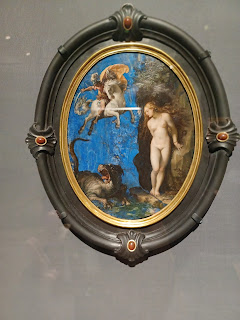
Perseus Rescuing Andromeda

In 2000 the art museum purchased the above painting done by artist Cavaliere d'Arpino.  I love the lapsi lazuli stone which provides the blue background for this painting.  It was this acquisition that caused the impetus for Judith Mann, senior curator of European art to 1800 at the museum, to do additional research which created this current exhibit of stone paintings.

Jesuit Church in Antwerp

The above painting, by Wilhelm Ehrenberg, was done in marble and alabaster.   Marble was the most luxurious stone to be used for paintings and it was used sparingly in Northern Europe by artists.


The Nativity was done by the Spanish artist Bartolome Murillo (1617-82).  The reflectivity of obsidian lends a deeper spirituality meaning to the painting, as noted by the art museum.  Aztecs considered the stone sacred; their empire had been conquered by Spain, through colonization of the Americas. 

I hope that I have given you an appetite to see this exhibit, and even if you do not live in St.Louis, it would be worth a few miles or more down the road.  Congratulations to the St. Louis Art Museum for a job well done!


Friday, February 25, 2022

A Serendipitous Weekend

 Have you ever been faced with what you perceive as a boring weekend?  That was what I thought as John and I packed for a weekend in Farmington, Mo.  His sister Carolyn lives there, and our main reason for going to that town was to visit with her.  Farmington is John's childhood home, and we have visited that town many times over the years- that was where his parents lived until they passed; his sister and some of her family currently live there.  Needless to say, we have seen all there is to see in that small town.  

On Saturday, after we had arrived, his sister informed us that she had recorded a television show which she thought John would be interested in.  After the program started I quickly became engrossed with it.  It was a story about Clint Harp, a woodworker from Texas, who is featured on the show "Restoration Road" (found on the Magnolia Network).  His interest is in restoring old buildings, and he was informed about an old granary, built pre-Civil War, located in Uniontown, Mo.  That town is in southeastern Perry County, Missouri.  The history of the building was that it was built by a German Saxon immigrant.  Uniontown was settled in 1839 by people from Thurigia, Germany.  By the way, the town was originally called Paitzdorf until the Civil War when the Union army had an encampment there.  Hence the name of Uniontown.

Apparently there was some interest in dismantling the granary, moving it to St. Genevieve,Mo., and  building a  cabin out of the logs.  Below is the final result.

No, that was not how the granary looked, it does have a similar shape- the logs were numbered so they could be easily reassembled.  However, a couple of the top beams had to be discarded because they had rotted, and new pine wood logs had to be cut and hand hewn.  Windows and a porch were added.  Also new chinking was needed between the logs- back in the day clay, dirt, silt sand and lime were used.  Today it is made with an acrylic elastic compound.  The door of the granary had a special marking on it, carved there by the immigrant farmer.  Historians call it a hex, s symbol placed there by farmers to protect the grain.  It could have had a religious meaning or perhaps was part of some black magic.  That door was saved in the restoration and used as the door to the bathroom in the log cabin.  An antique door was found for the front door, and surprisingly, the new proprietor had a key in her pocket which fitted neatly into the lock!  It all just came together very well for the new building, even its current location. The porch of the log cabin is pictured below.  The television show did display the interior of the cabin- quite a cozy place!

 Sunday, of what I thought was going to be our boring weekend, we drove south from Farmington for a drive through the countryside.  At our lunch stop in Perryville I suggested that we drive further south to Ste. Genevieve and look for the log cabin.  Fortunately the Welcome Center was open and we received directions to the cabin.  We found the cabin, the sign outside of it indicates it is the Sassafras Creek Cabin ( is a bed and breakfast facility).  This little adventure taught us something else.  We have been to St.Genevieve before, knew that it is the oldest European settlement in Missouri, settled by the French in 1850.  It is an interesting town to walk in, as it has kept many of the older homes.  What we learned this time is that the town now has Saint Genevieve National Historic Park, located near the Sassafras Creek Cabin.  Clint Harp mentioned in the television show that the French built their homes vertically, and he showed the Green Tree Tavern as an example of that architecture.  Within walking distance of the cabin we saw that building.  According to the national park brochure it has been dated to 1790 using dendrochronology.  The Janis family built it and used it as both their home and a tavern and an inn.  It is pictured below.  What an interesting weekend we had!  There are other older buildings, which have been moved to this national park, unfortunately nothing opened for viewing the day we were there.  We hope to return!


Friday, February 11, 2022

Six Mile Cypress Slough Preserve

 This was another interesting place which we visited during our second week in Florida.  It is within Fort Myer's city limits, and is over 3,500 acres of protected wetlands and uplands. It received its name in the early 1900s when travelers in wagons on their way to Fort Meyers would get stuck in a low swampy area (known today as the Slough).  When that happened they knew from experience that it was six more miles to town.  By the way, a slough is a forested wetland with slowly flowing freshwater.  A boardwalk was built over the slough in 1991, and is 1.2 miles in length.  Walking it we passed the largest body of water, called Gator Lake.

There really is a gator in the above picture!   We also passed by Otter Pond, and stood there for awhile looking for otters, but none made an appearance.

What did surprise us was a large water snake, hanging out in the water near the boardwalk.  We also saw a fair number of turtles, anhinga, herons and egrets.  Pictured below is a black-crowned night heron.  I was so pleased that I spotted him, he was a bit hidden.

My next picture here is of a sign I noticed by the bathrooms.  It sure gave me a chuckle!

Our last adventure in Fort Myers was an air boat ride.  In the past an boat ride meant a certain amount of time sitting quietly in a bayou or swamp looking at the wildlife surrounding us.  The air boat ride this time had only the purpose of giving us a wild experience; zipping among many mandrake groves at a rapid speed.  I did not appreciate it at all and felt sorry for the wildlife we were frightening.  And there were two other air boats near us also going at that speed!  Once we even got drenched with a big splash of water.  As we were leaving the boat later I saw a great blue heron sitting quietly in the water.  In the Slough I saw a quote which said: "Falling in love with the earth is one of life's greatest adventure" (Steve Van Matre wrote this, an environmental activist).  I have found, in our travels, that seeing any creature in its natural habitat is an awesome moment for me.


Wednesday, February 2, 2022

Our Second Week in Florida

 All of our family returned to their homes after Christmas, but John and I drove south to Fort Myers, were we took up residence for a week.  We had spent one winter there about 10 years ago, and now had plans to revisit some of the natural areas we had seen before.  There was one exception to that plan, and that was Myakka River State Park.  It has a mailing address of Sarasota, which places it about northwest of Fort Myers.  This park is one of Florida's "oldest and most diverse natural areas", according to the park's brochure.  The Myakka River flows through the park with miles of wetlands, prairies, hammocks and pine lands.  Besides the river, there are two shallow lakes here which attract many wetland creatures.  We saw quite a few of them, and spent a very enjoyable day at this park.

At one of the lakes we saw a large number of pelicans and maybe wood storks hanging out.  Unfortunately we were a good distance away from them, any good identification of them was consequently quite difficult.

Shortly after we were in the park we stopped near a bridge to check out what a few people were staring at.  An alligator was lying in the warm sun, near him were a few water birds.

Mayakka State Park has a canopy walkway and tower, part of which is pictured above.  It is necessary to climb 70 feet to reach the walkway. I just had to take a picture of John once we arrived at the top. I could not help but appreciate the fact that John seemed to climb that distance upwards effortlessly, not bad for a man who just turned eighty!

The next day we revisited a favorite park of ours, which is Corkscrew Swamp.  Unfortunately there was a dearth of animals and birds.  We did see what looked like a hawk up in the trees, however it was all white.  A park volunteer explained to us that it was a red shoulder hawk and that some birds in Florida loose their coloration during the winter months.  

One wonderful feature of Corkscrew Swamp is the old growth forests stretching back 5,000 years.  Pictured above is the Calusa tree, host to the endangered Ghost Orchid.  John and I were fortunate to see it blooming on our first visit to this swamp.

We left this park disappointed that we had not seen the birds and alligators here which we had seen in previous years.  But wait!  What was that sound rustling above us as we walked to our car?  Can you make out what that is in the picture above?  As best we could figure out it was a racoon.   Corkscrew swamp had not totally disappointed us!


Friday, January 28, 2022

Family December Celebrations in Florida


We finally arrived at our Florida beach house, pictured below.


The house is just a few blocks from the beach located on the Gulf of Mexico.  We only had a few blocks to walk to it, and with planning John's birthday party, setting up for Christmas, we only were able to take small amounts of time to spend at the beach.

It was a wonderful party for his 80th birthday, with little over twenty in attendance.  We had a delicious Italian catered meal for the occasion.  What made it especially special was that we as a family were all together, which had not happened in a couple of years.  Mike came in from Los Angeles, Dan and Amanda from D.C., as well as Melissa, Spencer and their three children.  Also my sisters, Linda and Julia, flew in to celebrate with us.  We had not been able to see them either for a couple of years.  And yes, we all were tested for the covid virus.

On one of our walks outside I could not help but notice a flowering tree decorated for Christmas.  The sun was shining on it, which already added beauty to it, and then there were the Christmas decorations; white snowflakes on the tree and a Santa standing below it.  Christmas always seems strange in Florida.  The same can be said for the decorations in the main room of our rented house.  We kept the crepe paper bunting, for which we put up for the birthday party (strangely red and black), in place for Christmas.

Someone stuck a metal crane (lawn decoration gift) in the plant, and then the crepe paper decoration above it seemed to give a right feel for our celebrations that week!  Yes, we did have a beautiful decorated Christmas tree, but for some reason it seemed more fitting for me to take the above picture to sum up our week!  Strange but good.

A couple of days before Christmas we walked through Largo City park which was lit up with many Christmas lights and decorations- we have enjoyed doing that in past years.  As we were headed out of the park the Grinch stopped to talk to our grandchildren.  Nathan, the oldest, would have nothing to do with him because "he stole Christmas".  However, Sammy, our youngest grandchild, was totally fascinated by the strange man.

Christmas day was a big party all day.  There were many gifts to be unwrapped, especially by the grandchildren.  We had a few guests for our Christmas dinner, and then Spencer and Melissa, with their children, took leave to spend the rest of their Florida vacation with his family.  John and I, along with Mike, Dan and Amanda, walked to the beach to watch the sun go down.  It was a good ending for our Florida Christmas.