Friday, January 20, 2012

San Fernando Valley Historical Landmarks

Our game plan yesterday was to complete our tour of the historical sites of the valley. There is not much left of the Shadow Ranch which was active during the 1880s, presently a small portion of it is park. The ranch home is now a preschool and much of the grounds have been turned into sports fields. However, the fine grove of eucalyptus trees, said to have been the first ones in the valley brought over from Australia, are still standing. We detected their odor immediately when we walked toward them. In San Diego we stayed at a park surrounded by those trees, so we recognize that smell very easily. It is not a great smell, but not all that bad either.
Our next stop was Orcutt Ranch Horticultural Center. It has nearly 100 of the oldest live oak trees in the valley. While walking on the nature trail we found one of them with a marker stating its age as 700 years old. The knars on its trunk as well as its height is quite impressive! It looks every bit its age.
While walking on the trail the distinctive call of a bird caught our attention, I researched that bird later and it may have been an oak titmouse. In that same area I espied a woodpecker. We also saw two blue jays chasing each other around a tree. It was a short nature trail but there was a lot to see. The Orcutt Ranch was built in the 1920s. W.Orcutt and his wife designed it with styles and symbols of the American Southwest. There is an inclusion of the Native American swastika above the door lintels. On that wall is also a series of pictures depicting two cocks fighting, a sport which is popular in Mexico.
As we were heading to our last spot of the day, a homestead acre and pioneer home, we drove on Woolsey Canyon Road which overlooks the San Fernando Valley. What a great view we had on that drive!


Thursday, January 19, 2012

Plants and Birds of San Fernanado Valley

When touring the Andres Pico ranch grounds on Monday we saw a century plant which had just finished flowering. I think that I need to show the century plant first, and then the stalk which grew out of it.
The stalk is in the background of the picture above. The century plant grows slowly, and it received its name from the idea that it takes 100 years to flower. That is not quite correct;  how long it takes to flower depends on the richness of the soil, climate conditions and the vigor of the plant. The volunteer at the ranch said she has enjoyed watching that plant this past year; seeing the stem come out of the plant , grow rather quickly, leaf out and produce white blossoms. Now the stalk is dead and needs to be chopped down. The stalk is what caught our attention, it must be at least 35 feet in height. Had not our guide pointed it out, we just would have thought of it as a tree and not connected it with the century plant at all.
 Also at the ranch we saw a flowering jade plant, a rather common sight here in the Los Angeles area.
Camellia and Magnolia trees are also in bloom, and today I saw a white iris, as well as jonquils. I think spring is starting around here, but it is hard to tell because some trees are dropping their leaves. Whatever season it is, it is just great being outside. And surprisingly we can always find a bit of nature right in the middle of the city! Yesterday, while biking through Sepulveda Recreation Area, we came upon one egret and several varieties of heron. There is another area of the park that has been set aside as a wildlife refuge, which we have visited, and only may see one egret in that area. What a surprise yesterday to see so many herons hanging out at a creek in the park, so close to a area heavily populated by people and traffic. While standing and watching a white egret and blue heron (pictured below) we heard a flapping of wings and two green herons flew out from the trees above us. We have never seen that many in one place, or that close to us.

Tuesday, January 17, 2012

Andres Pico Adobe

This is the second oldest adobe home in the Los Angeles area. It started as a one-room, single-story about 1834. The home was built by the Indians of what was then the ex-San Fernando Mission. Sometime between 1846 and 1860 the land around the house was owned by Andres Pico, the last Mexican governor of California. He chose, however, to live in the convent of the mission. His brother lived in the house at the time and added the dining room and present library. That same man, Pio Pico, passed the land on to his adopted children and at that time the adobe was modernized by adding a second floor. Other improvements were added to the house to produce an up-to-date Victorian residence of the mode of 1873. The building has undergone about 4 restorations since then. On Monday we took a guided tour of the home. We had been encouraged to visit the adobe by a friend we met at First Lutheran. She volunteers at the historic home.
This is a corner of the living room. All the furnishings are of the Victorian era. Behind the chair on the right is an Edison cylinder phonograph. The house has many antiques, from dolls to quilts to vintage clothing and branding irons. John asked if movie studios use the clothing and he was told that not only is the clothing used, but also movies have been made in the home, as Zorro. This home is a very important piece of the San Fernando Valley history. On the grounds of the Pico Adobe is the Lankershim Reading Room, which is one of the last remaining vestiges of the Lankershim Ranch. That ranch once covered the southern half of the valley. The Reading Room was built in 1904 and, before residing at the Pico Adobe,  it was used for a time as a research library at Roy Rogers' Canyon Chapel in Topanga Canyon. It is an octagon-shaped building made of redwood in the Folk-Victorian Style. What we found most fascinating about it are the sash pocket windows which slide down into seven panels of the building. When they are all down the building has a gazebo look to it. Today it serves as a mini-museum and contains artifacts pertinent to the valley's history.

Monday, January 16, 2012

Downtown Los Angeles

Saturday we took the metro train downtown, which is also what we did two years ago when we were in Los Angeles. This time, however, we did not spend any time looking at the historic buildings in the Old Plaza area. We instead took more time strolling through the Mexican-style market place, on Olvera street. Even though we had no serious shopping in mind, it still was fun to visit the craft booths and vendors of traditional Mexican wares. Plenty of food booths and restaurants are also available in the market place. We stopped to listen to Mexican music provided by one of the eating places. It was fun just taking in all the sights, sounds, and smells of the marketplace.
From there we walked over to Chinatown. The main street there is Gin Ling Way, which was named after a famous street in old Beijing. The name means "Street of Golden Treasures". And there are treasures to be found there, one shopping plaza has a long row of jewelry stores! The town is currently quite decorated. We came to find out the the Chinese New Year will be January 23. We were wished "Happy New Year" many times. I also learned that it will be the year of the dragon.
 And this time we had Chinese music for our listening pleasure.. The man pictured below stopped  playing on his two stringed violin to explain the instrument to us. It is called an Erhu. Unfortunately, with his broken English we could not understand most of what he said. However, he was a very sweet guy and after we placed a dollar in his donation pot, he gave us a bamboo backscratcher. 
I have not yet become bored with Los Angeles. It seems that we can drive or walk anywhere and find something fascinating to view. Returning to Union Station to catch our train that afternoon we noticed a large room in the station being readied for a banquet. We learned that a fashion show for charity was to take place in a few hours.. While we stood there a model came out to practice her walk across the stage.

Sunday, January 15, 2012

Nethercutt Music Collection

After a brief introduction to the first floor of the Nethercutt Museum our tour guide allowed us to wander around on our own for a brief time. Our free time was to last until the end of George Gershwin's Rhapsody In Blue. The music came from the player piano located on the landing above the floor. Near the piano is a Tiffany clock encased in a walnut cabinet. Its chimes rang out on the hour.
One of the first music boxes we saw on the next floor had five small dancers twirling to the music. It is typical of the "station music boxes" placed in railway stations and other places of business to entertain travelers during the railway boom of the late 1800s. This one was made in Switzerland in 1895.
 The next floor of the museum had orchestrions. They were made only in Europe and are mechanical devices able to produce the sound of a full orchestra. One in the Nethercutt collection has a 20 piece orchestra. It can be seen in the background of the picture below.
The Mighty Wurlitzer, in the foreground of the picture above, is the third largest in the world. During the  years of silent movies it was used in theaters to produce different sound effects. We were told that this organ had an option of  537 different sounds; everything from the sound of thunder to galloping hoofs, to a door bell ringing or a steam engine chugging away from a train station. We were told that it was not an easy task for the musician at the organ. He had to watch the screen, provide certain sounds at the appropriate times and perform for all the shows which may be shown on the screen in one day! A variety of those sounds were produced for us by our tour guide. He also played a couple of songs for us on the organ. While the organ was playing doors opened to reveal two rooms which contain 5,000 organ pipes. We fully enjoyed our two days at the Nethercutt Museum, and there is no admission price!

Friday, January 13, 2012

Nethercutt Car Collection

We returned to see the second building of the Nethercutt Collection. In the first building, which we toured Tuesday, there are 150 cars which the family restored. There is a total of 250 cars in the collection so we saw a few more today besides many musical devices. Our toured guide stressed that it is all "functional fine art".  The music boxes play, the cars can be driven and the musical watches keep accurate time. This posting will have a focus again on the cars, I promise that the next posting will feature other items in the Nethercutt collection! The car showroom we toured today is a bit fancier than the one we toured Tuesday. It was designed to look like a showroom of the 1920s and 30s. There is quite a bit of blaze to the room with the bright lights overhead, and the reflections in the mirrors of the gleaming cars.
 The first car pictured here is another one produced in St.Louis Missouri (I featured the other one in my posting two days ago). In the first years of car manufacturing there were over 4,000 car companies. So it probably is no surprise that I found another car company which used to be in St.Louis.  The 1930 Ruxton, pictured below, was made by New Era Motors. It was advertised as an  "Art Deco Front Drive Automobile". It was a sensation when introduced but that lasted only one year, after 200 of them were produced. Internal company strife and poor funding killed the Ruxton, according to the information provided by the museum.
The other car which I want to show here is is a 1932 Maybach. The informational sign posted near it says that it was "the very peak of  German automotive refinement". The story as to how the Nethercutt family received this car is an interesting one. Apparently it was smuggled out of East Germany under a load of cabbages (this was at the time when the Berlin Wall was in existence). It probably did not look this good back then!
It is hard to believe that many of the cars in this collection were once rust buckets before being restored. Once restored they are kept in mint condition. They are dusted daily, also waxed and detailed every 150 days, according to the curator. Just before leaving today we returned to the first building and were fortunate to be able to witness a corvette getting waxed and detailed. That was fascinating to watch!

Self-Realization Fellowship Lake Shrine

This is a 10-acre meditation garden that includes a spring-fed picturesque lake. In the 1940s Twentieth Century Fox had their studios here and built an authentic reproduction of a 16th-century Dutch Windmill.
The Self Realization Fellowship church worshiped in that building until a new temple was built. The new temple is a domed octagonal building crowned with a golden lotus. It sits high on a hill overlooking the lake to the east and the Pacific Ocean to the west. The founder of the church was Parmahansa Yogananda, who came from India in the 1920s. Students of the church learn through Self-Realization studies how to balance their lives with meditation. However, the garden is a shrine to each of the five principal religions of the world. At the Court of Religions (where there is a monument to each of those religions) one can gaze upon a nearby hillside to see a life-size statue of Christ. Yogananda felt that the goal of every faith is the same- direct experience of God.
On the grounds is also the Gandhi World Peace Memorial. Here a brass coffer containing a portion of Mahatma Gandhi's ashes was enshrined in a stone sarcophagus at the dedication of the Lake Shrine in 1950.
It is quite the spot for reflection and prayer. A path goes around the lake and along that path there are many small private areas where one may sit quietly and meditate. Flowers abound everywhere and their fragrance permeates the air. Birds also seem to enjoy the gardens, it all certainly gave me a sense of being in paradise!

Thursday, January 12, 2012

Life in Van Nuys

This San Fernando Valley suburb is where we have now been parked for a month. Our plans are to remain here for yet another month and then we will start heading east. Some recreational vehicle parks which we have been in are primarily populated with older citizens like John and I. This place has a variety of people including families with small children. The owner told us he has traveling nurses staying here, actors, construction workers as well as people living here while under-going cancer therapy. Our neighbor is a Los Angeles water works employee. He has his young daughter and a teen age son living with him. Except for a couple of motorcycles in the park and a small airport nearby, things are generally fairly quiet around us. While walking the streets in the neighborhoods around here I have been fascinated with the plethora of shopping carts hanging around. This is just one of those places in the Los Angeles area where certain people reside who are apt to readily use them, primarily I am speaking of the homeless. Oh, there is also the older person who uses them to take their groceries home or the young mother who loads her kids in them. But for the homeless a Food for Less or Home Depot cart is a necessary part of their existence. They need a cart to carry their blankets or sleeping bags or just all the stuff they daily accumulate. At least I thought those items would be important until I saw the cart pictured below. Someone felt it necessary to leave it behind. The first day it was over-flowing with stuff: a technical school graduation diploma, an unopened single serving box of cereal, a bar of soap (still in its wrapping), towels, underwear and many plastic bags. No, I did not rummage in the cart, I am only mentioning the items I saw sitting at the top. In the following days I watched as the cart slowly got relieved of its burden until only a few junky items remained. The cart still sits by its lonesome self  at the side of the road. It seems that it does not qualify for the cart retrieval service. Yes, only Los Angeles would probably need a company like that. We watched one day as a truck came by and loaded up shopping carts around the perimeter of a shopping plaza. Leave it to John to ask him what he was doing! He thought the carts were going in for repair.
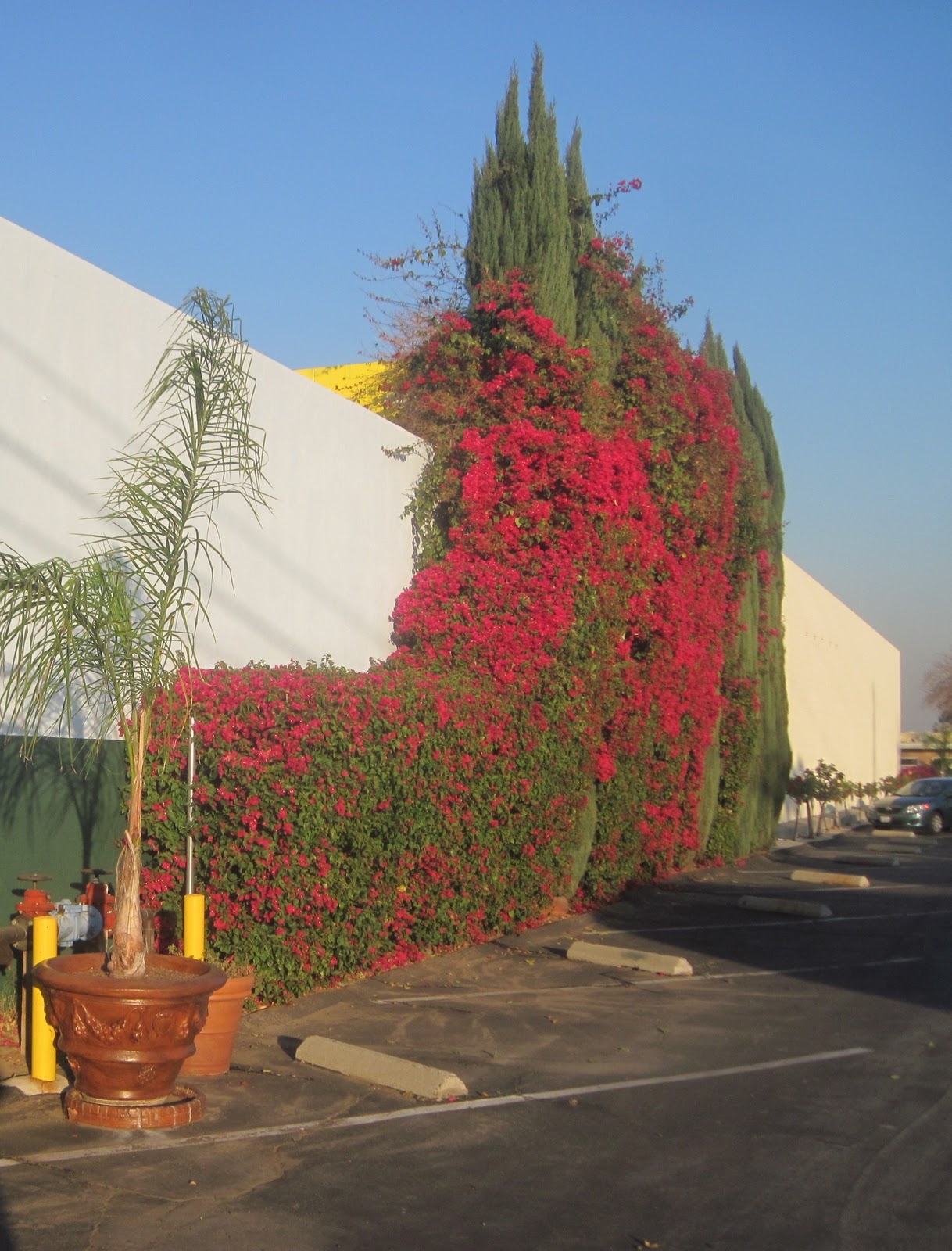
I can't leave you with the impression that we live in a questionable neighborhood. Check out this picture of a wall covered with bougainvillea. It is located at a trailer park next to us. Some of the homes around here are pretty run down, but there is usually beautiful foliage in the front yard.

Wednesday, January 11, 2012

Nethercutt Museum

Driving off Highway 405 toward the Nethercutt Museum we passed a large Merle Norman Cosmetic plant. At that time we did not realize there was a connection between Merle Norman and the museum. In 1923 J.B.Nethercutt went to live with his aunt Merle Nethercutt Norman. He later joined her in the family cosmetic business. In 1956 J.B. and his wife started collecting and restoring antique cars. Over the years they collected many different cars from classics to hot rods. The car, in which the lady is seated in the picture above, is one of those restored cars. It was one of the most expensive Packards sold in 1934. The shiny red car with the license plate of "Hussy" is one of over a 100 restored cars showcased in the museum. The next car which caught my eye was the 1928 Diana, manufactured by the Moon Car Company located in St.Louis, Missouri. It is described as a "The Light Straight 8/Sedan Deluxe". In Roman mythology Diana is a goddess of the moon. Appropriately the company thought one of their cars should be called a Diana. The goddess with her bow and arrow is a hood ornament on the car. I found a couple other cars in the museum also made by the Moon Car Company.
We were surprised to find a restored 1938 Pierce-Arrow Travelodge in the museum. A sign near it describes it as the ultimate in travel comfort; complete with a gas heater, beds for four, ice box, and a bathroom. The museum had done a great job in restoring it, considering that its last use was as a chicken coop! Attached to it is a Pierce-Arrow Limousine. Hard to believe that about 76 years ago it was possible to travel in such style!
 The museum also has a rather extensive collection of car headlights, carburetors, horns, spark plugs and hood ornaments. It was of interest to me that the swastika was a mascot, or hood ornament, before Adolf  Hitler started using it as a symbol for his evil empire. For many ancient cultures, even our Native Americans, it was a symbol for good luck, health and happiness. The rest of the Nethercutt Collection, which also includes a variety of musical  devices, is located in another building which we plan on visiting Friday.


Tuesday, January 10, 2012

Mission San Fernando

By now we have visited quite a few of the Catholic missions along the coast of California. This mission is the seventeenth in that chain, it was started in 1787. The current church, pictured above, is an exact replica of the original edifice erected  between 1804 and 1806. On the grounds of the mission are the graves of Bob Hope and his wife Delores. In 2003, the year he died, they had been married 69 years. John's first question, after he bought our admission tickets to the mission, was : "why is Bob Hope's grave here?" To which the clerk curtly replied: "his wife put him here".  I laughed at that, John certainly got his comeuppance for his inquisitive questions! John asked a different staff worker the same question later and the story we got then was that when Delores asked Bob where he wanted to be buried his reply was: "surprise me".
 In back of the graves, under the alcove, is a beautiful statuary created by Anna Hyatt Huntington. The bronze reproduction is titled "Holy Family Resting- Flight into Egypt".  Mary, Joseph and even the donkey certainly give off the impression that their trip was a bit difficult!
The burial plot of the Hopes is located in a small section of the rather extensive gardens of the mission. The mission has kept a lot of its land over the years despite its location in such a large metropolitan area as Los Angeles. In 1819 it had 121,542 acres. Through the years it has kept the church, convent, cemetery, workshops, and the foreman's house. And it has added a museum and the Archival Center for the Archdiocese of Los Angeles. The convent itself is a very impressive adobe building of two stories. Completed in 1822 its famous corridor has twenty-one Roman arches and the original iron grilles.
Across the street from the mission is the Mission Mortuary and Memory Garden. The gardens here are as equally beautiful as we found them at the mission. It is hard to believe that all this quiet beauty is located between two busy highways. The connecting street between those highways runs right pass the mission.

Monday, January 9, 2012

Norton Simon Museum Revisited

The last time we were at this art museum the weather was rainy and cold. Consequently at that time I did not take any pictures. The outside entrance to this museum has a sculpture by August Rodin called "The Burghers of Calais", which is pictured above. We did not have any plans to return to this art gallery in Pasadena. However, Pastor Hanson at Life House church, in his sermon Sunday, referred to a painting of Joseph which he had seen there. He commented that usually in nativity scenes Joseph, the father of Jesus, is often depicted in the shadows or not at all.. We easily found the painting in the museum among its collection of early Baroque paintings. The 17th century painting done by the artist Baciccio shows Joseph, by himself, holding Jesus very reverently with a total look of awe on his face. As Pastor Hanson saw it, it is as if he is viewing his son with joy in recognition of the fact that he is holding his Savior. The painting is very appropriate for the Epiphany season. There was another artist I looked for while at the museum. I recently read a historical fiction novel, With Violets, by Elizabeth Robards on the artist Edouard Manet. He was an Impressionist painter of the late 19th century. I found several of his paintings in the gallery, including a painting which he did of his wife. Interestingly enough, she looks to be quite prettier than Robard's description of her in the book!  Since we had already visited the museum two years ago, we visited the sculpture garden first.  The small pond in the middle of the garden adds a lot to it its beauty as it reflects the trees and sculptures surrounding it.
 The garden is replete with a large variety of plants. A number of the trees were gifted to the museum by the naturalist John Muir. Pictured below is a foxtail agave plant.
 

Friday, January 6, 2012

San Gabriel Mountains

Yesterday we hit a record high of 86 degrees here in Los Angeles. The weather stations here call that a "heat wave".  It did not bother John and I because were up in the mountains northeast of the city.
The ski areas were not in operation; there was snow on the ground but not enough for skiing. Ordinarily most of the roads up the mountain would be closed this time of the year. But only after we passed the 5,000 elevation mark did we get stopped by a gate across the road. We pulled off the road there and found a hiking trail. A sign at the beginning of the trail noted that we were in the Pleasant View Ridge Wilderness. The trail was a bit treacherous because of snow and ice on it. We had to be careful in those areas because one slip could easily send us tumbling down the mountainside. Despite that, it was a beautiful walk.
Trail signs warned us of black bear in the area. We did not see them but did see a black chipmunk and a western gray squirrel. I did some research after we got home and there actually is a black chipmunk. According to Ken Burton, a wild life expert, they can be seen "with some frequency but are not common". The gray squirrel has a very long and bushy tail (that tail especially caught my attention). My research on that critter indicated that those squirrels can be found in forests on elevations of 2,000 feet or above. Another animal in the area is bighorn sheep, which we also saw. We were just returning to our car when I glanced up the rocky slope across from the parking lot and espied some movement. Soon about seven sheep came into full view. Unfortunately they were too far up for me to get a picture of them. It was sunset about the time we headed down the mountain. Still John wanted to take a short side trip up Mount Wilson because he had heard about an observatory there. After driving up a very steep winding road to get there it was closed. It was still worth the trip to look down at Los Angeles from that mountain top.

Tuesday, January 3, 2012

Rose Bowl Parade, 2012

Yesterday was our second visit to the Rose Bowl Parade. Two years ago we purchased bleacher seats and a parking pass beforehand. This year we decided to join the masses and take a metro train to Pasadena. Unfortunately our timing was a bit off. Even though we started our trip at about 6AM, we still got into the main crush of people when we arrived at the parade site a little before 8AM. Consequently our viewing area was several rows back from the curb, and it was standing room only! However, we did see all of the parade and even got in a few good pictures. The float pictured below belonged to Trader Joe's. It was a fanciful wagon used to convey the parade's "Just Imagine..." theme. A fishing pole moved up and down, tennis rackets waved back and forth. The puff of smoke in the back of the wagon came from ketchup bottles which boomed and emitted smoke. Roses, mum and gladiolas decorated the lower parts of the wagon.
The second float I have pictured here was done by the Shriners Hospitals for Children. The plane on that float goes up and down. The theme is "Soaring for Kids"
The last one I want to show here has the theme of organ donation, "...One More Day". Faces of people who have donated their organs are on the clock's face.
 Our son Mike picked us up in Pasadena after the parade and we went out to lunch with him. When we arrived back at the metro station John and I acknowledged to each other that we were not ready to go home. It was sunny day and the perfect place to go would be the beach. We gathered up our suntan lotion, beach blanket and took the metro to Long Beach. That was an hour long trip, but we needed some time to just sit. Once we got to the  beach we laid out on our blanket. While John slept I watched shore birds pecking in the sand along the shore line. Even a pelican entertained me while he made several dives into the water for fish. While I was watching he managed to snag one. We left the beach when the sun started setting.

Sunday, January 1, 2012

Simi Valley

 We liked the beauty of the Simi Valley when we were there a few days ago and, as there were other places for us to visit in that area, we returned there yesterday. Our first stop was to see John's cousin and his wife in the town of  Moorland. After that we toured California Lutheran University in Thousand Oaks. It was easy to find the chapel as it is the  tallest building on the campus. The chapel, built in 1990, has a 75 foot spire which is topped with a 7 foot cross. It is quite a modern edifice. We were fortunate that the doors were open and we were able to tour the sanctuary, which we found to be quiet simple in design.
The campus has a beautiful setting in the valley with a ridge of mountains off in the distance behind it. Wildwood Park, located in those mountains, is where we stopped next. We had heard that the canyon is quite beautiful and has one rather large waterfall.
The hiking paths in the canyon are rather challenging with some very steep slopes.  But I, probably more so than John, was determined to see Paradise Falls. The sun overhead was quite warm but the air was cool in the lower levels of the canyon. We were hiking  along a river trail when we eventually heard the sound of falling water. Soon we saw a series of small waterfalls which cascaded down the rocky slopes of the canyon  into a 30 foot drop of thundering water. No question about it, it was worth the hike into the canyon.
By the time we hiked out of the park the sun was setting. We were still determined to take the scenic trip  through Simi Valley to the coastal town of Ventura. We ended up having our New Years Eve supper at a seafood restaurant on the Ventura pier. It was a wonderful way to spend our last day of 2011.