Wednesday, October 1, 2014

Tree Climbing for Fun

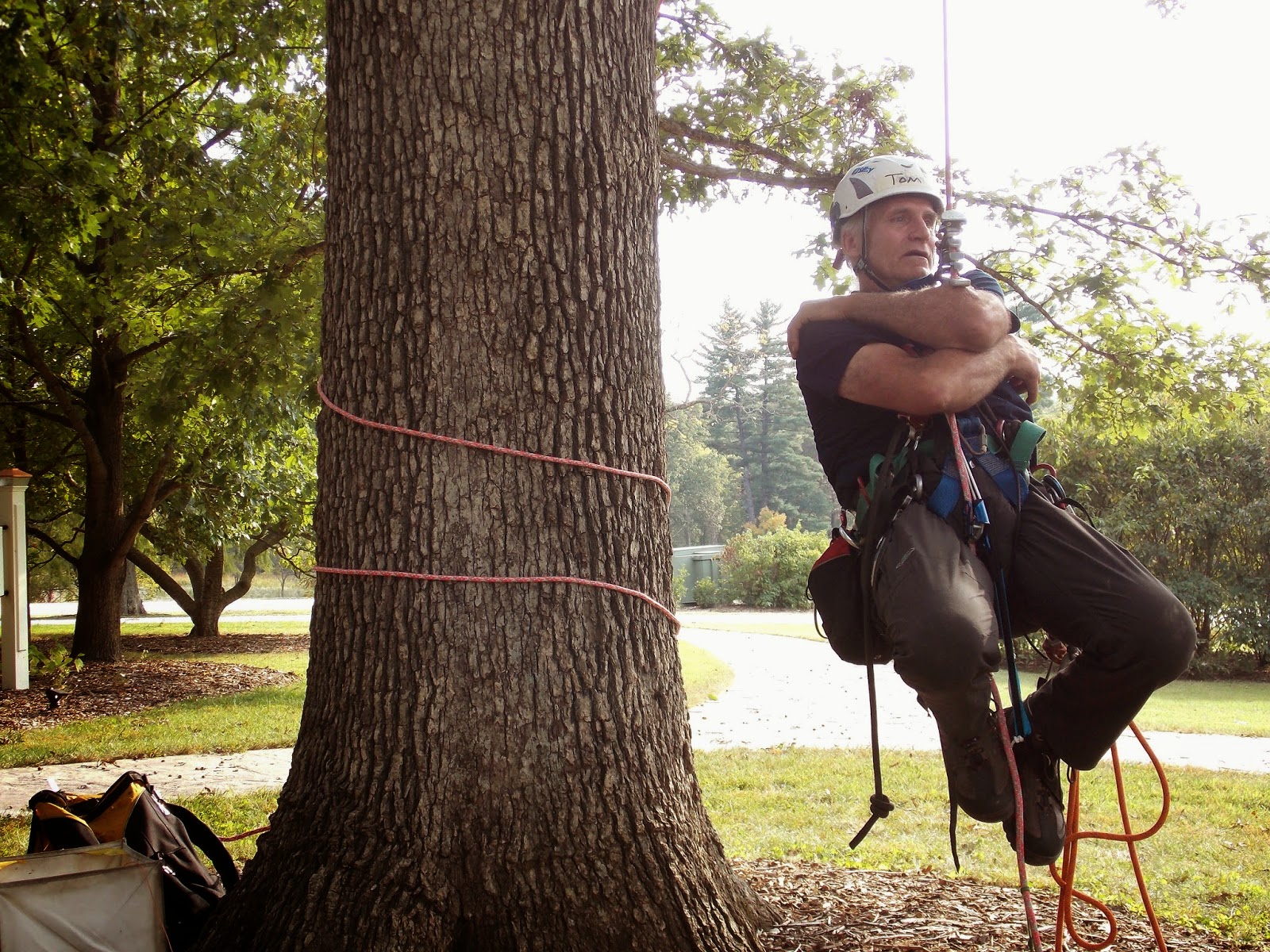
So as a kid you climbed trees for fun and as you got older you gave it up because, well, older people just don't climb trees for fun. Well, let me tell you that there are a lot of not so young folks that are still climbing trees for fun but not the kind of tree you climbed as a youngster. Nope! These are serious climbers going up trees where the first limb may be 100 feet off the ground, redwoods, large oaks, etc. They do it for the same reason people climb rocks, mountains, or explore caves. Today we got a first hand account of how to go about this activity. We were touring Shaw Nature Reserve in west St. Louis County and came upon a group of three men checking out a large oak tree they were going to use for a class in tree climbing at a Tree Climbing Festival this weekend. They were expecting 60 to 100 people from all over the country for this annual event. The three we talked to were from Minnesota, North Carolina, and Georgia. They were kind enough to show us the ropes, literally. They don't use spikes because that damages the tree so the first thing is to in some way get a rope up the tree so they can climb the rope using step climbers, explained later. This is done by using a very serious sling shot (see picture) that shoots a weighted bag attached to a thin but strong line over a limb that may be more then 100 feet up in the air.
This thin line has a 600 pound test strength but can't be used for climbing because a falling person might create more than 1000 pounds of force so this thin line is used to pull a larger line with a 5400 pound test strength over the limb. After this line is anchored to the tree the climber gets ready with his gear which is very much like a mountain climber or cave explorer would use (see picture).
The most necessary pieces of equipment are the step climbers, one on each foot or leg, that grip the rope when weight is on them and then release to slide up the rope for the next step becoming basically a rope ladder. After everything is in place the climber goes up just a few feet and bounces a few times to make sure the rope and equipment is holding okay and is ready to go (see picture).

Now the fun begins. The rest was all preparation. It took just a minute or two and the climber was 40 to 50 feet up in the tree (see picture). Looks like fun. To come back down he uses a brake device to slide down the rope like repelling.
When asked what happens after you get up the tree the three said you might look at the scenery, sit and visit with other climbers, or just meditate. So there you go. We may see you up the next tree.


Saturday, September 27, 2014

Ferne Clyffe- Illinois State Park

It will soon be going on three weeks that we have parked in southern Illinois.  The initial reason was to assist our daughter Melissa with babysitting while she was studying for her social work license test.  She has since successfully passed that hurdle and we are planning to move northward to St.Louis in the coming week.  It has certainly been a joy babysitting our grandson Nathan during the past few weeks!  This past week he and his Mom joined John and I on several short hikes at Ferne Clyffe State Park.  We are very thankful for the Scout publication, a guide to Southern Illinois tourism and recreation which has made it possible to find this park, as well as many others which I have written about on this site.
According to Scout this park is a "Hiker's Paradise".  The large rock shaped like a ship, pictured above, was our first clue as to what we were about to experience in the park.  We only had to look behind it at the large rocky cliffs to get a further idea of what we were to see in this park.  Because our daughter was carrying her son we could only go on the short paved trails.  However, I would venture to say that even with that small restriction, we saw a lot of the wonders of Ferne Clyffe.
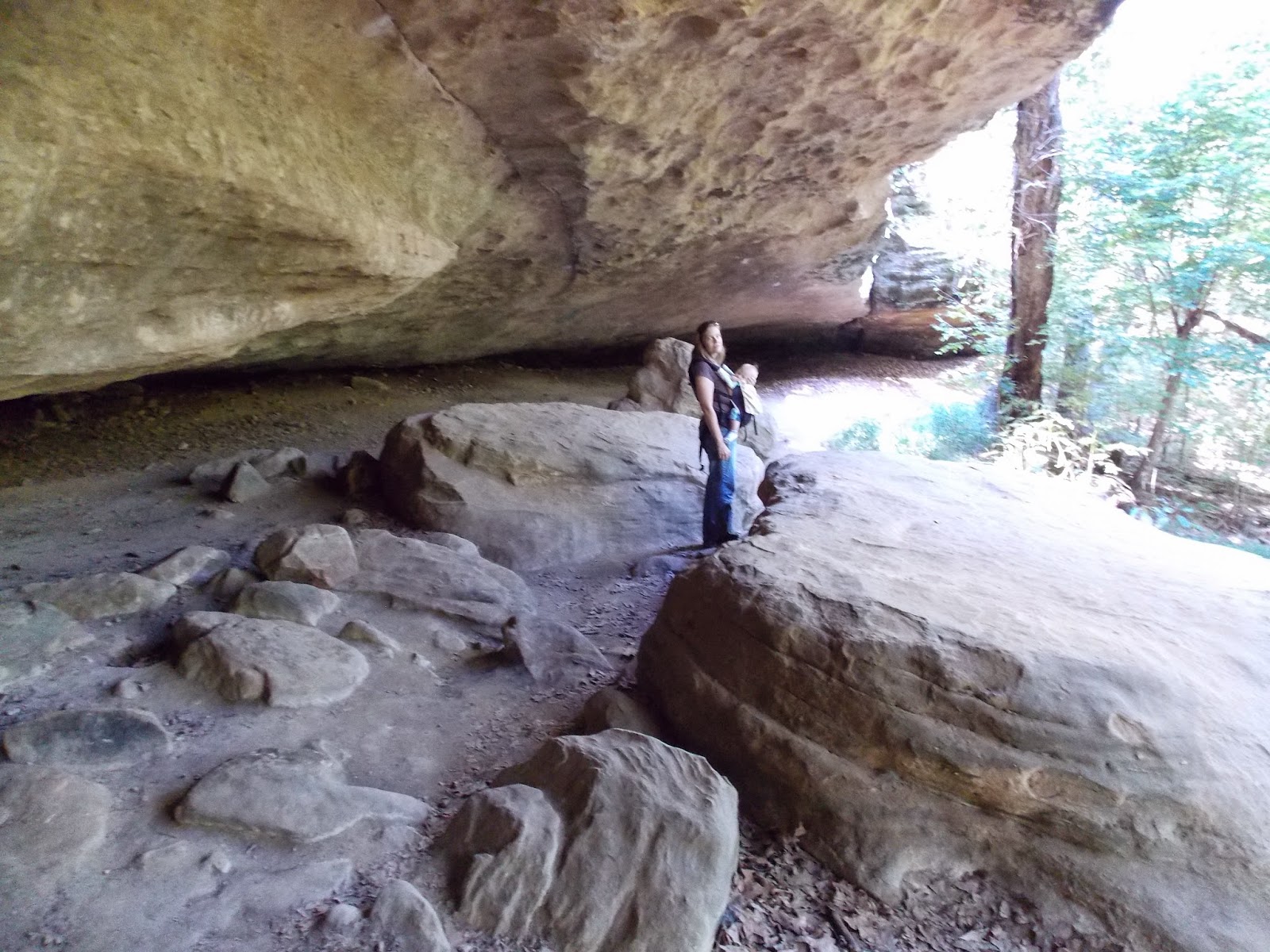
Pictured above is what is the site of a 100-foot waterfall, that runs intermittently and is at its best viewing after a heavy rain.  We discovered that on the "Big Rocky Hollow Trail".   Melissa and Nathan are standing below it next to a small pool of water.  I believe it was here where John was not content to just look at the would-be waterfall, he had to climb it.  He did make it to the first level of the falls, and had to slide down from it on his bottom.  I was not quick enough with the camera to catch that sight!
 Melissa also did her share of climbing among the rocks, despite having the baby in tow.  Nathan even managed to fall asleep, unfortunately missing some of the more awesome sights.  With  high rocky bluffs there are also caves, and this park has its share of them.
This is without a doubt the most spectacularly scenic parks we have seen so far in southern Illinois.  Every trail we hiked on had some jaw-dropping natural wonder which surprised us.  We were even impressed with the sight of one tree (pictured below in the foreground) which had been able to grow tall and straight despite the large boulders laying at its feet.   I will sign off on this posting with that one last parting camera shot.


Tuesday, September 9, 2014

Peoria, Illinois

We have moved on from Lake Geneva and are parked by the Illinois River.  It seems a bit strange to me that we have been around so many rivers and lakes the past few months.  We certainly did not deliberately plan that!   Awhile back John suggested Peoria as a place to visit and I agreed, thinking that there really is not much to see or do there but I did want to visit where I once trained for pediatric nursing.
Pictured above is the nursing school building for St.Francis Medical Center, same building which I lived in about fifty years ago for three months.  The hospital's children's section is now call Children's Hospital of Illinois.  I enjoyed my training there, and it subsequently led me into 38 years of pediatric nursing.  After visiting the medical center on Sunday we looked for a place to eat.  I happened to glance at the paper and noticed that at the Exposition Center of Peoria there was a festival of Beer, Bar-B-Que and Bluegrass Music and we headed there for lunch- see how well we plan things?   I also noticed in the paper that the Peoria Symphony was playing at the riverfront that evening, we did that also later in the day.
Pictured above was the scenery we had while listening to the symphony.  It was a good concert, the symphony is going into its 117th season.  George Stelluto the director took a few minutes to review the orchestra's history with us.  John Philip Sousa and Luciano Pavarotti both performed with the symphony in the past.  He added that another notable person who visited Peoria was Abraham Lincoln.  And here I will digress to share with our readers other history of Peoria which I learned from historical markers at the riverfront.  The breweries and distilleries row of Peoria financed the Civil War.  In the twentieth century the town dropped its title of "Brewery Capital of the World" and became the "Earth Moving Capitol of the World".  The Holt Company came to Peoria then, later known as the Caterpillar Company.
Peoria has at least two wonderful museums, however they were closed Monday.  We still had a wonderful day at the Wildlife Prairie State Park.  In this park are 50 native Illinois species that roam the park, including bison and black bears, wolves and big cats.
 
 It is an old coal mining site so there are deep ravines and forested hillsides for the animals to roam, there are no cages to contain the larger animals.  It does make it harder to find the animals, and a certain amount of hiking is required to see them, but it is so much more enjoyable than a regular zoo!  Pictured above is a bobcat- it was interesting to watch him saunter down a hillside, walk along a stream and pounce on some small prey.  Also, while wandering around the park, we chanced several times to espy deer peeking out of the woods and contemplating our presence.  We also enjoyed a hike later in the day at Forest Park Nature Center where we came upon a large flock of wild turkeys foraging for food on a hill above us.


Saturday, September 6, 2014

Kenosha, Wisconsin

It is time to start heading south, it did get a bit cool for us early this morning.  We will be leaving the Lake Geneva area today, and driving into Illinois.  Yesterday, on our way to Kenosha, we stopped at the Jelly Belly Center which is located in Pleasant Prairie.  We took a train tour through the factory which amounted to stops at video stations where the history of the Jelly Belly Candy Co. is told.  We were informed that to see the actual production of the candy we need to visit their company out east.
 One interesting part of the tour was their art gallery which has mosaic artwork done with jelly bellies.  At the end of the tour we were encouraged to visit the sample bar.  They actually have flavors of "barf" and "dirt", "moldy cheese" as well as "peas and carrots".  They will make any flavor requested by the public.
The colorful fountain pictured above can be found on the ground's of Kenosha Public Museum.  Rain storms kept us inside the museum most of the day, and that was not a bad place to be!  In the museum there are wonderful natural history exhibits on the Ice Age, Native Americans of Wisconsin, as well as the Schaefer mammoth of Kenosha County.  In 1830 there were four Indian villages near present day Kenosha.  The main village was called "Kee-neau-sha-kau-ning" or, literally translated, "Long Nose Abiding Place" in Potowatomi.  There was an abundance of pickerel  fish found in the rivers of the area-they have long noses.
Currently there is in the museum the artwork of Peter Bianchi, who worked for National Geographic magazine from 1959-1974.  He is a native son of Kenosha, and died in 2001.  In 2003 his wife donated a selection of thirty paintings and drawings to the museum.  His famous painting of the fossil Zinjathropus entitled "Earliest Man" is in that collection.  Peter Bianchi accompanied Dr.Leaky to Africa in 1959 to illustrate his prehistoric Olduvai Gage discoveries.  Also in the picture above is a medal he sculpted for National Geographic which was awarded to the American Antartic Mountaineer Expedition in 1966-67.
 
Kenosha is Wisconsin's southernmost Lake Michigan port.  Once the rains stopped I took a brief walk to the harbor and saw this lighthouse, which I later learned was the Kenosha Pierhead Lighthouse.  Established in 1856, it was one of a succession of lighthouses in this location, as structures were either destroyed by natural causes or became obsolete as the pier extended.  In 2008 it was deemed "excess" by the Coast Guard and sold to a local artist.

Friday, September 5, 2014

Lake Geneva, Wisconsin

This town has always fascinated me.  When I lived in Chicago, during nursing school, it was always referred to as that place where the rich people of Chicago spent their summers.  In the past two days I learned it was all that, and much more.  The first day we were here we walked around the downtown and from there into the residential areas.  We learned, from historical markers, that the town was founded in the mid 1800s.  Pictured below is a home built in 1847, and later owned by Charles Wilson ambassador to England.  In the 1870s he helped obtain the railroad link from Chicago that made Geneva's resort development possible.
The house reportedly had been visited by such important personages as President Grant and Mary Todd Lincoln.  Later, that same day, we walked a small portion of the shore path from where we could view some of the resort homes along the lake.  Many of the homes are over one hundred years old and have been torn down, or rebuilt several times- they have also changed ownership.  At the Visitor's Center we purchased a small copy of  a shore path guide, and later purchased a much larger book explaining the history of the homes along the lake shore.  Walking the shore path was fascinating, we never knew what we were going to see around each bend of the path, from beautiful landscaped lawns to towering mansions.  It reminded us of our walk around the summer homes of Newport, Rhode Island.  I found out later that Geneva Lake has been referred to as the "Newport of the West".
Stone Manor, pictured above, is the largest mansion on the lake and was built in 1899.  The owner's granddaughter donated the mansion to an Episcopal School, it has also been a restaurant and Christmas tree museum.  In 1968 a tax auction was held and a developer purchased the home and land for $75,000.  Currently it has luxury condominiums with a rooftop pool.   Also that first evening on our walk we came upon the Expect a Miracle Mansion owned by freight industry entrepreneur, author and speaker Carolyn Gable. A fence along the path at her residence has inspirational quotes from the Talmud as well as Oprah Winfrey.
There was no way we could walk the entire foot path around the lake, so the next day we took a guided boat ride which provided us with a view of more of the lake's resort homes.  We learned that many of the home were built by Chicago's movers and shakers of  the late nineteenth and early twentieth centuries.  Such people were William and Philip Wrigley whose assets included Wrigley Gum Company, Chicago Cubs, Wrigley Field, and most of Catalina Island off the coast of California.  They have a complex of estates still today on the shores of Lake Geneva which are owned by extended family members.
The original building, called Hillcroft, was built in 1895.  It was purchased by Philip Wrigley in 1927.  It was sold again in 1981, torn down and rebuilt to incorporate many of the original architectural features.  In the picture above notice the full extent of the home, as many others on the lake it seems to extend forever!

Another house, which is rather modest in size, is the Blacktoft, built in 1881.  It was originally painted black, but  now is very distinctive with its white clapboard and many red chimneys.  In later years it was the summer residence of Montgomery Ward Thorne, descendent of the founder of the Montgomery Ward Stores.  We learned on our boat tour that there are 1,000 piers around the lake and they all get pulled out of the lake come December. Residents on the lake live here an average of 35 days out of the year.  Probably an exception to that was 1871, the year of the great Chicago fire, when people fled the city to live in their summer residences on Lake Geneva.  In case you are wondering if there is a place for you along the shores of Lake Geneva, there is one public beach for which there is an admission fee.   In the background of the picture below is what use to be the Riviera Ballroom.  Built in 1932,  it was a popular venue for some of the biggest names in music history, including Louis Armstrong.


Wednesday, September 3, 2014

Devil's Lake State Park

Over the Labor Day week-end we made a trip to Plover,Wisconsin, the home of our niece Rachel and husband Ben and daughter Eliza.  Also visiting them were Rachel's parents Marcus and Heidi, as well as her brother Adam and his wife Kjerstin with their son Kai..  Our travels are certainly wonderfully enhanced by family gatherings!  Technically I was done with writing about southwestern Wisconsin.  Devil's Lake is north of Spring Green, about 20  miles south of the Wisconsin Dells.  As I had written before, the southwestern section of the state is called the Driftless region.  In contrast to that area, Devil's Lake is glaciated.  It was formed many years ago when the Wisconsin glacier invaded hills from the east, and impounded an ancient river.  As the ice melted it left a mass of rock and sand (moraines) at both ends of a gorge, damming the river and creating Devil's Lake.  That is about as simple as I can make it!  The park has within its boundaries parts of the Ice Age National Trail,  so we were pleasantly surprised when we discovered that we did not have to pay the state fee for entering the park because we had a national park pass.
It was a sunny day when we arrived at the park in the early afternoon.  However, at our first stop we encountered rain.  Many people swimming and boating on the lake for the holiday week-end were caught unawares and the park soon cleared out quickly.  We visited the Visitor's Center where we received a booklet on Devil's Lake.  Information in that brochure provided us with a 17-mile driving tour around the lake, which seemed the better way for us to see it given the uncertainty of the weather.
It turned out that the showers we encountered were fairly brief and we could occasionally stop the car and hike.  Messenger Creek and springs are the only water input into Devil's Lake, it has no natural outlet.  The lake itself is less than 50 feet deep.  Parfey's Glen is another natural treasure of Wisconsin.  As Spring Green Preserve, it has rare plants and animals- many plants here are commonly found much further north.  We hiked into the glen; a moist, lush woodland within a narrow sandstone gorge.  We had to stop and turn back when our path became steeper and required us walking over slippery wet rocks.  By that time it was getting late into the afternoon anyway and we were certainly not feeling adventurous!
Our last stop was on the western side of the lake.  The weather had cleared and we felt that we still wanted to see an overlook of the lake, unfortunately that did require a hike up a bluff.  The bluffs which surround the lake can be as high as 500 feet.  On this, the western side of the lake, we are looking at the Baraboo Hills off in the distance.  The vista from here was certainly worth the effort of climbing up to see it!   Today was our last one in this section of Wisconsin, from here our plans were to move to southeastern Wisconsin.


Last Pictures from Southwestern Wisconsin

In the past week I tried to cover the majority of what we saw in this part of the state, but there is much more which I did not tell you about.  I must say that we packed a lot into every day!  When we were at House on the Rock I could not help but think of Frank Lloyd Wright.  I wondered whether he and Alex Jordan ever chanced to meet.  There was forty seven years difference in their ages, so maybe not.  They seemed to have so much in common- a deep love of the hills and bluffs of the Wisconsin River Valley, and a desire to build homes blending in with the natural surroundings.  Wright built six structures in Spring Green, including his own home Taliesin.  We had toured his western home in Arizona and, as it is not cheap to visit his places, we decided not to visit the buildings in this area.  We did stop at the Frank Lloyd Wright Visitor Center, a place which he designed.  It has a cafe, exhibits of his work, and bookstore- all of which have outstanding views of the Wisconsin River.  There we learned of the Unitarian Chapel located nearby and which was his family's church.  Wright worked with a Chicago architect in creating the "cottage church".  He was a young man at the time it was built in 1886.  While walking through the cemetery next to the church we discovered the gravestone of Wright, as well as those of his six children.
We also visited Tower Hill State Park, and climbed a bluff there to a shot tower built in 1831.  From the tower's shaft there was a 90 foot tunnel built down to the banks of the Wisconsin River.  Lead shot was produced there for thirty years. The tunnel opening by the river is pictured below, from here the shot was sacked and loaded on barges for shipment to St.Louis and other river towns.
 Another beautiful and scenic area which we hiked is Natural Bridge State Park.  The 35 foot high sandstone bridge was created after many years of erosion by water, frost action, wind and gravity.  Beneath the bridge is a natural rock shelter which archeologists excavated in 1957.  They found remains of fire pits of people who lived there possibly as long ago as 12,000 years.
 
We could not leave the area without visiting the "Wisconsin Desert", located at Spring Green Preserve.  As an interpretive sign at the park describes it, it is where "forest meets bluff and bluff levels into sandy plains and dunes".   All I can say is what a beautiful place!
 
 We did not have a lot of time to spend walking through the prairie, but we kept going until we found cactus, which turned out not to be very far at all.  For some strange reason, the prickly pear cactus is starting to bloom, it must be all confused living in this northern climate!


Tuesday, September 2, 2014

House On The Rock- Second Part

Alex Jordan enjoyed spending time in his retreat house on the rock, pursuing his interests in books, art and sculpture.  He also enjoyed listening to music recordings, especially orchestral sounds.  He collected guns, armor, and dolls for the Mill House.  However, his imagination was flying into wider interests than his collections, because he soon was creating music machines.  In 1974 he showcased them as The Music of Yesterday.  One of the more interesting is the Mikado with its flamboyant Oriental facade.
He purchased Asian figures from the Merchandise Mart in Chicago for the machine, and had one of his workman create the animation.  A music roll plays several numbers including "Dance Macabre" and "Harem Bells".  We stood and looked at the musical wonder long after the music stopped because the figures were still raising their eyebrows and rolling their eyes- very hilarious!  Also in this building are the "music environments" of Miss Kitty's Boudoir, the Gladiators, Blue Danube- to name a few.  As Jordan's collections grew, so his house continued to grow with a series of interlocking buildings and themed rooms.
 
 Jordan felt that his best work was the Organ room, built in 1981.  I would have to agree.  As we stepped into this room, which has a very large chandelier with winking red lights, we heard organ music playing J.S. Bach's "Sheep May Safely Graze".  What a surreal, awesome experience!  As we wound our way through a maze of walkways and winding staircases organ music continued to play other musical numbers including a variety of show tunes.  Besides large organ consoles and pipes, there are large brew kettles, cheese vats, compressors, religious statuary, and thousands of whiskey barrels.  I believe that it was in this room where I also saw "The Four Horseman of the Apocalypse".  Jordan had always admired A.Durer's prints of that Biblical passage in Revelations chapter 6.
 
  One room he had envisioned in his house from the very beginning was the Infinity Room built in 1985, which is pictured below as it extends 218 feet over the Wyoming Valley from the house.  It is counter balanced by 105 yards of concrete which allows the last 140 feet to extend unsupported over the valley.
 
Pictured above is part of a sea creature which is in battle with a giant octopus, the sculpture is as long as the Statue of Liberty is tall.  It can be found in the Sea Heritage Room, a room which was not completed before Alex Jordan's death in 1989.  Reportedly a frail Jordan had climbed into the mouth of the whale several months before he died.  In reality, volumes could be written about House on the Rock.  I did not even write anything about the world's largest carousel which it houses.  The carousel has no horses but 269 creatures, both real and mythological.  It also sparkles with 20,000 individual lights.  I would not mind returning to this house in another few years, and it should be on everyone's bucket list! 

Monday, September 1, 2014

House On The Rock


The visitor to House On The Rock in Spring Green, Wisconsin cannot help but feel that they are in for a magical, fun experience when they enter the driveway to this special house.  Large flower pots, besides containing many colorful flowers, are also crawling with lizards and snakes and a variety of winged creatures.  There are more of these pots in the parking lot as well as at the entrance to the house.  John and I had been here probably about 20 years ago, but I am certainly glad we returned.  I did not remember the flower pots, as well as many other things in the house or Japanese Gardens. 
After purchasing our tickets we entered an area of the building where there are many exhibits and much information on the creator of House On The Rock, Alex Jordan.  He was a dropout from college, and in his early twenties became fixated with a chimney rock called Deer Shelter Rock, located near his home.  He frequently had picnics on it, and eventually paid twenty dollars to lease it.  Later he was able to purchase the land surrounding the rock, and the rest is history.  By the 1940s, at the age of 26 years, he started building - carrying water, timber and cement up the 75 foot rock.  He dismissed the enormity of this project with these words:  “I did the whole top myself.  There never was a master plan- it just developed as I went along. What happens is you start out small, build a platform, some place between the rocks….”   By the 1960s the house was in the shape we see it today, and Jordan opened the house to the public.  He had a full-time employee by then who helped him put in some 110,000 plants on the 200 acres which surround the rock. Japanese gardens with ponds and waterfalls can be seen from the walkways around the buildings.
In 1961 he added to the structure with the Mill house and in 1968 the Gate House.  The rooms of these  additions have built-in sofas, benches and bookcases.  There is a warm and intimate atmosphere enhanced by the cozy nooks and casual seating.  It is a shame that no one is currently living in these rooms!
In 1970 Jordan was enthralled by Tiffany reproduction lamps and hung many of them in the house.  He also covered the windows with blue glass to redirect light and increase the effects of the lamps.  I will write more on this fascinating House as well as Jordan's amazing collections in my next posting
 
.

Saturday, August 30, 2014

New Glarus, Wisconsin

It is easy to understand why Swiss immigrants chose New Glarus as a place to build their homes and dairy farms, when one considers the beauty of southwestern Wisconsin with its lush rolling green hills and tall river bluffs.  True, it is not quite as wonderful as the Alpine homes the Swiss left in 1845, but it does come close.   To understand this community, known as “America’s Little Switzerland”, we first paid a visit to the Swiss Historical Village located in the town of New Glarus.  Below is the flag of Switzerland depicted by a variety of plantings.
Our guide through the village had a lot of information regarding his heritage to share with us as his mother’s father was one of the first immigrants arriving here from Switzerland.  In the Swiss Village there are 14 historical buildings to explore, including a Swiss church, Swiss bee haus, country school, and a settler’s log cabin, pictured below.
The log cabin was built in the 1850s on a farm northeast of New Glarus.  As families moved in and out of the home, additional rooms were built until the log cabin was concealed within a frame house.  In 1975 as the abandoned house was being razed a 14x16 foot cabin was uncovered and donated to the New Glarus Historical Society.
Pictured above is a typical cheese factory which is stocked with milk cans, cheese kettles, molds, butter churns, and many implements used long ago when many farms around New Glarus had their own cheese factories.  Many of the immigrants on the cheese farms brought with them from the old country knowledge on how to make Emmenthal/Swiss cheese as well as Limburger.  In 1910 Helvetia Milk Company opened in town (known now as Pet Milk).  The company paid farmers far more for their milk than the cheese farmers paid, so many of them closed their factories.  In 1962 when Pet Milk left town “staying Swiss” became a means of economic survival.  Today New Glarus is a tourist town which has been decorated with Swiss- style architectural motifs to create the feeling of the old country.  After touring the historic village John and I spent some time walking the streets of New Glarus where we saw the town’s cow parade hanging out around various shops.  They were imported from Switzerland and painted with unique designs by local artists.  Pictured below is Choco the Brown Swiss cow, the Maple leaf emblem is painted on him and he wears a wreath of maple leaves.  He can be found at the Maple Leaf Cheese and Chocolate Haus.  Before leaving town we had a delicious supper of Swiss dishes as sausage, vegetable soup with melted Swiss cheese and German potato salad.  One thing I learned is that the German and Swiss culture do have some similarities.


Friday, August 29, 2014

National Mustard Museum

Maybe this blog has been a bit boring, one can take so much of presidential libraries, capitol buildings, old homes and botanical gardens.  I am excited that this posting has a bit of zest to it!  We toured a mustard museum, now how exciting is that?  The history, processing, use and marketing of mustard is delightfully served up with a dollop of humor in this unusual museum.  The lady pictured below is wearing a sweatshirt which has the words POUPON U. written on it.  Many of you are aware of John's penchant for unusual tee shirts, finding a shirt here was his main impetus for visiting the museum.
The gift shop also has mustard from every state in the union, as well as from around the world.  For our tasting pleasure the day we were there samples of cranberry mustard and sesame honey mustard were available for dipping with pretzel sticks.  I found both of them quite delicious!  And would you believe that the store even has a mustard vending machine?
There is an funny story as to how this museum came into existence.  It began with a baseball game.  Barry Levenson, who in 1970 was Assistant Attorney General for Wisconsin, was an avid Red Sox fan (he grew up in Massachusetts).  In 1986 Boston made it to the World Series and in the sixth game they were one pitch away from winning the series.  However, the Mets rallied to win that game as well as the seventh, taking the World Series.  Levenson was so despondent that he could not sleep one night, instead wandered the aisle of an all-night grocery store.  He thought perhaps he needed to get a hobby.  Then he heard voices calling him from the mustard aisle saying: "if you collect us they will come".  He left the practice of law in 1991 and devoted his life to mustard.  His first museum in Mount Horeb opened to the public in 1992, he then moved to the current site in Middleton, Wisconsin in 2009.  As the mustard in the grocery store predicted, thousands have been coming, and we came.
Seriously, we did gain some very interesting information regarding mustard.  Canada is the greatest exporter of mustard seeds and the United States is its largest customer.   It is a part of the cruciferae family, which includes such vegetable as broccoli, radishes, and cabbages.  There are three types of mustard plants, each named for the color of the seed when ripened:  black, yellow, and brown.  There are other uses for mustard other than culinary.  In the seed is a powerful oil which has been known to relieve muscle pain and soreness, it also stimulates the heart and respiratory systems. And I now know what to do with all the mustard that was foisted on us at the end of our family reunion, I can use it for a mustard bath!  According to a Colman's ad which I saw in the museum, when I can't sleep mustard will give me a feeling of repose as the blood which is churning in my head (as I worry and toss) is drawn away from my head and distributed over my body.  Actually, if I did not wish to use up all the mustard and perhaps share it with you, only two tablespoons in my bath water would also cure my insomnia.

Thursday, August 28, 2014

Mineral Point and Mount Horeb


Mineral Point is Wisconsin’s third oldest city, it was settled in1827.   As I mentioned in a previous post, it was a lead and zinc mining center during the 19th and early part of the 20th century.  The majority of the city is a historic district, as we drove through the city it was difficult to find any other structures than the stone cottages and large rock buildings which were built by the early Cornish immigrants.  The depot is one of the few surviving pre-Civil War train stations in the United States.   Within its two-foot thick walls is a large collection of artifacts, unfortunately it was closed when we came by.
The scarcity of food and high cost of food gave the Cornish people the impetus to move from England in the 19th century.  Another big factor in their immigration was the fact that there was mandatory support of the Anglican state church.  The heavily Methodist Cornish population resented that fact and sought religious freedom in America.  As we drove into Mineral Point a very large church stood out among the other buildings of the town.  We drove immediately to it and discovered that it was First United Methodist Church. The congregation started in 1854, and the current facility was built in 1987.
Mount Horeb is rich in Norwegian history, by the late 1800s more than 75% of the community was Norwegian.  In the mid 1980s resident woodcarver Michael Freeney, also known as the Troll Carver man, was asked by city officials to create carved trolls for the Business 18/151 highway.  This became know as the “Trollway”.  We walked through the town and were able some of the trolls as “Mayor Troll” and the “Accordion Player”.  The cleanest troll in town is “Tub Troll”.   At the Welcome Center we came upon “Sweet Swill” with her pet pig Arnold.  According to information provided for us at the center she is pondering whether to put her money in the bank or Arnold.
After finding as many trolls as possible we drove to nearby Verona, the home of our nephew Adam and wife Kjerstin.  Our sister-in-law Heidi was babysitting her grandson Kai Sondre for the day, so we were able to visit with her.  All of them, with the exception of Adam who was out of town, joined us for supper in Mount Horeb.  On of the more famous eating establishments in town is a brew pub called the “Grumpy Troll”, he is pictured below.  Beside their wondrous variety of micro beers, the pub is know for its soft pretzel.  It comes warm and served with several sauces.  Just a warning, it is very large and even if shared, can still thoroughly destroy any chance of eating a meal after consuming it!