Sunday, March 3, 2013

Rio Grande Valley National Wildlife Refuge

The picture above perhaps gives you an idea of what we have to look forward to when we comment to each other: "let's go for a hike".  The above is the winter landscape of the Rio Grande Valley, and this park especially has plenty of prickly pear cactus, which you see in the foreground of the above picture.  And there is not much of a chance of seeing any wildlife if you head out in the afternoon, which we are wont to do.  My brother Wayne and I have told John that for out next hike he will have to haul himself out of bed early in the day!  Surprisingly, we did see a fair number of wildlife Friday afternoon.  We saw our first road runner since we have come to the Valley, also a caracara (that bird is like a vulture, he feeds on carion and small animals).  A distance ahead of us on the trail four javelina walked across our path and, coming back on the trail, an armadillo scurried away from us into the underbrush.  All of them moving to fast for me to get a picture.  There are three hypersaline lakes in this refuge, which are currently quite dry.  This use to be a stopover for migratory birds.
That is Wayne and John setting out to explore the lake called La Sal del Ray, or "the salt of the king".  By royal degree all minerals found in the New World were considered the property of the King of Spain.  Salt was the first export of the Valley, it was hauled out by ox carts.  Over the years the salt has been used for brine shrimp harvesting, for therapeutic mineral baths as well as drilling fluids and lubricants for oil field operations.  Not sure at the present time if the salt is being harvested because of the lake being so dry.  However, we soon discovered that the lake is not entirely dried up, as we walked on its surface we starting sinking into mud.  In the picture below is a puddle of mud and salt.
Not very exciting, right?  But I must say there really is not much picturesque in this barren wasteland.  We did find a scattering of large animal bones, I will spare my readers that!  Seriously, there were numerous deer tracts on our hike in the refuge, it sure puzzled us as to the location of their fresh water source!


Monday, February 25, 2013

Pioneer Days Festival

We attended this festival at the Museum of South Texas History in Edinburg last Saturday.  Actually there was a larger fiesta going on in Edinburgh that same week-end, with a carnival and parade.  For some reason John thought that this smaller affair at the museum would be more interesting.  At this festival there were demonstrations on weaving, wood carving, corn husk doll making, and even how to rope a horse.  In the picture below several young cowboys are learning how to work the lasso.
All right, I can see my readers starting to yawn.  Wait, it does get better!  John found a booth where there was a lady very eager to teach him how to make a pinata.  She soon discovered that John was very interested in what she had to say.  In the picture below some of the pinatas which she has made are hanging behind her, one of which is a pinata celebrating the Day of the Dead.
While John was absorbing all the details which are involved in making in pinatas, I perused the written information available on the table regarding pinatas.  It is believed that the custom of swinging at the colorful boxes originated in China.  Marco Polo discovered the Chinese fashioning figures of cows and oxen and covering them with colored paper.  At their New Years celebrations the figures were knocked open and seeds spilled out.  The custom spread to Europe in the 14th century when it was adapted to Lenten  celebrations.  In Italian pignatta means "fragile pot" and clay containers were used.  In the 16th century Spanish missionaries to North America discovered the indigenous people using pinatas in a couple different ways.  They were used to celebrate the birthday of the Aztec god of war.  A clay pot was placed at the feet of an image of a god, when broken it spilled out treasures for him.  Mayans also hung a suspended clay pot, and the players of the sport, with their eyes covered, swung at it until it broke.  The missionaries adapted the sport to give the natives a religious lesson.  They filled the pinata with candies and fruit, it then was used to symbolize charity.  The stick for breaking the pinata symbolized virtue, and once it was broken the candies and fruit were the just reward for keeping the faith.  I abbreviated the religious lesson, there was much more to it than what I can cover here.  Anyway, my thinking on pinatas has certainly been broadened!
Outside of the museum there was a tent set up for musical performances.  There were cloggers from a nearby college and two Mexican ladies who did some tap dancing.  It was most impressive to also see them do their swirls and twirls with a glass of water on their heads!  I was certainly entertained at the festival, and especially enjoyed the Mexican and Native America flavor of it all.  To top everything off, a couple in their wedding regalia thought nothing of posing for pictures inside the museum, amid the throngs of people.

Friday, February 22, 2013

Gladys Porter Zoo, Part Two

Perhaps a large reason we enjoyed the Brownsville zoo, besides the fact that it has a large variety of animals, and birds on display, is the fact that it is a beautiful park.  On its 28 acres there are natural enclosures for the animals as large rocks and cave-like structures, and it also has  flowing streams and tumbling water-falls.  Not to also mention the fact Brownsville lies on sub-tropic land where there are tall swaying palms, blooming hibiscus and bougainvillea, as well as many desert shrubs and cacti.  Pictured below is a napping sun bear whose home is Southeast Asia. The picture should give you a small idea of the natural beauty of the zoo.
Our docents were quite eager to show us some of the endangered species which the zoo has.  Of the 350 species represented, nearly 50 are endangered.  The Arabian oryx is a tiny antelope who, in 1962, was discovered to be rapidly dying out.  Porter Zoo hopes to increase the herd and return it to Oman.  The animal was first mentioned in written history as the fabled unicorn.  A side view of the oryx does give the appearance of a single horn on its head.
I am misleading my readers a bit with the above picture.  Mama oryx does have one horn, she had to have it surgically removed.  In the African section of the zoo the gazelles and giraffe are penned together.  I could not pass up taking a picture of those two animals sizing each other up! 
In the Australian section of the zoo we saw a couple of mama kangaroos who had babies in their pouches. We noticed only a part of one of the joeys sticking out of his mother's pouch, unfortunately he had crawled in backwards and we could only see the feet.  Judging by the length of the feet, it was an older joey.  Our guides informed us that they get kicked out of the pouch by 8 months of age.  One of the most dangerous birds in the world can be found in New Guinea and Australia.  The bird, a cassowary, has been known to fatally injure New Guinea natives by kicking and slashing them with its dagger-like claws.  Mating can only be done when the female is in a peaceful mood.  She is generally about 5 feet tall and 125 pounds, the male is smaller.  He has the responsibility of incubating their eggs and rearing of the young.  I was fortunate that the bird came out from under his shade tree for me to get a picture.  My what big scarey claws he has!
 Our guided tour of the zoo lasted 3 hours, I don't believe the docent-led tours usually last that long, but our guides had a lot to share with us and we, in turn, had many questions.  It was one of the best tours we have ever taken of a zoo, and we felt that we had learned a lot.  There is so much more I could share with you about our time there, the zoo also has a wonderful free-flight neotropical aviary as well as a Macaw Canyon.  On our own we explored the herpetarium, as well as the butterfly and botanical gardens.


Gladys Porter Zoo, Brownsville, Texas

There is a lot to be seen in the town of Brownsville, we do hope to make at least one more trip there.  It is located about 60 miles south of McAllen.  Our main goal Thursday in traveling to Brownsville was to visit the zoo.   One resident of the zoo has been making the news lately, and she is the one who prompted us to make the trip there yesterday.  I am referring here to a female gorilla  born about nine weeks ago.  Apparently her mother did not have adequate maternal skills so the baby is being sent to the Cincinnati zoo on Friday where there is a surrogate mother available for her.  At the Porter zoo there is no lactating mom for her, but the greater issue is that her mom came from the Cincinnati zoo.  She was considered an outsider at the Porter zoo, and her baby would also be shunned by the female gorillas.
While at the zoo we stopped at the nursery were the baby gorilla was enjoying her morning bottle, in the above picture she is getting burped.  We were very fortunate that, shortly after we arrived at the zoo, a docent greeted us and encouraged us to take a tour of the zoo with him and his wife.  We informed him that we wanted to see the baby and it was one of the first stops on our tour.  We spent about 3 hours touring the zoo with the docents, and they made sure that we saw all of the highlights of the zoo.  The couple are Winter Texans from Canada and have been leading tours of the zoo for a couple of years now.  They were very informed regarding the different animals, even knew their given names.  The Tropical American and African sections of the zoo have a wide variety of orangutans, spider monkeys, gorillas, and chimpanzees.  Most of them were quite active while we were there, with young adult male gorilla's making their chest-thumping sounds, and mating calls.  We were also treated to the gymnastics of a female gibbon.
The spider monkeys have their own island with a moat around it.  From a distance they look quite human!
I was quite taken by the bright yellow hands of the golden handed tamarin monkey. He is from an area north of the Amazon River in Brazil and feeds mainly on fruit, seeds and insects.  I will have more pictures pertaining to the zoo in my next posting. I have so many to share with our readers as it was fairly easy to get close-up shots of many of the animals and birds as we toured the zoo. 


Sunday, February 17, 2013

Rio Grande Valley Music Festival

This just seems like a good day to get another posting out.  It is windy and overcast, and a bit chilly.  Thank goodness, however, that down here in the valley we can always count on the weather turning around for the better in another day or so!  John and I have certainly taken on a different life style in the past months since we have arrived here.  There are many social activities in the valley available for Winter Texans.  I joined a swimming aerobics class here in the park, and both John and I have joined a biking club.  I have mentioned before that we joined the Texas Chorus.  We had rehearsals and performances to attend for that in the past month.  We had our last concert, with the Winter Texas Orchestra, last evening here in the park.  I am sorry that it has come to an end.  Speaking of making music, we attended the Rio Grande Valley Music Festival yesterday.  Our sister-in-law Mary Jo has been attending many rehearsals for that.  Her Dulcimer Group had a couple of performances for the festival.  In that group there are about 22 mountain and hammer dulcimer players.  Their concert was very well done with some good toe-tapping music!    In the picture below Mary Jo can be seen on seen on the stage, she is the woman on the right with a bright pink blouse.
It was a two day festival and there was a small admission charge.  All the performers donated their time for the performances.  Money raised from the festival was given to local school groups for their music programs.
Pictured above are a couple of dancers from the Folkloric dance troupe, from Edinberg, Texas.  They receive grants from the festival to pay for their costumes and other expenses.  There were also other dance groups performing at the festival.  I was surprised to see a Mexican May Pole dance, as I thought that custom was totally European.
 One final sad note here.  Our cat KC passed on Wednesday.  He had not been eating as per his usual, and also sleeping a lot.  His back legs were giving out on him.  Strangely enough, with those weak legs of his, he had been recently attempting to slip out the door when we had it open.  He had not shown any interest toward doing that in a long time!  Also, on the last day of his life he walked toward the door again, as if he wanted to get out.  He probably wanted to die in some place other than his home.  Just before he died he dragged his body to his litter box, and I wondered why he did that, as weak as he was during his last hours.  His dying gasps were in the litter box, strangely enough.  John found a spot in the park's storage lot to bury him.  We thought of taking his ashes back with us to Missouri where KC was born, but here in the valley he will have many sunny days.  He always liked to take his naps where the sun would be shining the brightest in our home.  It will take a long time for me to get use to not having our wonderful cat around!

Wednesday, February 13, 2013

Dolphin Boat Tour

As I said in my last posting, we did see many dolphins on our boat ride from the Bazos Santiago Harbor to the Gulf of Mexico.  However, they were diving up and out of the sea so rapidly there was no possibility I could get a picture of them.  Also, we may see them come up out of the water, or at least show their fins, but there was no guarantee that where we saw them last was where they were going to come out of the water again!  They may travel a distance under the water before they surface again.  Shortly after starting our trip out on the water a deck hand dropped a net into the sea with the purpose of showing us some of the creatures of the deep.  That was about as fascinating for me as watching the dolphins.  His net brought in puffer and inkfish, as well as flounder, a variety of snails, one spider, one white shrimp and many starfish.  The deck hand who talked to us about the different fish seemed very knowledgeable about them, he said that prior to his present job he had been a fisherman for 20 years.

My sister Julia was brave enough to hold one of the pufferfish, which is also know as "blowfish".  It puffed up with air the minute it was picked up out of the tub into which it and the other fish had been placed into.  Pufferfish have an extremely elastic stomach which can be filled with either water or air as a deterrent to any predator who may entertain the idea of consuming the inflated fish.  Pufferfish are used in making sushi, however, parts of its body are poisonous.  Chefs who prepare the delicacy have to know how to prepare the fish for human consumption.  When placed back into the water the pufferfish could only lay on its side until it deflated, then it flipped over and swam away, blowing bubbles out of its mouth in the process.  What a fascinating fish!
Another interesting creature, which our guide showed us, was the inkfish.  It is actually not a fish, but a cephalopod or invertebrate; the one he showed us is one of 800 species, which include the squid and octopus.  The crew mate squeezed the ink sac of the fish to show us how it expels the colored liquid to confuse its predators.  Another fish which we looked at closely was the flounder.  It is a flat fish which usually lies on the bottom of the ocean floor.  It has eyes which migrate to different parts of its head as it changes from larval to juvenile stage.  As it lies on the ocean floor its eyes are on the side which faces up. 
We also examined several starfish closely. They have an eye spot on each of its arms.  If injured the arms grow back.  Its many tube feet are very tiny and filled with sea water, which allow the fish to move about on the ocean floor.  Both sides of the starfish can be seen in the picture below.
Later in the day, after our boat trip, we crossed the causeway over to Padre Island.  We did get some beach walking done.  We were going to have supper in Port Isabel, but the traffic on the causeway was so jammed up because of construction. It seemed a more expedient to find a restaurant on the island.  That turned out to be an excellent idea because we found a place to eat overlooking the harbor, and we had more dolphins to watch as they were cavorting in and out of the water.  What a perfect ending to our day!


Tuesday, February 12, 2013

Port Isabel, Texas

Since we are located fairly close to the Gulf of Mexico, we have been anxious to get in some beach time.  However, since we knew that my sister Julia also enjoys the beach a lot, we waited until she visited us before driving over to South Padre Island.  Unfortunately, Saturday was not the best of days for such a trip.  It started out overcast, but still fairly warm.  While waiting to board a dolphin boat we did experience a brief shower.  In the long run, however, we had a great day.  The dolphin docks are at the base of the Queen Isabel Causeway, which links the town of Port Isabel to South Padre Island.  In the former town is Old Point Isabel Lighthouse, and it was at the top of that lighthouse where I took a picture of the causeway and harbor.
Old Point Isabel Lighthouse has been a well-known landmark since it was built in1852 on the grounds of a military depot.  It has survived war damage, coastal storms and years of abandonment.  It was a strategic prize for Confederate and Federal Troops during the Civil War.  Its light once projected 15 miles out into the Bazos Santiago Harbor.  That light was extinguished during the Civil War, as well as from 1885-95.  Its usefulness was forever ended in 1905.  The white house in the foreground of the picture above was once the home of the lighthouse keeper.
As I mentioned earlier in this posting, while in Port Isabel we took a dolphin boat tour.  While we were waiting at the Dolphin Docks for our boat to come in, a deep sea fishing boat arrived.  One of its passengers emptied her bucket of fish on a wooden table, which is provided on the docks to clean fish.  The brown pelicans and sea gulls seemed to know what was going to happen next!  We witnessed quite a feeding frenzy when the lady threw her fish scraps into the harbor.  I will write about our dolphin boat tour in my next posting.  We were fortunate to see many dolphins on that boat ride.


Monday, February 11, 2013

Nuevo Progreso, Mexico

My sister Julia flew into McAllen on Thursday and, after dropping her luggage off at our home, we headed to Mexico for an afternoon of shopping.  For John and I it was our first foray into Mexico since we have arrived in the valley.  There is not too much for Winter Texans over the border, unless one is in need of some cheap dental work or medicine.  However, shopping and dining in the restaurants does provide some entertainment and fun.  In the past John and I usually went to the town Reynosa, but recently we had been warned to stay away from that town because it is not safe.  Maybe we should have questioned that by first checking with our friend from Our Savior Lutheran, who daily drives to work in Reynosa.   But Nuevo Progreso, a small town located close to Reynosa, would serve our purpose well because we just wanted to get a little shopping done and enjoy an authentic Mexican meal with a margarita or two!
Just as the margarita drink is very Mexican, so also are pinatas and tequila, pictured above.   Most tourists in Mexico may not usually purchase pinatas, but many of them are there for the tequila, and other cheap liquor buys (however, there is a hefty state tax on liquor upon crossing the border).  Pure vanilla is another popular purchase for tourists, in Mexico it is not as expensive as in the states.  It comes in rather large bottles, so unless one bakes a lot, one bottle can last a lifetime for Winter Texans!  There are also plenty other items as jewelry, handmade Mexican blankets, baskets, and purses for sale.  What is amazing to me is how low they will come down in the prices they charge, if one is willing to haggle with them long enough.  I am usually reluctant to do that, however, considering the level of poverty in Mexico.  There is also a certain amount of begging which is done outside of the stores, but usually the Mexicans have something to offer in return, as small pieces of gum.   Just as we were walking out of town and heading for the border several children ran toward us.  John was not moving fast enough so they surrounded him, hoping he would purchase the gum they had for sale.  He was so kind to oblige.  A nickel or dime, even a quarter, is a lot of money to them.


Friday, February 1, 2013

San Juan and Weslaco, Texas

Our only stop in San Juan Thursday was at the Basilica of our Lady of San Juan del Valle National Shrine.  The history of this shrine goes back to the time of the Spanish conquest of Mexico.  Spanish missionaries placed a small image of the Immaculate Conception in the church of San Juan de los Largus,Mexico.  A miracle of healing happened later at that shrine in 1623, and devotion to Our Lady grew throughout Mexico.  In 1942 a priest serving in San Juan, Texas was convinced that fostering a devotion to our Lady of San Juan would benefit the people of the town and draw the community together.  The first church/shrine was built in the 1950s, but 16 years later was burned down by a small low-flying airplane.  A new church was built in 1976, and it was later designated Our Lady of San Juan del Valle national shrine.  In 1999 Pope John Paul named it as a minor basilica.  Today the church is one of the most visited shrines in the United States.
While at the shrine we learned that there was going to be a mariachi festival the next day at the basilica.  We returned Friday evening for that event, unfortunately because we were trying to locate the wild parrots of Weslaco ( we were told at the Valley Nature Center that they can be found in various places in the town at sunset, but we had no luck with that venture), we were late to the festival and every one of the 2,030 seats in the basilica were taken.  Ushers were kind enough to find some folding chairs for us, and we were treated to some fantastic mariachi music.  The basilica has its own band, and, after they played a few selections, other mariachi bands from one middle school and several local high schools played.  All of those high school bands have received awards in both state and national competitions.  At the end of the evening all the bands gathered in front of the basilica's altar to play a couple of musical selections together.
 I have gotten a bit side- tracked here.  My original intention in this posting was to write about our trip to the Valley Nature Center,  which we visited on Thursday, after our first trip to the shrine in San Juan.  We got there in the early afternoon, and it was not a good time for seeing birds or any wildlife.  But  I did find something very interesting while walking through that park.  I happened to look down at the ground and see moving blades of grass.  The blades were being carried by leaf cutter ants to their nest.
Look carefully under each leaf and you will find an ant!  Consider a 200 pound man lifting a car weighing 2,000 pounds, that should give you an idea of the burden of the ants.   I did some research on them and learned that there are 47 different species of them.  They can be found in South, Central America, Mexico and southern parts of the United States.  Leaf cutter ants cut off leaves of plants with their strong mandibles and carry them to their nest. There they chew them up, mix that pulp with their feces and fungus spores for their food.  John and I followed a line of those leaf- toting ants for about a 100 feet,  their trail ended at two different holes in the ground.  Watching those ants made our trip to the nature center very worthwhile!


Monday, January 28, 2013

76th Annual Texas Citrus Festival

Shortly after we had arrived here in December I had seen advertisement regarding this festival, and already determined back then that we would it attend it.  It is a big deal down here, almost like the Tournament of Roses in California.  The festival celebrates what Rio Grande Texans are very proud of;  their groves of oranges, lemons and grapefruits famous for their rose colored flesh and sweet taste.  The activities for the festival begin a couple of weeks before, with a Product Costume Show and Royal Reception.  A week later is the Royal Coronation of King Citrus and Queen Citrianna.  The latter event is the first place where the 2013 Royal Court and the duchesses competing for a place on the court are introduced, wearing their regalia.  The duchesses represent a Valley product, and must wear a ball gown the color of that product.  The Duchess of the Ruby Red Grapefruit is pictured below.  With her is her assigned page.
All of the duchesses rode in the Parade of Oranges, which we attended Saturday afternoon.  The Royal Court, pictured below, was the first float in the parade.  Other members of the court include heralds, train bearers as well as crown bearers.  There are also princesses, who range in age from 6 years to college age students.  The duchesses are of high school age.  It is quite the social event for everyone involved.
While we were observing the parade a lady came and stood next to us, camera in hand.  She explained that she wanted to get a good picture of her daughter who was Duchess of Palm.  She had been a princess 10 years ago and, according to her mom, it was her time to be in the festival again.  Her daughter successfully applied to be a duchess.  The gown she wore was quite beautiful, it had to be specially designed and cost $3,000.00.  The Duchess of Palm is pictured below.
 "Kaleidoscope of World Cultures" was the theme of the 2013 Texas Citrus Festival.  The Rio Grande Valley is a melting pot of culture, as evidenced by the many floats representing countries from around the world, as Germany, China, and Italy, to name but a few of those entries.  Pictured below is a colorful float which depicted the theme of  world cultures.
There were also floats representing various Texas cities, schools of the valley, as well as the Texas winter recreational vehicle parks.  Many of those parks had their own chosen kings and queens.   High school and mariachi bands, as well a variety of dancing groups, kept the momentum of the fun going with their rousing mixture of marches and Tejano music.  It was a good parade, complete with over 80 floats. We came two hours early, just to get a good spot from which we could see it all.  We had heard that the festivities bring in over 100,000 people annually, however we did not feel the crush of people which we have encountered at other parades in the past.  Most importantly the weather was perfect, with a warm sun and a cool breeze.


Sunday, January 27, 2013

Rio Grande City, Texas

Our second stop of the day Thursday was at another border town, Rio Grande City.  One of the oldest settlements in Texas, it was founded in 1746 by Jose de Escandon, a Spanish colonizer.  The town was once part of a ranching community.  During the 19th century the city had a active passenger and cargo shipping trade with New Orleans.  We came to the city primarily to see Fort Ringgold, which was established in 1848 as a border cavalry post by General Zachary Taylor during the Mexican War.  Driving into the historical area of the city we saw no signs pointing us to the fort, so we decided to get out of the car and walk. We soon found ourselves walking on a shady lane through a park-like area which covered several blocks.  Large concrete picnic benches and tables were located along that path.  The shade was appreciated as it had turned out to be quite a warm day with temperatures in the mid eighties.
This path ended at a Replica of the Lourdes Grotto Shrine.  It was build and dedicated in 1928 by a Oblate Father of the Mary Immaculate.  We decided to ask for help to find the fort.
The shrine was an unexpected surprise, as was our next stop.  We stopped at the Starr County Historical Foundation office building to learn the location of the fort, and that office building was located near the La Borde House, a luxurious, full-service hotel.  Built in 1899 it was once a traveler's way station for many years.  It was also once a trading post.
We did eventually find Fort Ringgold.  General Robert E. Lee served there in 1859 when he was sent to investigate a Mexican raid on Rio Grande City.  His house is still on the grounds of the fort and is pictured above.  During the Civil War Confederate Troops evacuated the fort when Union Troops anchored off the Texas coast.  In 1865 it was reoccupied due to hostilities with Mexico.  It was rebuilt in 1869, and occupation of it continued until 1944.  In 1947 the fort was turned over to the Rio Grande Consolidated Independent School District, who rehabilitated some of the buildings for classrooms and administrative offices.  It has not been very often when John and I have found original buildings of a fort still standing, so this was an interesting fort to explore.  We saw the fort's hospital building, commissary, and several of its barracks.  Most of those buildings, not in use by the school district, are badly in need of repair.  Before leaving the town we made some effort to find a wildlife refuge, which a local citizen encouraged us to visit.  While driving in the back streets of Rio Grande looking for that park we saw some very poor sections of the town. One time I glanced out my window and was surprised to see a calf hanging out on the back porch of a residence!   We asked a local policeman about the wildlife refuge and he showed us its location, however because of its close proximity to the border, he did not encourage us to visit it.  On that note we decided to head for home.


Friday, January 25, 2013

Roma, Texas

Brochures advertising this town tout it as having an outstanding birding center, great views of the Rio Grande River, and impressive 19th century architecture in its historic district.  Once we arrived in the town on Friday, we immediately headed to the river bluff area for a view of the river.  As we looked out of the river the loud noise of a swamp boat caught our attention.  It was a Mexican Border Patrol boat cruising at a fast clip on the Rio Grande.  Looking across the river we noticed a couple of trucks with machine guns loaded on them, as well as a large number of soldiers toting other guns.  They were observing a yellow raft being pulled by a couple of men who were wading in from an island not far from the Mexican shore.  The raft was loaded with cardboard boxes, which, upon reaching the shore, were loaded onto the trucks.  It looked like all of the men were Mexican military troops, and a lot of their attention was directed toward the mysterious boxes.
We assumed that maybe the boxes contained illegal drugs.  It seems that frequently in the local news recently there are reports of numerous drug busts on our side of the border, on one of those occasions tons of marijuana was recovered.   A local man standing near us on the river overlook commented that just about a month ago some kind of shoot-out occurred on that same Mexican shore, with hand grenades being lobbed.  In the course of our day Friday, in border towns along the Rio Grande, we were frequently warned by the Border Patrol and local police to stay away from any land near the river, that it is just not safe.  The town pictured above, a Mexican sister city of Roma, is Miguel Aleman.  Roma was founded in 1765 by Mexican families.  Many residents of the town still have their land grants from that time, which was the Spanish Colonial era.  While John and I were exploring the historic area around Roma Plaza, we were approached by one of its residents who seemed eager to share with us the history of the town.  He said he was the eighth generation of his family to still be living in the town.  He also pointed out to us a building across from his residence.  It was where, in 1952, the movie Viva Zapata! was filmed, starring Marlon Brando.  Anthony Quinn supposedly rode a white stallion on the balcony.  The house is pictured below, it is pretty run down and in need of some major repairs.
Another old building, which I found interesting, was Rosita's Cantina.   Built in 1880, it was where local residents would arrive on horseback to drink and have a good time.
 The word "Beer" still appears on the side of the building.  It is a good example of the 19th century architecture found in the historical area of the town.  The buildings back then were either built of local sandstone or ornate molded brick, designed by a Prussian immigrant by the name of Heinrich Portsheller.  After the Mexican-American War ended in 1848 many Anglo American entrepreneurs flocked to Roma because of the thriving riverboat commerce.  After the Civil War the number of those Americans decreased and currently it is mainly Hispanic people who reside in Roma.

Wednesday, January 16, 2013

Mission, Texas

Of course, this town is named after an historical landmark, the La Lomita ( "the little hill").  It is a mission founded by the Oblate Fathers in 1865.  The mission originally sat on land provided by a Spanish land grant in 1767.  The land was used by the church for farms and ranches to support the priests and their charities.
The adobe church, built in 1865,  has been rebuilt and restored a couple of times.  It was relocated to its present location in 1899.  The Oblate Fathers are credited with being the first to plant citrus in this region, which is now known for its ruby red grapefruit.  We have a tree on the lot where our home is now parked, the fruit is quite delicious!  In 1912 a local land developer, John Shary, started the first large-scale commercial citrus grove, and by 1922 shipped his commercial crop. 
Our other stop yesterday afternoon was at the Mission Historical Museum. In the annex of the building there is currently a showing of local quilts.  We were also able to explore the town's old post office (built in 1940), which use to be part of that building.  It has a hidden room where the postal inspector was able to make a surprise visit to check on the postal workers.  In that room there are very tiny windows whereby the inspector can make his observations without anyone knowing of his presence in the building. 
In the main building of the building is currently on display a Sister Cities Exhibit.  According to the museum newsletter, Mission enjoys a "thriving relationship" with 12 sister cities of Mexico.  It is showcasing regional traditional Mexican dresses and art which reflect the customs and traditions from each of those regions.  The dress pictured above is from Ciudad Allende Nuevo Leon, on it is painted points of interest and industries of that city.  I found it interesting that the dresses from each of the 12 cities were so different from each other, and that there is such a a wide variety of cultures within Mexico.  Also in the museum was an area dedicated to Tom Landry (1924-2000).  He was a much loved coach of the Dallas Cowboys,  and Mission was his hometown.  We thought the museum in Mission would be quite small and uninteresting- however, we were pleasantly surprised at how well it entertained us on one cold afternoon in January! 
I will be doing a road trip with my sister Linda back to St.Louis tomorrow, and will continue my posts on the Rio Grande Valley once I return next week.  Unfortunately, now that my sister is leaving, the weather warmed up a bit today,  at least the sun came out!

Tuesday, January 15, 2013

Birding in the Santa Ana Wildlife Refuge

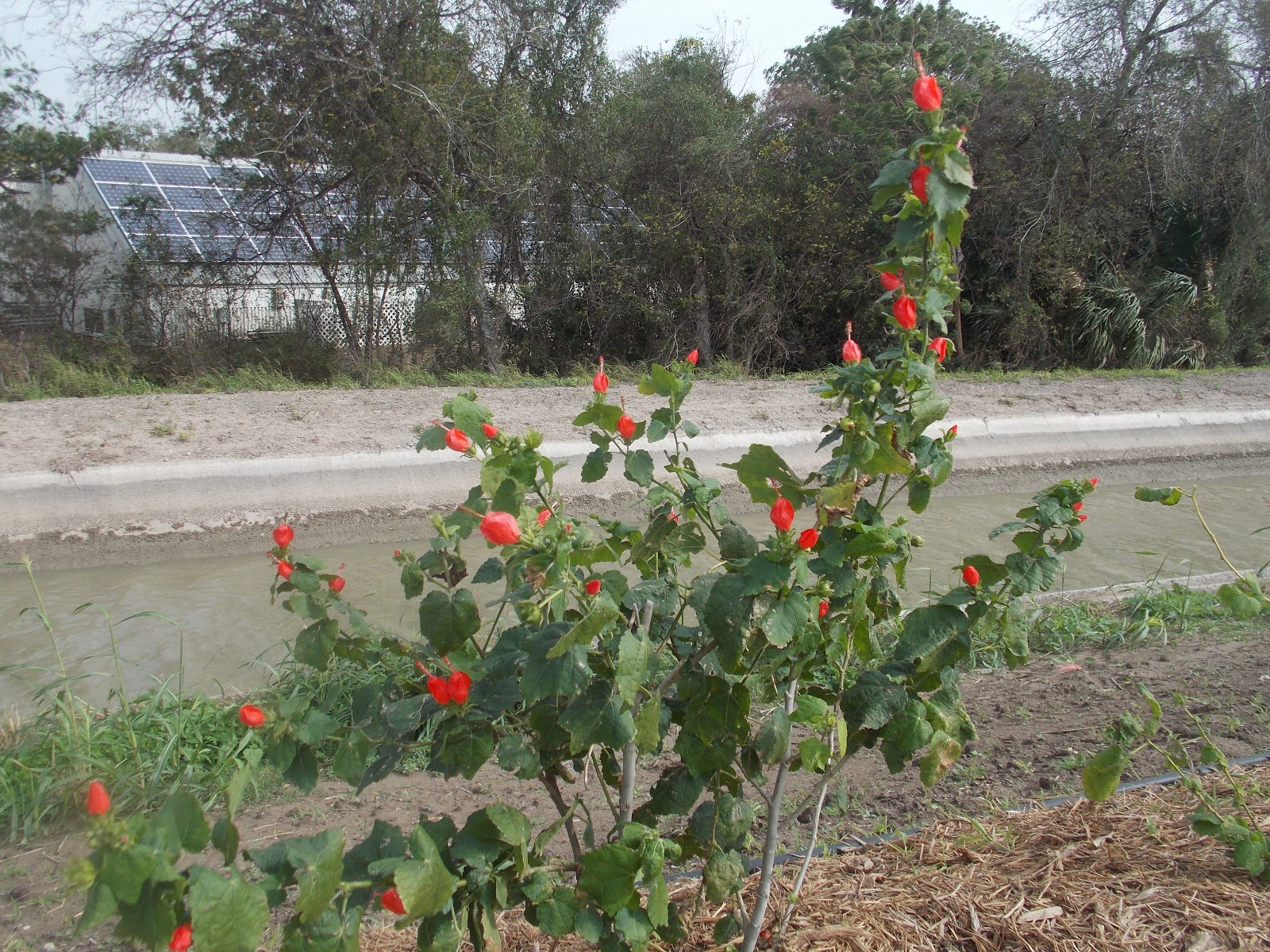
We did return to the refuge yesterday as we had learned in our previous visit that guided bird walks were offered daily at 8:30 AM.  It was 48 degrees and misting, but we did the hike and thoroughly enjoyed ourselves.  My sister Linda is visiting us and has only a few days to spend here.  Yesterday was supposed to be the better one of the next two days, so we drove over to the refuge, not even being sure that a ranger was going to do a birding hike because of the inclement weather.  What is amazing was that, even with the winter-like gray pall which seemed to hang over the park, the refuge was still pretty with the hanging Spanish moss, green cactus, mesquite, and red flowering shrubs.  Pictured below is the Turk's cap shrub.
When we arrived at the visitor's center of the park a staff member had just put food out in the bird feeding station's outside of the center, everything from orange slices to suet to bird seed.  I teased the park ranger and told her that since there were so many birds at the feeding stations,  I saw no need to go out on a hike to find them!  The first bird I saw at the feeding station was an Altamira oriole,  I was interested in seeing that oriole because it is only located in the tree and willows of southernmost Texas  It has very striking black and orange coloring.  Another bird which I had been wanting to see was the golden-fronted woodpecker.  That bird came to feed at a suet bar hanging from a tree.  That bird has an orange nape, and the male has a spot of red on the top of his head.  I did not initially have my camera with me, but after our hike with the ranger I returned to the feeding station with my camera.  Many kiskadees and red winged blackbirds were then at the feeding station, and some chachalacs also made an appearance.  Two other birds which I found interesting at the feeding station were the Inca dove and the olive sparrow.  The latter is a striking small green colored bird.  It was interesting to see different birds other than the usual morning dove and the brown sparrow.
After viewing the feeding station, where our guide for the birding walk pointed out many other different birds, we hiked to two different lakes in the refuge.  The first lake, Pintail Lake, was out in the open, with no tall trees sheltering it- it was bitterly cold and here the mist seemed to turn into big drops of rain.  But it did not matter, we were thrilled to see a variety of ducks in the lake, also some shore birds as black-necked stilts and sandpipers.  A beautiful little blue heron hung around the lake, in flight his deep purple coloring stood out brilliantly against the gray sky.  We also saw white-faced ibis.  I was puzzled when our guide said they were ibis, having only seen white ibis, and  the white faced ibis we saw is black.  When our guide pointed out the long curved beak, I then could identify them as being in the ibis family.  At Willow Lake we were a lot more comfortable, with the rain stopping and the wind less intense .  I believe that it was there that the ranger espied a loggerhead shrike high in a tree.  She shared with us the information that the black-masked bird is known as a "butcher bird".  It impales its prey (as rodents, small birds and snakes) on thorny brush, and them consumes them.  After two hours of hiking with the ranger, we left her to explore a bit more of the park on our own.  We found a hanging bridge which connects two 25' observation towers. Those high vantage points gave us a great view of the refuge and from them we saw more chachalatas scurrying around on the forest floor. At that point we were quite chilled so we did not try to see any other wildlife.


Saturday, January 12, 2013

Wintering in McAllen, Texas

It has been awhile since I have sent out any further postings, sorry about that.  Last week we had several days of cold, wet and windy weather.  We were fortunate if the weather warmed up to fifty degrees during the day!  We had very little desire to even get out and walk any short distance.  Most Winter Texans spend their time playing cards or bingo when the weather turns bad, which is not for me.  Then I saw a notice in our community hall from a food pantry.  The Rio Grande Food Pantry was in need of packers and sorters. John and I filled out an application to work as volunteers and consequently spent an afternoon there this week.  The pantry is in an old citrus warehouse, stacks of non-perishable items fill the large rooms there.  Some of the containers have food to be sorted and packed, many boxes have already been filled and are ready to be distributed to the 200 food agencies which are located through out the Valley.   We worked with two men who are also retirees, and later two college students joined us- they just wanted to kill some time while they are on break from college.  We were also informed that sometimes the workers are people sent in from the courts who have to put in service time.  Anyway, the work was a bit more labor intensive than we expected, especially when it came to filling boxes with 40 pounds of can goods, weighting them and placing them on a conveyor belt.  John and I got smart after awhile and worked as a team, it did make the load lighter!
We also have joined the Texas Chorus and spent one afternoon this week in our first rehearsal.  The chorus is a group of Winter Texans, residents of the many recreational vehicle parks in the area.  Last year there were about 80 members joining the chorus.  I was surprised at how our well our first rehearsal went, many of the voices have been in choirs for years.  Our director has been leading the Texas Chorus for about 14 years and is an excellent musician.  I also like the musical selections which we will be doing, one of which is a Broadway number.  Our first performance, with an orchestra, will be in the beginning of February.
Tuesday our sister-in-law Mary Jo unexpectedly had to go into the hospital for surgery.  Fortunately she is now on the mend, but it has been an interesting experience for me, having been a nurse for many years. The hospital is a few blocks from our home and is very reflective of the Hispanic culture which dominates this part of Texas.  The medical center seems to be in touch with the latest technology and took good care of Mary Jo, they just do many things differently- which we found to be true of a lot of our experiences here in the Valley.  I just have to keep in mind that this area was once part of Mexico and the rate of poverty here  is one of the highest in the nation.
Today the weather was quite warm and muggy, but we were anxious to get out and hike. Pictured above is one of the wetland areas of the Santa Ana National Wildlife Refuge.  It was established as a sanctuary for migratory birds and other wildlife in 1943.  The Rio Grande River forms the southern border of the park.  We were there by late morning.  The sky was overcast and it was quite windy- all not very good conditions for seeing birds or other wildlife.  However, we plan to be back next week for one of the refuge's guided birding tours.  My sister Linda is arriving here tomorrow and I am sure she will be anxious to join us.  Once she is here we will certainly start exploring the Rio Grand Valley more.

Saturday, January 5, 2013

International Museum of Art and Science

The beautiful sunny days we first had down here are only a memory now.  Since then we have had almost a week of gray skies and moist cool weather.  So we are left to explore the science and art museums in the area of the Valley.  The International Museum is located in McAllen and is rather small compared to the one in St.Louis.  It does have a couple impressive exhibits, however.  In the science section there is a Science on a Sphere, a 6 foot, 20 pound fiberglass animated globe that uses four projectors and state of the art technology to show dynamic and animated images of the atmosphere, oceans, planets, and much more.  It was designed by the National Oceanic and Atmospheric Administration and NASA.
In the art museum there are 29 imaginary portraits done by Picasso when he was 87 years old.  He painted   them on corrugated cardboard, and then had them transformed into lithographs by one of France's leading    lithographers.  The suite of 29 portraits were then sent back to Picasso for correction, the whole process      took a year.  Something else which I enjoyed very much in the art museum was a collection of stained glass  windows obtained from churches on the east coast.  They were made in the Tiffany studios.                        
Our time during  these gloomy days is also spent attending the musical jam sessions in the clubhouse of our   park.  Many of  our residents have been in professional musical groups and consequently the musical            offerings have been quite good.  Sometimes in the jam sessions there are as many as about 30 people playing on a variety of musical  instruments as guitars, harmonicas, mandolins, and keyboards.  My sister-in-law       
Mary Jo joined the group yesterday on her dulcimer.   Today we attended a big band jam session in another park.   That session featured many brass instruments and was also very entertaining.    By Monday the          weather should be in the seventies, in the meantime we will just have to look away from the gray skies and     enjoy the bright colors of the blooming plants and shrubs which can be found ever where here in the Valley.            


Tuesday, January 1, 2013

Hildalgo Pump Station

On the last day of 2012 we decided that it was necessary to get out and do some hiking as the weather was going to turn cool and damp after that.  The pump station in Hidalgo has a museum as well as a birding park-it was a place which we had been wanting to visit. 
The pump station was used in the early 1900s to siphon water off the Rio Grande, it helped the local ranchers not only in watering their cattle, but also in irrigating a variety of crops.  The pump station was closed in 1983 when the Rio Grande had meandered off to the southwest.  Unfortunately, once we got to the park we discovered that the museum was closed.  However, it is also a birding center and we did find one trail which was open.  We first explored the area immediately around the station.  Here there are many blooming plants and shrubs with berries on them.  There were numerous butterflies flitting among the flowers.
While I was gazing at the activity of the butterflies I heard a bird chatter nosily in the tree above me.  The owner of that voice was a bird with green and blue plumage.  As he flew away he displayed his bright yellow tail feathers.  I later learned that it was a green jay.  We did not see much wildlife on the trail which we later hiked over.  Several Border Patrol agents drove past us on their all terrain vehicles.  The park is about ten miles southwest of the U.S.- Mexico border.  According to the McAllen Moniter there has been an increase in illegal immigration, especially on the ranch lands north of the border.  In December 127 illegals were found dead near a Border Patrol's checkpoint.  That same month a large group of immigrants were apprehended walking through the brush, among them eight women and three children younger than 12, including an 11-year-old girl from Honduras traveling alone.  It is hard to believe that our country has a neighbor in such dire straits that its citizens find it necessary to risk their lives in order to leave it!  Even though we were still miles from the border yesterday, we saw tall fences around in the park, as well as cameras and numerous Border Patrol trucks in the vicinity.  Our tax dollars at work!