Time has been flying here for us between trips to Carbondale and Farmington. We have also been busy with doctor's and dental appointments, a well as physical therapy for myself. Our motor home has also chosen this time to go ill with several items, including the refrigerator and television, malfunctioning. This certainly is the place and time for everything to get repaired, as St.Charles is where we bought our motor home and the best place to have it repaired. Also, we have my sister Julia's home nearby as a place to reside when our home is in the shop. Consequently, for a variety of reasons, we will continue to stay in the St.Louis area for one more month. The weather is getting quite warm here, but it still is home and not a bad place to be if that is necessary.
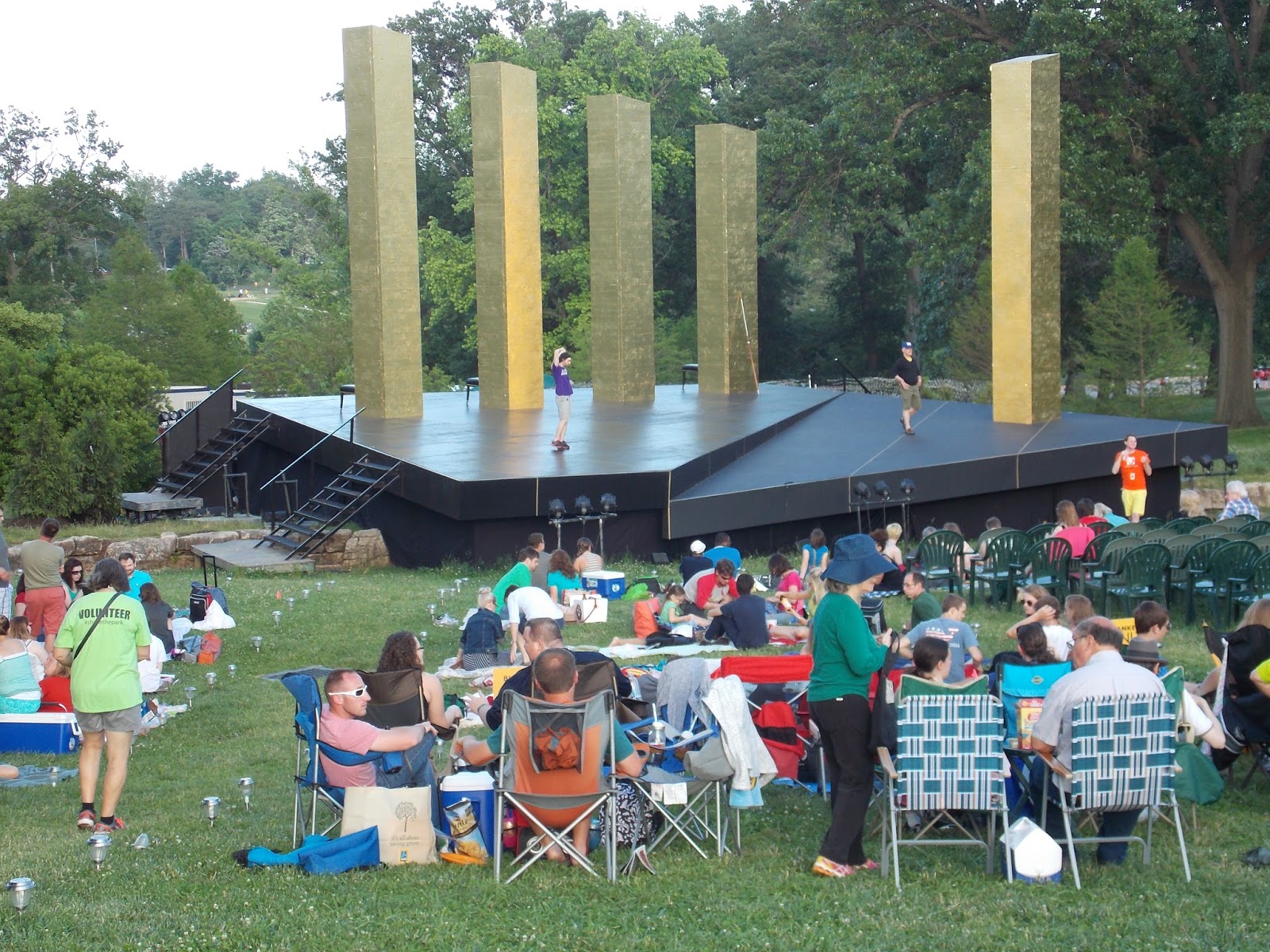
And St.Louis has many outdoor activities to engage in if we are looking for something to do, one of which is the Shakespeare Festival annually put on in Forest Park during the end of May. This is its fifteenth year of the free festival, hard to believe that so many years have passed since we first started attending! This year the outdoor production is Anthony and Cleopatra. It always helps me to read a synopsis of any production written by Shakespeare before viewing it on stage. The Post Dispatch helps with that by printing it in the paper, as well on a wall near Shakespeare's Glen at Forest Park.
Another opportunity to review the story of Anthony and Cleopatra before the show is by attending an abbreviated production of it on a small stage. Teen-aged children play the various roles, and I think they did a good job of tackling a Shakespeare play! Pictured below is the arrogant Cleopatra with her ladies-in-waiting.
Because of the chance of a large crowd and limited seating we usually arrive at the show site a few hours before the production starts. A 90-minute Green Show is traditionally a prelude to the evening's main performance and includes featured local musicians and clowns, a family activity area, and jugglers.
Those young jugglers are good, and they also juggled knives. Anyway, the production finally started and it was a good show. I knew nothing regarding the story of Mark Anthony and Cleopatra, must of missed their story in world history class and never saw the movie in which Elizabeth Taylor starred. But it is a great love story filled with romantic angst and political intrigue. The language of Shakespeare is difficult to understand but I love the magic of words in any shape or form, and he is a master of them. It was a 2 and one-half hour production, we were tempted to leave at intermission but stayed to the end. We just had to see if the frustrated lovers could triumph over the machinations of Caesar and live happily ever after! If you live in St.Louis do go and see this awesome show and hey, it is free! It runs until June 14.
Thursday, May 28, 2015
Thursday, May 21, 2015
City Museum of St.Louis
In the past John and our children, as well as other extended family members, have visited this museum at least a couple of times. I seemed to be otherwise engaged (usually working) when they went. Before going there Sunday we had quite a discussion as to whether it would be an appropriate place for our grandson, who now is a walking dynamo. John said it was not a place for young children. Melissa checked it out on- line and the information she received there told her otherwise. It was a bit dicey getting downtown to 16th street because of a parade going on which blocked off many streets, as well as a graduation at Harris Stowe which added more traffic to the congested streets. We almost returned home, but did find a way to circumvent the bottle necks and get to the museum. My initial impression of the place was that there was fun to be had ahead of us. A bus hangs off the roof of the three story building, tunnels and stairs surround it.
It used to be a shoe manufacturing building, but now has been transformed into a museum with educational exhibits as well as a fun house with activities for old and young alike. There is an area for toddlers.
Our grandson Nathan was quite content with the colorful balls and trucks. His grandmother found a most unusual rocking chair to play with. She first had to let go, get her feet off the ground and let the chair take over. I think it is guaranteed not to tip anyone over!
On a more serious note, I did find natural history exhibits pertaining to butterflies, moths, beetles and fossils. There is also a wonderful architectural history museum featuring artifacts of buildings now long gone. It was in that area that I learned the story of "Grimsley's Folley". In 1836, presiding over the St.Louis Board of Alderman, Colonel Thorton Grimsley introduced a bill which set aside 30 acres of high ground in the city that would be held publicly as a park and which would become the centerpiece of the Lafayette Square District. He is pictured below, along with some architectural artifacts. That is exactly how randomly interesting the City Museum is, one never knows what will be around the corner!
There is also a circus arena in the museum, where young performers were being taught acrobatics. And on display is some interesting modern art, pictured below is the world's largest underpants. Our time there was a bit shortened because of the traffic jams we encountered getting there. I would like to come back, to explore further the multilevel caves as well as the aquarium. And to see the new roof attractions- that area was closed off because of construction activity.
It used to be a shoe manufacturing building, but now has been transformed into a museum with educational exhibits as well as a fun house with activities for old and young alike. There is an area for toddlers.
Our grandson Nathan was quite content with the colorful balls and trucks. His grandmother found a most unusual rocking chair to play with. She first had to let go, get her feet off the ground and let the chair take over. I think it is guaranteed not to tip anyone over!
On a more serious note, I did find natural history exhibits pertaining to butterflies, moths, beetles and fossils. There is also a wonderful architectural history museum featuring artifacts of buildings now long gone. It was in that area that I learned the story of "Grimsley's Folley". In 1836, presiding over the St.Louis Board of Alderman, Colonel Thorton Grimsley introduced a bill which set aside 30 acres of high ground in the city that would be held publicly as a park and which would become the centerpiece of the Lafayette Square District. He is pictured below, along with some architectural artifacts. That is exactly how randomly interesting the City Museum is, one never knows what will be around the corner!
There is also a circus arena in the museum, where young performers were being taught acrobatics. And on display is some interesting modern art, pictured below is the world's largest underpants. Our time there was a bit shortened because of the traffic jams we encountered getting there. I would like to come back, to explore further the multilevel caves as well as the aquarium. And to see the new roof attractions- that area was closed off because of construction activity.
Thursday, May 14, 2015
Rockwoods Reservation
We are still hanging out in the St.Louis area, however that does not preclude us finding something to write about. Rockwoods is located in western St.Louis County. About 20 years ago we visited it rather frequently with our children. For all of us a large yawning cavern with two massive rooms was the main attraction. John and I decided it would be great to see the park again.
At the entrance to the Visitor's Center of the park two beautiful blooming trees greeted us. One was a tulip tree and the other a yellowwood tree, the blossoms of which are pictured above. In the center we learned about the history of the park, the land has certainly gone through many interesting changes over a period of 200 years. Evidence of that past can be found in the park, and includes such relics as old crumbling lime quarries, railroad berms and building foundations. Cobb,Wright and Case were mining companies that purchased the land in 1868 for $100.00 an acre. Later Glencoe Lime Company built a railroad spur on the land. That usual policy for mining companies was to blast and destroy the quarries but Glencoe went into bankrupcy in 1933 and left an unstable cavern behind. John and I took the trail leading to the cavern, expecting to see it as we remebered it from about twenty years ago. We came close to the end of the trail and still had not seen that cavern. What we did come upon was a small opening in a stone wall, entrance to which was fenced off. The trail to it was over grown with weeds.
Later we learned at the center that the cavern had collapsing walls and needed to be closed. Now only bats find refuge there. We still had a wonderful walk as the park has deep ravines, tall rocky cliffs and a shallow creek running through it. We heard a variety of birds quite nosily filling the air with their songs. We also saw a woodpecker busily flitting from tree to tree looking for food. The area has been designated by Audubon Missouri as an Important Bird Area. Wildflowers are in abundance, we saw one particular type of butterfly frequently who seemed to be enjoying them.
At the entrance to the Visitor's Center of the park two beautiful blooming trees greeted us. One was a tulip tree and the other a yellowwood tree, the blossoms of which are pictured above. In the center we learned about the history of the park, the land has certainly gone through many interesting changes over a period of 200 years. Evidence of that past can be found in the park, and includes such relics as old crumbling lime quarries, railroad berms and building foundations. Cobb,Wright and Case were mining companies that purchased the land in 1868 for $100.00 an acre. Later Glencoe Lime Company built a railroad spur on the land. That usual policy for mining companies was to blast and destroy the quarries but Glencoe went into bankrupcy in 1933 and left an unstable cavern behind. John and I took the trail leading to the cavern, expecting to see it as we remebered it from about twenty years ago. We came close to the end of the trail and still had not seen that cavern. What we did come upon was a small opening in a stone wall, entrance to which was fenced off. The trail to it was over grown with weeds.
Later we learned at the center that the cavern had collapsing walls and needed to be closed. Now only bats find refuge there. We still had a wonderful walk as the park has deep ravines, tall rocky cliffs and a shallow creek running through it. We heard a variety of birds quite nosily filling the air with their songs. We also saw a woodpecker busily flitting from tree to tree looking for food. The area has been designated by Audubon Missouri as an Important Bird Area. Wildflowers are in abundance, we saw one particular type of butterfly frequently who seemed to be enjoying them.
Saturday, May 9, 2015
Road Trips East and North
The last two weeks have passed quickly and we have been busy traveling around in our little Fit. The first trip I took without John but with my sister Julia to Nashville Indiana. It was to be a girls week-end of scrapbooking and shopping. Also joining us was my daughter Melissa, as well as my niece Laura and sister-in-law Mary Jo. Only male with us was my grandson Nathan.
Nashville is an historic artist's colony tucked away in the blue hills of Brown County. Pictured above are some of the art objects which can be found there. It also has many small picturesque wooden buildings, some of which are historic, as the structure pictured below. That building use to be a church, a sign on it identifies the store as once being Antioch Christian Church, which exsisted from 1870-1938. It is now a general store and bakery. I hung around that store for sometime with Nathan trying to get him asleep. The music of old Gospel songs coming from this building helped put him to sleep.
We stayed at an old country farmhouse about 10 miles out of town. It was just us and cows for miles around. Nathan was quite fascinated with the cows, and they with him.
John and I traveled to Plover Wisconsin last week for the baptism of the children of two of our nieces, Rebecca and Rachel. Melissa and Nathan also joined us for the trip. I do believe I have become very knowledgeable on how to entertain a one year-old during a long road trip! Pictured below is the baptism picture of Noah, one of the babies who were baptized at Good Shepherd Lutheran chuch last Sunday. His parents, Rebecca and Cyril, are to the right of him and his sponsers, Adam and Kjerstin are on the left. The pastor holding him is his grandpa, Bishop Marcus Lohrmann. My brother Marcus had the pleasure of baptizing two of his grandchildren that day, Emilyn and Noah.
Emilyn is pictured below with her family (parents Ben and Rachel and sister Eliza), as well as her sponsers, Adam and Kjerstin. Adam and Kjerstin have a son who is one years old, so it was a fun week-end with a lot of young children. As we are learning with Nathan, they keep us young!
Tuesday, April 21, 2015
Two Missouri Covered Bridges
We are now parked in St.Charles Missouri, and will stay here for a couple of months. Consequently my posts will not be as frequent, but they will be appearing occasionally. John and I are not ones to sit still for very long, and, like yesterday, are apt to head out suddenly on a whim to seek a new adventure. Last week, on a trip to Farmington, we took a short detour to visit the Sandy Creek covered bridge. Missouri has preserved 4 of the estimated 30 covered bridges which once spanned its rivers and creeks.
This bridge was one of 6 bridges built in 1872 to allow passage from the Jefferson County seat of Hillsboro to St.Louis. It was substantially damaged during a storm in 1886 and repaired using one-half of the original timbers. It has since been restored several times over the years and at unknown dates was further modified with a corrugated metal roof instead of pine shingles, concrete piers, and one I beam. As with many covered bridges, it eventually allowed only pedestrian traffic.
As I noted at the beginning of this post, we refused to let overcast skies and a brisk cool wind keep us inside yesterday and took a drive to find another covered bridge. This time it was necessary to drive north to a location near Mark Twain State Park. Pictured above is Union Covered Bridge, built in 1871 and served travelers in Monroe County for 99 years. Notice that the siding is vertical, like most houses. The Sandy Creek siding is horizontal, which gives it the barn-like appearance. Supposedly the barn-like appearance made it easier for farm animals to cross the river without becoming nervous. As you may notice in the picture of the Union Covered Bridge, it has sustained damage over the years from high water, fire and just plain neglect. I certainly hope it gets repaired soon! Even walking over the bridge was a bit scarey as the wood flooring has a few loose boards. In the past overweight trucks damaged its structural timbers.
Our trip to the Union Covered Bridge took us close by Florida, Missouri, the birthplace of Mark Twain. Over the years the home where he was born in 1835 has been preserved. He died in 1910 and in 1924 his only surviving daughter, Clara, liked the idea of a park in her Dad's memory. She was a contralto concert singer and gave local concerts to raise money to buy the land for what is now Mark Twain State Park. In 1959 Twain's birth home was moved into the visitor's center of the park. It is a two room structure which once housed Samuel and his parents plus his five siblings and a teenage slave for nine years. Mark Twain once wrote, "Recently someone in Missouri sent me a picture of the house I was born in. Heretofore I have always stated that it was a palace, but I shall be more guarded now".
This bridge was one of 6 bridges built in 1872 to allow passage from the Jefferson County seat of Hillsboro to St.Louis. It was substantially damaged during a storm in 1886 and repaired using one-half of the original timbers. It has since been restored several times over the years and at unknown dates was further modified with a corrugated metal roof instead of pine shingles, concrete piers, and one I beam. As with many covered bridges, it eventually allowed only pedestrian traffic.
As I noted at the beginning of this post, we refused to let overcast skies and a brisk cool wind keep us inside yesterday and took a drive to find another covered bridge. This time it was necessary to drive north to a location near Mark Twain State Park. Pictured above is Union Covered Bridge, built in 1871 and served travelers in Monroe County for 99 years. Notice that the siding is vertical, like most houses. The Sandy Creek siding is horizontal, which gives it the barn-like appearance. Supposedly the barn-like appearance made it easier for farm animals to cross the river without becoming nervous. As you may notice in the picture of the Union Covered Bridge, it has sustained damage over the years from high water, fire and just plain neglect. I certainly hope it gets repaired soon! Even walking over the bridge was a bit scarey as the wood flooring has a few loose boards. In the past overweight trucks damaged its structural timbers.
Our trip to the Union Covered Bridge took us close by Florida, Missouri, the birthplace of Mark Twain. Over the years the home where he was born in 1835 has been preserved. He died in 1910 and in 1924 his only surviving daughter, Clara, liked the idea of a park in her Dad's memory. She was a contralto concert singer and gave local concerts to raise money to buy the land for what is now Mark Twain State Park. In 1959 Twain's birth home was moved into the visitor's center of the park. It is a two room structure which once housed Samuel and his parents plus his five siblings and a teenage slave for nine years. Mark Twain once wrote, "Recently someone in Missouri sent me a picture of the house I was born in. Heretofore I have always stated that it was a palace, but I shall be more guarded now".
Monday, April 13, 2015
Little Grand Canyon in Shawnee National Forest
As I noted in my last posting, we saw some quite a variety of colorful wildflowers in this park. Pictured below are bluebells.
We also saw two different kinds of trillium, the white variety as well as the dark purple called wake robin. We also saw large patches of what looked like the poppy flower. I checked later with the Illinois Department of Resources web site and found out that there is a wood poppy in this part of the country.
One other unusual looking wildflower, which Melissa found, is the yellow bellwort.
Our hike in the park took us along woodland paths as well as 365 feet down into a canyon. Unfortunately we chose to do this after some hard rains, so the trail down and up was a wet one. Weathered ledges and steps helped us somewhat in navigating the many streams of water. Our daughter Melissa was carrying Nathan in a backpack, how she managed this 3.6 mile trek into the canyon is beyond my understanding.
It was fortunate that Melissa's husband Spencer took a break from his studies to join us. I do not think John or I could have given Melissa and Nathan the assistance needed to climb over wet rocky ledges! It was enough of a challenge for us to manage on our own, and our walking sticks certainly helped. At the top of the canyon we had a panoramic view of the Big Muddy as well as the Mississippi floodplain.
Pictured above is the creek flowing through the park, looks like the Big Muddy backed up into it after the recent storms. It took us about three hours to hike the loop down into the canyon and back up along Hickory Ridge. Nathan slept through most of the hike. We were fortunate it was a cool day. And what with the abundance of wildflowers in the park, it was a good time of the year to hike this trail. However, it was a bit wet and muddy. I think we did good going through the canyon, all of the mud was on our shoes and not our clothes!
We also saw two different kinds of trillium, the white variety as well as the dark purple called wake robin. We also saw large patches of what looked like the poppy flower. I checked later with the Illinois Department of Resources web site and found out that there is a wood poppy in this part of the country.
One other unusual looking wildflower, which Melissa found, is the yellow bellwort.
Our hike in the park took us along woodland paths as well as 365 feet down into a canyon. Unfortunately we chose to do this after some hard rains, so the trail down and up was a wet one. Weathered ledges and steps helped us somewhat in navigating the many streams of water. Our daughter Melissa was carrying Nathan in a backpack, how she managed this 3.6 mile trek into the canyon is beyond my understanding.
It was fortunate that Melissa's husband Spencer took a break from his studies to join us. I do not think John or I could have given Melissa and Nathan the assistance needed to climb over wet rocky ledges! It was enough of a challenge for us to manage on our own, and our walking sticks certainly helped. At the top of the canyon we had a panoramic view of the Big Muddy as well as the Mississippi floodplain.
Sunday, April 12, 2015
Return to Southern Illinois
We probably did return north too soon, not because of cooler weather but because of spring rains and stormy weather. A few days ago a tornado touched down in northern Illinois, here we have only dealt with strong winds and rain. The night when strong winds rocked our home we thought it was also hailing, however the next morning we discovered that the wind had brought down a torrent of gum balls on our roof! Scarey times, but we have survived. Easter week-end we did have a break in the weather. On Saturday Epiphany church had an Easter egg hunt for the children. Our grandson Nathan is still too young to understand what that is all about. He had eggs all around him, but chose instead to pull on the grass.
Nathan took his first steps around Christmas time. On Easter, early evening, he decided to walk across the living room. There is no stopping him now. Today, at a park, he laughed gleefully as he ran up and down some small hills. He even stopped suddenly and turned around, quite smoothly I might add. We are still carrying him when we are hiking, but soon he will be hitting the trails on his own legs!
He so loves the outdoors! Last week we returned to Giant City park. You may recall my posting on it last year about this time, with one picture of the large sandstone formation called the Devil's Stand Table. This time I will post Balanced Rock, another one of the awesome formations in the park.
Hiking around this park we saw the first blooming wildflowers of the season, mainly Dutchman breeches.
What a beautiful flower with its delicate fern-like leaves! Yesterday we hiked the Little Grand Canyon, also in Southern Illinois, where we saw an abundance of wildflowers. More on that hike in my next posting.
Nathan took his first steps around Christmas time. On Easter, early evening, he decided to walk across the living room. There is no stopping him now. Today, at a park, he laughed gleefully as he ran up and down some small hills. He even stopped suddenly and turned around, quite smoothly I might add. We are still carrying him when we are hiking, but soon he will be hitting the trails on his own legs!
Hiking around this park we saw the first blooming wildflowers of the season, mainly Dutchman breeches.
What a beautiful flower with its delicate fern-like leaves! Yesterday we hiked the Little Grand Canyon, also in Southern Illinois, where we saw an abundance of wildflowers. More on that hike in my next posting.
Sunday, March 29, 2015
Tupelo, Mississippi
On our drive through Mississippi Friday John notice one interesting road sign, and I another. As we passed the town of Scooba I read the town's welcoming sign which noted that it is the home of the world champion turkey caller. Who would have thought there was such world prize? What other country calls their turkeys? Further on down the road John read : "trucks turning, watch for long logs". Up to that point we had not seen logging trucks, and it seemed to be a strange sign. We later learned that the Tupelo gum tree is used for construction and, as those trees grow in the area of the city, the city was named after them.
There is a Civil War battlefield in Tupelo, as well as a Buffalo Zoo, but the town's biggest tourist attraction is Elvis Presley's birthplace, pictured above. His dad, uncle and grandfather built it, but unfortunately it was repossessed about three years after Elvis was born because his dad forged a check and was sent to prison. Elvis returned to the town in 1956 (age 21years) for a concert, and while here bought the land around the park for a playground, the city bought the house. When Elvis was a young boy that part of Tupelo was the wrong side of the tracks and there were no parks for children to play in.
Besides his birth home, there is a museum on the Birthplace Complex as well as the church (Assembly of God Pentecostal) where his family worshiped. The church had been had been moved from a couple of blocks down the street. In the church there is a multi-media presentation by which we could experience a typical 1940s service, and see it through the young eyes of Elvis. The pastor is intense with his message and lively gospel music is provided by the choir. I could see in the showmanship of the preacher how Presley got his rock and roll movements ten years later! The pastor also played a guitar during the services and taught Elvis how to strum a few chords. At the age of about 5 years Elvis was singing for the services.
At the age of eleven Elvis was in a hardware store with his mom planing to purchase a gun (that store is still in business). It was to be his birthday present, however his mom, with the help of a clerk, persuaded him to buy a guitar. At age 13 he won fifth place in a talent contest at the Alabama Mississippi state fair. During the seventh grade he started bringing the guitar to school and singing for his classmates. The school is still a place of learning for east Tupelo. A picture of a guitar standis in front of the building.
Elvis played a lot of country music in his younger years, but slowly he blended that with gospel, jazz and blues. The African American neighborhood next to his influenced the latter music for Elvis. One last note here, the birthplace of Presley gets almost as many visitors as his home in Graceland, and they come from around the world. While we were there we met met people from Austria and Turkey. The Presley family moved to Memphis when Elvis was about thirteen years old, however Tupelo was never forgotten as his childhood home and the place where he first started crooning and strumming.
There is a Civil War battlefield in Tupelo, as well as a Buffalo Zoo, but the town's biggest tourist attraction is Elvis Presley's birthplace, pictured above. His dad, uncle and grandfather built it, but unfortunately it was repossessed about three years after Elvis was born because his dad forged a check and was sent to prison. Elvis returned to the town in 1956 (age 21years) for a concert, and while here bought the land around the park for a playground, the city bought the house. When Elvis was a young boy that part of Tupelo was the wrong side of the tracks and there were no parks for children to play in.
Besides his birth home, there is a museum on the Birthplace Complex as well as the church (Assembly of God Pentecostal) where his family worshiped. The church had been had been moved from a couple of blocks down the street. In the church there is a multi-media presentation by which we could experience a typical 1940s service, and see it through the young eyes of Elvis. The pastor is intense with his message and lively gospel music is provided by the choir. I could see in the showmanship of the preacher how Presley got his rock and roll movements ten years later! The pastor also played a guitar during the services and taught Elvis how to strum a few chords. At the age of about 5 years Elvis was singing for the services.
At the age of eleven Elvis was in a hardware store with his mom planing to purchase a gun (that store is still in business). It was to be his birthday present, however his mom, with the help of a clerk, persuaded him to buy a guitar. At age 13 he won fifth place in a talent contest at the Alabama Mississippi state fair. During the seventh grade he started bringing the guitar to school and singing for his classmates. The school is still a place of learning for east Tupelo. A picture of a guitar standis in front of the building.
Elvis played a lot of country music in his younger years, but slowly he blended that with gospel, jazz and blues. The African American neighborhood next to his influenced the latter music for Elvis. One last note here, the birthplace of Presley gets almost as many visitors as his home in Graceland, and they come from around the world. While we were there we met met people from Austria and Turkey. The Presley family moved to Memphis when Elvis was about thirteen years old, however Tupelo was never forgotten as his childhood home and the place where he first started crooning and strumming.
Thursday, March 26, 2015
Pensacola, Florida
From the historical village we walked over to Plaza Ferdinand V11. On this path we saw more of the Colonial Archeological Trail. Trailside exhibits relate to features that were a part of the town and forts. To recapitulate what I wrote in the last posting, land here was first occupied by the Spanish in 1754, who built Fort San Miguel. Sites of that fort's structures are marked on the trail, as well as the British government buildings which were built later. Florida's colonial period ended when Andrew Jackson took over as governor of Florida in 1821. There is a site marked on the trail where the flag of Spain was lowered for the last time and the American flag raised. A bust of Andrew Jackson is located in the plaza.
Colorful pelicans can be found on street corners and in front of stores all over Pensacola. The one pictured above is in front of the Florida State Museum, which is on the archeological trail we had been following. It is titled "In Tribute to our First Nations". It is in honor of the first people in Florida, Native Americans.
We next took a detour from the historical area and wandered down a street toward Pensacola Bay. The port has been important part of Pensacola's economy. Over the years million of tons of lumber, bricks, fish and other products have passed through these waters since the first recorded shipment in 1743. That information I learned in the wonderful Museum of Industry located at the historical village.
Our next destination was the Sevillle Quarter where some of the buildings have French Creole architecture, which we have seen in the French Quarter of New Orleans. That particular architecture we also saw in other areas of downtown Pensacola. In the Seville Quarter we saw more historical homes from the mid 1800s. Outside one of those homes I was drawn to a tall blooming tree with a sweet floral scent. The leaves feel like velvet. And I have so far failed to find out what it is! The flowers are pictured below.
Walking through Fountain Park we chanced to come upon some wooden sculptures holding up sagging branches of a live oak. They are quite weather-worn, loosing their paint and cracking- but still very charming. Tomorrow, Thursday, we will continue our trek northward.
Colorful pelicans can be found on street corners and in front of stores all over Pensacola. The one pictured above is in front of the Florida State Museum, which is on the archeological trail we had been following. It is titled "In Tribute to our First Nations". It is in honor of the first people in Florida, Native Americans.
We next took a detour from the historical area and wandered down a street toward Pensacola Bay. The port has been important part of Pensacola's economy. Over the years million of tons of lumber, bricks, fish and other products have passed through these waters since the first recorded shipment in 1743. That information I learned in the wonderful Museum of Industry located at the historical village.
Our next destination was the Sevillle Quarter where some of the buildings have French Creole architecture, which we have seen in the French Quarter of New Orleans. That particular architecture we also saw in other areas of downtown Pensacola. In the Seville Quarter we saw more historical homes from the mid 1800s. Outside one of those homes I was drawn to a tall blooming tree with a sweet floral scent. The leaves feel like velvet. And I have so far failed to find out what it is! The flowers are pictured below.
Walking through Fountain Park we chanced to come upon some wooden sculptures holding up sagging branches of a live oak. They are quite weather-worn, loosing their paint and cracking- but still very charming. Tomorrow, Thursday, we will continue our trek northward.
Wednesday, March 25, 2015
Historic Pensacola, Florida
In one of the tourist brochures of Pensacola we read that the city was the oldest in the United States. Strange, we had learned when we were in St.Augustine, Florida that it was the oldest. We learned the full story yesterday at the Historic Pensacola Village. The Spanish arrived with 1500 people in 1559, and left two years later. A variety of misfortunes had brought their numbers down to 200 by the time they left. If they had stayed, then Pensacola would be the oldest city, but the Spanish did not return for another 130 years. After that France evicted them once, and then Spain returned to claim the land. Pensacola, from 1752 to 1821 had a succession of Spanish and British forts (which had also been occupied by Americans), the ruins of which can be seen on the Colonial Archeological Trail in downtown Pensacola. To summarize the complicated history, the city was under 5 flags which had been raised in turn 10x- here I am including the Confederate as well as the American flags.
Such a convoluted history makes for some interesting archeological findings! Pictured above, from left to right, is an olive jug from Spain, white and blue plates from Mexico (ca.1550) and from France a marbleized slipware- the red bowl- from the early 18th century. The other blue and red jug is also from France. Near the historical village is an archeological museum where I took the above picture.
Most of our day was spent in the historical village, which has about 15 buildings from the early days of Pensacola. Most of them are located on their original sites. One that had been relocated is the Julee Panton Cottage built in 1804. Fifteen to twenty per-cent of it was intact before reconstruction. Julee was a "free woman of color" ( had been a slave in the past) who purchased real estate as well as slaves (whom she always later freed). In the cottage is a display of a document she wrote in 1804 to the governor of Florida asking for a lot on which to build her home. She made mention of the fact that she made her living manufacturing candles and baking cakes and pastry. In 1900 the African American community outnumbered the whites, and despite the fact that many of them held professional jobs and were merchants, they were never accepted socially. However, they continued to live side by side the whites in the downtown area.
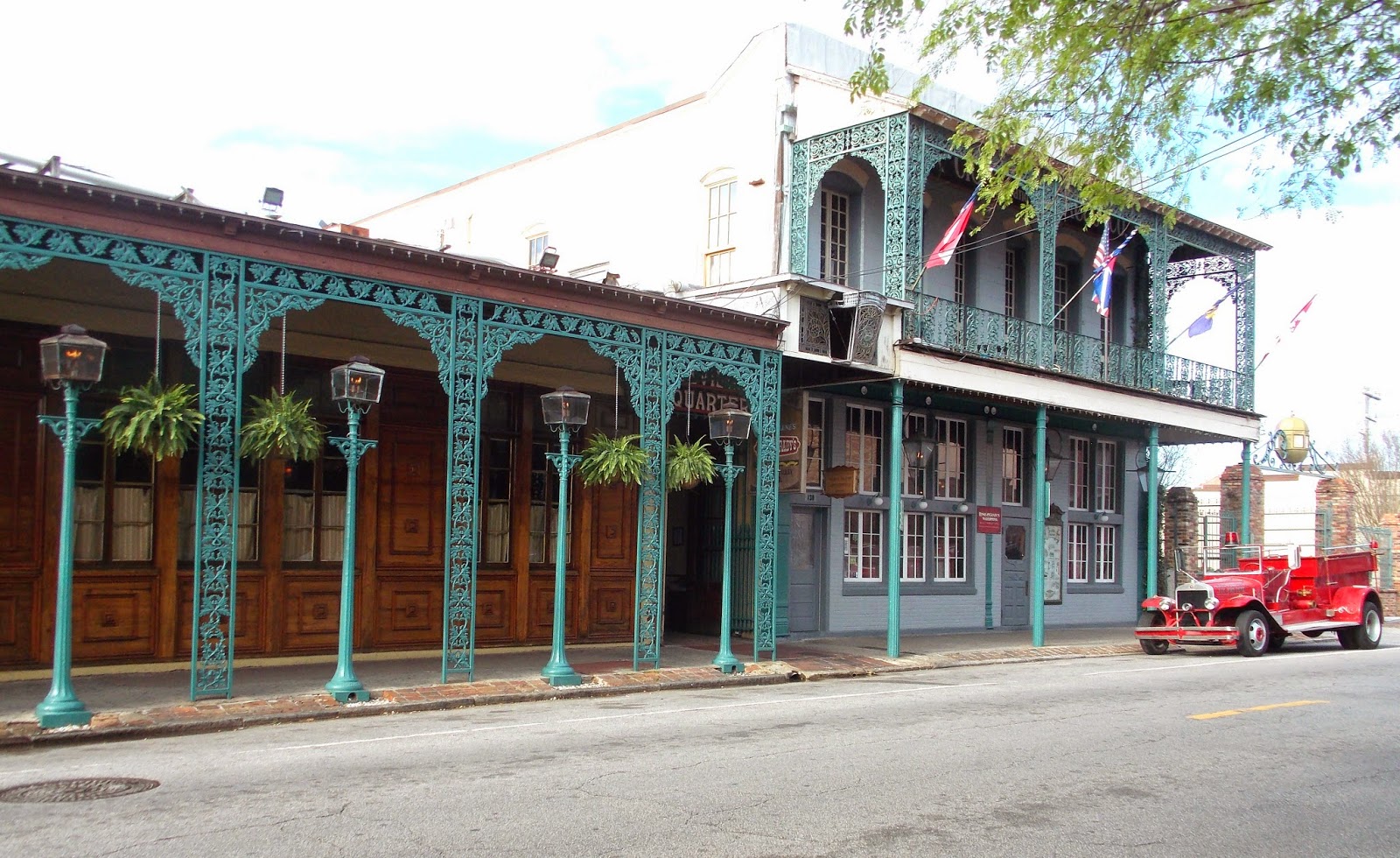
Christ Episcopal Church, built in 1832, is one of the oldest surviving church buildings in Florida.
The original stained glass has been moved to the new church. The altar area is the resting site for three of the church's rectors. When that section of the church was lengthened it covered part of the graveyard which was behind the building, so their graves were included inside the church.
Joining a guided tour later in the day enabled us to see the inside of Christ Church, as well as two homes built in the late 1800s. Pictured above is the Dorr house built in 1871 by Clara Barkley Dorr, the widow of a lumber tycoon. In 1862 the Confederates burned everything in the town of Pensacola which they considered of some use to the enemy, which included sawmills, factories, boats, naval stores and warehouses. By July of 1863 only 82 people were living in the city. I will have more regarding Pensacola in my next posting.
Such a convoluted history makes for some interesting archeological findings! Pictured above, from left to right, is an olive jug from Spain, white and blue plates from Mexico (ca.1550) and from France a marbleized slipware- the red bowl- from the early 18th century. The other blue and red jug is also from France. Near the historical village is an archeological museum where I took the above picture.
Most of our day was spent in the historical village, which has about 15 buildings from the early days of Pensacola. Most of them are located on their original sites. One that had been relocated is the Julee Panton Cottage built in 1804. Fifteen to twenty per-cent of it was intact before reconstruction. Julee was a "free woman of color" ( had been a slave in the past) who purchased real estate as well as slaves (whom she always later freed). In the cottage is a display of a document she wrote in 1804 to the governor of Florida asking for a lot on which to build her home. She made mention of the fact that she made her living manufacturing candles and baking cakes and pastry. In 1900 the African American community outnumbered the whites, and despite the fact that many of them held professional jobs and were merchants, they were never accepted socially. However, they continued to live side by side the whites in the downtown area.
The original stained glass has been moved to the new church. The altar area is the resting site for three of the church's rectors. When that section of the church was lengthened it covered part of the graveyard which was behind the building, so their graves were included inside the church.
Joining a guided tour later in the day enabled us to see the inside of Christ Church, as well as two homes built in the late 1800s. Pictured above is the Dorr house built in 1871 by Clara Barkley Dorr, the widow of a lumber tycoon. In 1862 the Confederates burned everything in the town of Pensacola which they considered of some use to the enemy, which included sawmills, factories, boats, naval stores and warehouses. By July of 1863 only 82 people were living in the city. I will have more regarding Pensacola in my next posting.
Monday, March 23, 2015
National Naval Aviation Museum
Wisteria and azalea bushes are pictured above, they are quite profuse all over Pensacola and presently in bloom. Sunday afternoon found us at the aviation museum. Our nephew Michael's flight lesson was cancelled because of inclement weather so he was able to join us. The museum is on the base of the Naval Air Station. At the entrance of the museum we came upon this very meaningful sculpture of five aviators from both World Wars, the Korean, Vietnam and Desert Storm wars. A sign near it notes:" in the universal language of all aviators a World War 11 pilot relives his flight with naval aviators from his past and future".
We joined a guided tour of the museum after our lunch at the Cubi Bar and Grill. The walls of that eating area are decorated with plaques from an officer's club which was once located in the Philippines during World War ll. That made for a fascinating dining experience. I thought that I was going to be bored to death with a guided tour, but our guide was a retired naval pilot from 1972 to 1992. He knew his military history quite well, in addition to the mechanical features of all the different naval aircraft through the years. I paid attention through the first hour, but after that I was not doing well with listening. What I did manage to pick up, however, was that after World War ll the aircraft certainly became more mechanically involved. And we had progressed from firing guns from planes to dropping bombs and missiles. After the Vietnam War many planes have a wider range of capabilities involving upgraded radar and electronics. Such an example is the E-2 Hawkeye, even I was impressed with its rotating radar dome and 8-bladed propellers!
Of course my husband John and Michael appreciated the tour more than I did, one being a retire aircraft engineer and the other a naval pilot in training. There are more than 170 historic naval aircraft in this museum, in addition to many exhibits as the Apollo Space,Women in Naval Aviation and the Coast Guard to name but a few. The Blue Angels, a precision flying team, practice some mornings at the museum. They are headquartered here on the naval base in Pensacola.
Pictured above is one of the team's planes currently residing at the museum, a FA-18 Hornet. The Blue Angels have been flying for 65 years, and over that time used 8 different aircraft types.
We joined a guided tour of the museum after our lunch at the Cubi Bar and Grill. The walls of that eating area are decorated with plaques from an officer's club which was once located in the Philippines during World War ll. That made for a fascinating dining experience. I thought that I was going to be bored to death with a guided tour, but our guide was a retired naval pilot from 1972 to 1992. He knew his military history quite well, in addition to the mechanical features of all the different naval aircraft through the years. I paid attention through the first hour, but after that I was not doing well with listening. What I did manage to pick up, however, was that after World War ll the aircraft certainly became more mechanically involved. And we had progressed from firing guns from planes to dropping bombs and missiles. After the Vietnam War many planes have a wider range of capabilities involving upgraded radar and electronics. Such an example is the E-2 Hawkeye, even I was impressed with its rotating radar dome and 8-bladed propellers!
Pictured above is one of the team's planes currently residing at the museum, a FA-18 Hornet. The Blue Angels have been flying for 65 years, and over that time used 8 different aircraft types.
Saturday, March 21, 2015
Fort Pickens
We wanted to visit a beach one more time before leaving Florida. One reason we chose this city is that our nephew Michael is down here for flight training on the naval base. On the second day of our trip north from Ocala I started noticing large patches of wildflowers along the roadside. I was especially intrigued by some white ones which I could not identify from our rig windows. John was kind enough to stop so I could look at them closer and take a few pictures- no small feat on a busy highway. What a surprise, wild Easter lilies!
We are now parked northwest of Pensacola. What should have taken us about 2 hours Thursday took us four. Traffic was horrendous on the coastal highway from Panama City to Pensacola, as it is spring break time for many people across the nation, as well as locally. Friday we choose to go to the beach and discovered that many tourists do not go so far as the barrier islands west of Pensacola. The beach area I am referring, and was our final destination, is the Gulf Island National Seashore. At the fee gate to this park we were informed by the guard on duty that there would be a tour of Fort Pickens in an hour.
European colonization as well as American expansion in the early 1800s created a concern regarding threats of invasion for our young country. Fort Pickens is the largest of four forts built to defend Pensacola and its navy yard. Building of the fort began in 1829 and was completed in 1834. Over 21.5 million bricks were required, which were made locally. The work force was provided by African-American slaves, their pay went to their owners. The picture above of the fort shows only a small piece of the total structure.
Our guided tour took us to the officer's quarters, gun rooms, mine chambers, and tower bastions. We also viewed the parade grounds as well as a dry moat which surrounds the fort. I could see how construction of this fort was no small feat! Pictured below is one of the rooms.
Water seeps down the walls now, mold and grass is growing, as well as stalactites. Ironically, the only real action this fort saw was when the country was at war with itself. Fort Pickens was one of the four seacoast forts that remained in Union Control during the Civil War. In 1886 our government imprisoned Geronimo and 15 other Apache men here for about 18 months. By 1898 the fort was past its prime. New rifled artillery could penetrate its walls and another fort was built within its walls using reinforced concrete.
After a good two hours at the fort I was more than ready for a walk on the beach. We had a beautiful walk, among large sand dunes of glistening white sand, which is typical of the beaches around Pensacola. You may also notice the concrete battery above, one of many on the island where the fort is located. While looking for shells, of which there are not many to be easily obtained as the tide was in, we came upon a young dead deer- something we would not usually expect to see on the beach! I will spare our readers that sight, and instead post here a picture of what I think is possibly a laughing gull.
We are now parked northwest of Pensacola. What should have taken us about 2 hours Thursday took us four. Traffic was horrendous on the coastal highway from Panama City to Pensacola, as it is spring break time for many people across the nation, as well as locally. Friday we choose to go to the beach and discovered that many tourists do not go so far as the barrier islands west of Pensacola. The beach area I am referring, and was our final destination, is the Gulf Island National Seashore. At the fee gate to this park we were informed by the guard on duty that there would be a tour of Fort Pickens in an hour.
European colonization as well as American expansion in the early 1800s created a concern regarding threats of invasion for our young country. Fort Pickens is the largest of four forts built to defend Pensacola and its navy yard. Building of the fort began in 1829 and was completed in 1834. Over 21.5 million bricks were required, which were made locally. The work force was provided by African-American slaves, their pay went to their owners. The picture above of the fort shows only a small piece of the total structure.
Our guided tour took us to the officer's quarters, gun rooms, mine chambers, and tower bastions. We also viewed the parade grounds as well as a dry moat which surrounds the fort. I could see how construction of this fort was no small feat! Pictured below is one of the rooms.
Water seeps down the walls now, mold and grass is growing, as well as stalactites. Ironically, the only real action this fort saw was when the country was at war with itself. Fort Pickens was one of the four seacoast forts that remained in Union Control during the Civil War. In 1886 our government imprisoned Geronimo and 15 other Apache men here for about 18 months. By 1898 the fort was past its prime. New rifled artillery could penetrate its walls and another fort was built within its walls using reinforced concrete.
After a good two hours at the fort I was more than ready for a walk on the beach. We had a beautiful walk, among large sand dunes of glistening white sand, which is typical of the beaches around Pensacola. You may also notice the concrete battery above, one of many on the island where the fort is located. While looking for shells, of which there are not many to be easily obtained as the tide was in, we came upon a young dead deer- something we would not usually expect to see on the beach! I will spare our readers that sight, and instead post here a picture of what I think is possibly a laughing gull.
Subscribe to:
Posts (Atom)